Survivor: The Benny Turner Story
Bill Dahl and Benny Turner
Nola Blue, Inc.
2017: 238 + xiv pages
This is a little gem of a book where Benny Turner, with Bill Dahl's assistance, tells his fascinating story from growing up in Texas along with half-brother Freddie King, moving to Chicago where he worked with his half-brother, along with various gospel, rhythm and blues and Chicago blues legends, spending time with Mighty Joe Young after Freddie passed until Young had medical issues, then spending years leading Marva Wright's Band, and after her passing taking up the spotlight as a leader and recording and performing under his own name.
The story begins as Turner goes into his family background, noting Freddie's real father who abandoned him and how he became King while Benny is named after his father. They grew up in Jim Crow Texas although it wasn't until several years passed that he experienced the humiliation blacks could be subjected to. While his father did not play, his mother did as did several uncles including Uncle Leon. Benny states his mother and Uncle Leon played songs from Robert Johnson and Leadbelly, which I take allegorically (as to songs similar to those of Johnson and Leadbelly) and not literally. What is more important than this is the closeness of his family, including his relationship with his half-brother and he helped Freddie in the cotton fields, although he was accidentally injured once and still has a four inch scar from it, and the accidental death of Uncle Leon. His mother also lay down the discipline as he was growing up.
The family moved to Chicago in 1950 with his father getting a job with a steel company assisting with molten steel and tipping buckets into molds. It was a whole new world of experiences including electric lights, indoor plumbing and Freddie wanting to see a refrigerator make ice and also getting enrolled in school and the like, with Benny initially enrolled in a predominantly white school where he faced racist bullying and after fighting out of a situation was enrolled in a black school, but even here he had to fight himself out of a similar situation except here it was neighborhood kids, but he also recalled experiences of police harassment simply walking back home form a movie theater.
Besides recalling some of the interesting characters in the neighborhood and other situations, he starting singing doo-wop with classmates and after awhile they even went to Chess Records hoping to record and met Rice 'Sonny Boy Williamson' Miller who they watched record with Turner recalling the interaction between the Miller and Leonard Chess. Benny would next cross paths with Miller while playing with his brother. Turner recounts his experiences auditioning for gospel groups and other vocal groups, and day jobs after his father was disabled after being hit by a car. He started playing guitar in a gospel group, the Kindly Shepherds with whom Turner traveled and made his first recordings. He recounts experiences traveling with them including harassment from police down south.
While his career was starting, brother Freddie's career was taking off. Turner notes the influences of Jimmy Rogers and Robert Lockwood on King's guitar style as well as King's admiration of Earl Hooker while also noting folks like Jimmy Lee Robinson that were in King's bands. He recalls Freddie taking him to see Howlin' Wolf who put King under his wing, and recalls Freddie recording "Spoonful" with the Wolf, a recollection that will bring back the controversy of decades ago on Freddie's claim of having recorded that backing Wolf. He also recalls Freddie playing with Robert 'Mojo' Elem and T.J. McNulty who Luther Allison would front after Freddie started going on the road (Luther told me this years ago and Turner includes a picture of a very young Luther with McNulty here).
The detail I have provided is incomplete but indicates the contents of this wonderful memoir that details his own musical career that included touring with Dee Clark which he spends some detail on and later he would play bass with The Soul Stirrers (the first electric bassist with a gospel group) as well playing with various Chicago blues and soul legends including Freddie in a band that included Little Johnnie Jones and Abb Locke. Later he would return to Freddie's band after his time playing with the Soul Stirrers though also spent time with Jimmy Reed and others before rejoining Freddie who he remained with until his passing detailing concerts, recording sessions and the like. And he was with Freddie until the end, remembering some conversations between the brothers, the last performance and the aftermath of his death.
After his brother's death, Mighty Joe Young got him into his band with whom he would play with until surgery intended to fix a pinched neck in his neck, instead left unable to play with that arm. Around this time, he moved to New Orleans although remaining close with Young until Young passed away in 1999. In New Orleans he started playing at the Old Absinthe Bar which unfortunately now is a daiquiri shop. Interweaving his experiences living in New Orleans was his hooking up with Marva Wright, who was a church-going woman starting as a blues singer although beginning her career singing blues. At the time Marva had a band of jazz players which she didn't like (in fact hated it), when she hooked up with Turner which was fine as he really preferred working with just one person like he had with Freddie and Joe Young. It was the beginning of a lengthy time as he became her band leader. There are recollections of her powerful singing, especially with the bishop, organist Sammy Berfect who passed in 1999, of a plane ride in Europe where all the band members were scared for their lives and being reunited with Tyrone Davis in New Orleans who he had not seen in years, and then seeing James Cotton in Brazil who he had last seen when Cotton had been in Muddy Waters' band. Hurricane Katrina of course interrupted Turner's life as it did Marva. Marva relocated to Baltimore, and Benny flew in to play a benefit for Marva at the now closed Bangkok Blues in Falls Church, Virginia a Washington DC suburb, that Benny includes a photo of himself from on page 197 (it was likely my photo although uncredited but I recognize the location), noting it was his 1st post-Katrina performance. Marva eventually came back to New Orleans and Benny rejoined her until she suffered a stroke in 2009 and passed in 2010.
After Marva's passing, Turner took the spotlight at last and the last chapter details some of the events such as going up to the Rock and Roll Hall of Fame with her niece Wanda when Freddie King was inducted, as well as paying a musical tribute to Marva Wright at the New Orleans Jazz & Heritage Festival and later at the Rock'n'Bowl in New Orleans. Then he ran into an old friend, Sallie Bengtson, with whom he has partnered to release a number of recordings as a leader and this memoir, and recounts his tours over the past several years such as running into old friends, former Muddy Waters band-member Bob Margolin and Mark Wenner of the Nighthawks.
As Turner states near the book's end, he still has plenty to say and play and one certainly hopes that he does for many years to come. He shares here some observations on the state of the music today. He may be a blues survivor, but he remains today a terrific musician who continues to enrich us today with his performances, recordings and this book. The lively text is also copiously illustrated with photos from Turner's entire life. This is highly recommended to all fans of blues music.
I received my review copy from a publicist. This review appeared in the September-October 2017 Jazz & Blues Report (Issue 374).
Ron Weinstock's semi-regular collection of observations, reviews and more about blues, jazz and other matters informed by the blues tradition.
Showing posts with label Bill Dahl. Show all posts
Saturday, October 14, 2017
Saturday, November 12, 2016
The Art of the Blues
by Bill Dahl; Art Consultant: Chris James
Chicago; University of Chicago Press
2016: 224 pages (including index)
"The Art of the Blues" is a coffee table sized volume subtitled "A Visual Treasury of Black Music's Golden Age." Released in time for the holidays in 2016, it is visually a marvelous collection of blues (and jazz) ephemera including old song-sheet covers, publicity photos, record company catalogs, 78 and 45 labels, music magazine covers, record album covers and concert photos. Interspersed are brief overviews on a variety of themes relating to the history of blues recordings, specific artists, photographers and record companies and more by long-time blues journalist and scholar Dahl. Dahl also captioned the hundreds of illustrations in this handsomely produced and printed volume. Guitarist Chris James assisted on the selection of the images.
It is not a perfect volume as there are some occasional, minor inaccuracies (unavoidable with the actual range of subjects that Dahl writes about) in the text (Jimmy Rushing was a member of the Blue Devils and recorded with them prior to joining Bennie Moten) and one wishes there was more consistent crediting to photographers or artists of the images included. At the same time, even I, who have been following this music (and reading about it) for decades, learned quite a bit such as about the Hook Brothers photographers (best known for the publicly known Robert Johnson images), along with the companies that made concert and tour posters that are highly prized collectors items today.
Dahl takes us from the days of minstrel shows and cakewalks to great rhythm and blues revues of the 50's and 60's and the three guitar Kings of the Blues. It is quite a wonderful text as well as visual treat. I purchased this and am quite pleased I did. This will be truly a wonderful gift for the blues and jazz lovers on your gift list.
by Bill Dahl; Art Consultant: Chris James
Chicago; University of Chicago Press
2016: 224 pages (including index)
"The Art of the Blues" is a coffee table sized volume subtitled "A Visual Treasury of Black Music's Golden Age." Released in time for the holidays in 2016, it is visually a marvelous collection of blues (and jazz) ephemera including old song-sheet covers, publicity photos, record company catalogs, 78 and 45 labels, music magazine covers, record album covers and concert photos. Interspersed are brief overviews on a variety of themes relating to the history of blues recordings, specific artists, photographers and record companies and more by long-time blues journalist and scholar Dahl. Dahl also captioned the hundreds of illustrations in this handsomely produced and printed volume. Guitarist Chris James assisted on the selection of the images.
It is not a perfect volume as there are some occasional, minor inaccuracies (unavoidable with the actual range of subjects that Dahl writes about) in the text (Jimmy Rushing was a member of the Blue Devils and recorded with them prior to joining Bennie Moten) and one wishes there was more consistent crediting to photographers or artists of the images included. At the same time, even I, who have been following this music (and reading about it) for decades, learned quite a bit such as about the Hook Brothers photographers (best known for the publicly known Robert Johnson images), along with the companies that made concert and tour posters that are highly prized collectors items today.
Dahl takes us from the days of minstrel shows and cakewalks to great rhythm and blues revues of the 50's and 60's and the three guitar Kings of the Blues. It is quite a wonderful text as well as visual treat. I purchased this and am quite pleased I did. This will be truly a wonderful gift for the blues and jazz lovers on your gift list.
Saturday, January 15, 2011
Johnny 'Guitar' Watson's North Sea Funk-Blues Romp
Johnny ‘Guitar’ Watson was one of the most versatile, innovative performers of the past five decades. A multi-instrumentalist who first recorded as a rollicking Amos Milburn styled pianist before picking up from the late Guitar Slim to become a highly influential guitarist and showman whose impact was evident on the likes of Jimi Hendrix and even Etta James (listen to some of her vocals and Watson’s vocal on his single, “Cuttin’ In.’). Besides hard blues classics like “Three Hours Past Midnight,” and “Too Hot,” he recorded jazz piano for Chess, duets with Larry Williams for Okeh, and then his proto-type rap and funk records that got labeled Disco-blues in the seventies and inspired and got sampled by many hip hop artists. His last studio album “Bow Wow” was even nominated for a Grammy, and at last he had started performing in venues like the House of Blues.
He had been touring overseas in Europe through the good times and bad, and was died while performing in Japan. Shout Factory’s relatively recent reissue of his DJM recordings fortunately has led to a recognition of the fact that continued to stay contemporary.
There have previously been a couple of fine DVDs of his European performances (from TV shows) available. The British Charly Films has just issued “ Live in Concert -1993,” centered on his North Sea Jazz Festival performance. Its a performance not that different from the other DVDs I have seen by him. This is Watson the funkster whose blues roots are always evident. The ban kicks off with a funk number “Booty Ooty” before bringing him up for “Strike on Computers,” mistitled here as “Jam,” with his complaints how computers are replacing human beings even in the musical realm.
I suspect that those expecting to see him rip things up on guitar will be disappointed, as he only plays guitar at length on a couple numbers as well as on keyboards, focusing on his singing and interacting with the audience. The songs included are typical including “I Need It,” “Superman Lover,” “Ain’t It a Bitch,” and the long extended “A Real Mother For Ya.” His funky version of “Gangster of Love,” displays how his music evolved from the original recordings which adapted the “Hootchie Kootchie Man”/ “I’m a Man” melody, whereas “Three Hours Past Midnight” is his longest exploration in the blues here, with his playing focusing as much on musical textures as on blistering guitar runs. And he plays the band like he plays guitar, evoking sounds from them, bringing up his saxophone player to wail or play some harp and letting his keyboard players loose.
What sets this apart from the other Watson DVDs are the included extras. These include three numbers from a 1996 German blues festival including a marvelous blues “ Wrong Doing Woman” which incorporates “Three Hours Past Midnight”; a 14 odd minute memoriam from German TV that includes interviews with Watson a clip of him performing “Bow Wow,” as well clips of the video he did to promote that song; a radio interview from 1987; footage of a young Watson on British TV including a snippet of his wild guitar, a piano boogie and playing rhythm guitar behind Bo Diddley; another video performance, this time from 1980 and a biography and discography.
Bill Dahl provides a concise overview of his life in the booklet that accompanies this which includes a listing of his recordings and recordings he appeared on including those with Larry Williams, George Duke, Frank Zappa, Frankie Lee and Herb Albert. These extras are as valuable as the North Sea Jazz Festival performance and make this clearly the Johnny ‘Guitar’ Watson DVD to pick up.
This DVD was originally reviewed in the October 2008 Jazz & Blues Report (Issue 309) at page 24.
I likely received a review copy of the DVD from Jazz & Blues Report.
He had been touring overseas in Europe through the good times and bad, and was died while performing in Japan. Shout Factory’s relatively recent reissue of his DJM recordings fortunately has led to a recognition of the fact that continued to stay contemporary.
There have previously been a couple of fine DVDs of his European performances (from TV shows) available. The British Charly Films has just issued “ Live in Concert -1993,” centered on his North Sea Jazz Festival performance. Its a performance not that different from the other DVDs I have seen by him. This is Watson the funkster whose blues roots are always evident. The ban kicks off with a funk number “Booty Ooty” before bringing him up for “Strike on Computers,” mistitled here as “Jam,” with his complaints how computers are replacing human beings even in the musical realm.
I suspect that those expecting to see him rip things up on guitar will be disappointed, as he only plays guitar at length on a couple numbers as well as on keyboards, focusing on his singing and interacting with the audience. The songs included are typical including “I Need It,” “Superman Lover,” “Ain’t It a Bitch,” and the long extended “A Real Mother For Ya.” His funky version of “Gangster of Love,” displays how his music evolved from the original recordings which adapted the “Hootchie Kootchie Man”/ “I’m a Man” melody, whereas “Three Hours Past Midnight” is his longest exploration in the blues here, with his playing focusing as much on musical textures as on blistering guitar runs. And he plays the band like he plays guitar, evoking sounds from them, bringing up his saxophone player to wail or play some harp and letting his keyboard players loose.
What sets this apart from the other Watson DVDs are the included extras. These include three numbers from a 1996 German blues festival including a marvelous blues “ Wrong Doing Woman” which incorporates “Three Hours Past Midnight”; a 14 odd minute memoriam from German TV that includes interviews with Watson a clip of him performing “Bow Wow,” as well clips of the video he did to promote that song; a radio interview from 1987; footage of a young Watson on British TV including a snippet of his wild guitar, a piano boogie and playing rhythm guitar behind Bo Diddley; another video performance, this time from 1980 and a biography and discography.
Bill Dahl provides a concise overview of his life in the booklet that accompanies this which includes a listing of his recordings and recordings he appeared on including those with Larry Williams, George Duke, Frank Zappa, Frankie Lee and Herb Albert. These extras are as valuable as the North Sea Jazz Festival performance and make this clearly the Johnny ‘Guitar’ Watson DVD to pick up.
This DVD was originally reviewed in the October 2008 Jazz & Blues Report (Issue 309) at page 24.
I likely received a review copy of the DVD from Jazz & Blues Report.
Tuesday, October 12, 2010
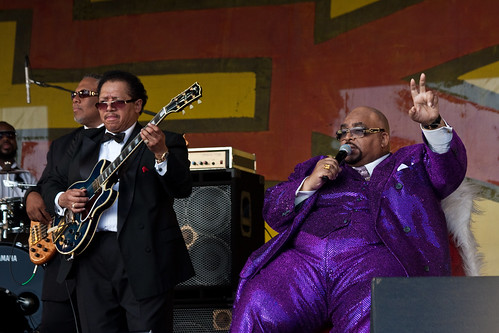
Remembering Solomon Burke
A number of media including bloggers have shown their appreciation of the great Solomon Burke. So to supplement my blog entry of a couple days past, here are some links and quotes for you. This is only a small sample of what is out there.
Ben Sisario drafted the obituary for New York Times: "In a genre known for outsize personalities and flamboyant showmanship, Mr. Burke stood out for his sheer boldness and eccentricity. A radio D.J. crowned him the King of Rock and Soul in 1964, and Mr. Burke took the coronation to heart. For the rest of his career, he often performed in full royal habit — crown, scepter and robe — and sat on a golden throne onstage. Wide-shaped in his youth, he grew into Henry VIII-like corpulence, and in his later years had to be wheeled to his throne."
Terence McArdle wrote the Washington Post Obituary:
"Anointed "King Solomon" by promoters and disc jockeys, Mr. Burke was known for his outsized personality, regal bearing - he often wore a crown and carried a scepter - and above all, his rich baritone voice.
My friend Bret Littlehales blogged on him.
"Mr. Guralnick [in his book "Sweet Soul Music"] provides insight into the tightrope walk between the sacred and the profane that Solomon Burke had mastered from his early days onward. Part man of the cloth, part hustler, all genius and possessed with one of the three or four greatest voices in the history of the idiom, Burke divided his time between the church and the stage, selling his blessings backstage at the Apollo during breaks from performing his great hits, like Cry to Me and Got to Get You Off My Mind."
Music historian Bill Dahl has an extended appreciation:
"Everything about Solomon Burke was bigger than life. Way bigger.
Burke’s profoundly regal bearing, underscored by his insistence on performing while seated on a red throne with a crown adorning his head, came to him entirely naturally. Baltimore deejay Rockin’ Robin christened him the King of Rock ‘n’ Soul in 1964 amidst great hoopla, and Solomon took that gala coronation literally. As one of the greatest of all ‘60s soul singers (Jerry Wexler, his former producer at Atlantic Records, deemed him the absolute best), Burke was one of the top R&B hitmakers of that decade. Burke managed to remain contemporary as the decades progressed; the Rock and Roll Hall of Famer won a 1992 Grammy for Best Contemporary Blues Album, and his 2010 disc Nothing’s Impossible, produced by recently departed Memphis icon Willie Mitchell, won widespread acclaim."
Here is Kit O'Toole of blogcritics.com with an appreciation..
"What makes a great soul singer? Thinking about legends like Wilson Pickett, Aretha Franklin, Otis Redding, and Mavis Staples, just to name a few, one quality immediately comes to mind: sincerity. Each of these singers possessed the ability to sing with utter conviction, making the listener feel every heartache, each moment of joy, or even anger. 1960's soul man Solomon Burke, who passed away October 10 at 70, had this unique skill; his bluesy, sometimes husky, voice acted out emotions expressed in lyrics, demanding that the audience hear—and consider—every word in a song. While he may never have cracked the Top 20, Burke's brand of R&B influenced the Rolling Stones and helped usher in a golden age of soul music."
Writer-musician Ted Drozdowski's blog from The Boston Phoenix's website:
"Soul music powerhouse Solomon Burke’s life was filled with great performances — from tent revival meetings to sweltering nights in southern roadhouses to concerts at the Apollo, the Montreux Jazz Festival, Bonnaroo, and even a Ku Klux Klan rally.
But one of the most memorable, at least for the few in attendance, was in 1994 at the Original House of Blues in Cambridge, where Burke — after two sold-out nights playing a catalog of hits reaching back to 1961 — donned the raiment he wore as bishop of the House of God for All People church and sang gospel to an audience of roughly 30 sitting rapt at his feet as he perched on the lip of the stage. Occasionally he moved the microphone away from his mouth to let his voice carry naturally, casting a spell with its absolute clarity, complex tones, and uncanny ability to move from gravel-dappled lows to falsetto without skipping a note."
Ben Sisario drafted the obituary for New York Times: "In a genre known for outsize personalities and flamboyant showmanship, Mr. Burke stood out for his sheer boldness and eccentricity. A radio D.J. crowned him the King of Rock and Soul in 1964, and Mr. Burke took the coronation to heart. For the rest of his career, he often performed in full royal habit — crown, scepter and robe — and sat on a golden throne onstage. Wide-shaped in his youth, he grew into Henry VIII-like corpulence, and in his later years had to be wheeled to his throne."
Terence McArdle wrote the Washington Post Obituary:
"Anointed "King Solomon" by promoters and disc jockeys, Mr. Burke was known for his outsized personality, regal bearing - he often wore a crown and carried a scepter - and above all, his rich baritone voice.
With his contemporaries Sam Cooke and Ray Charles, Mr. Burke brought the enduring influences of gospel and country music to bear on rhythm-and-blues - a combination much copied by other soul singers throughout the 1960s.
My friend Bret Littlehales blogged on him.
"Mr. Guralnick [in his book "Sweet Soul Music"] provides insight into the tightrope walk between the sacred and the profane that Solomon Burke had mastered from his early days onward. Part man of the cloth, part hustler, all genius and possessed with one of the three or four greatest voices in the history of the idiom, Burke divided his time between the church and the stage, selling his blessings backstage at the Apollo during breaks from performing his great hits, like Cry to Me and Got to Get You Off My Mind."
Music historian Bill Dahl has an extended appreciation:
"Everything about Solomon Burke was bigger than life. Way bigger.
Burke’s profoundly regal bearing, underscored by his insistence on performing while seated on a red throne with a crown adorning his head, came to him entirely naturally. Baltimore deejay Rockin’ Robin christened him the King of Rock ‘n’ Soul in 1964 amidst great hoopla, and Solomon took that gala coronation literally. As one of the greatest of all ‘60s soul singers (Jerry Wexler, his former producer at Atlantic Records, deemed him the absolute best), Burke was one of the top R&B hitmakers of that decade. Burke managed to remain contemporary as the decades progressed; the Rock and Roll Hall of Famer won a 1992 Grammy for Best Contemporary Blues Album, and his 2010 disc Nothing’s Impossible, produced by recently departed Memphis icon Willie Mitchell, won widespread acclaim."
Here is Kit O'Toole of blogcritics.com with an appreciation..
"What makes a great soul singer? Thinking about legends like Wilson Pickett, Aretha Franklin, Otis Redding, and Mavis Staples, just to name a few, one quality immediately comes to mind: sincerity. Each of these singers possessed the ability to sing with utter conviction, making the listener feel every heartache, each moment of joy, or even anger. 1960's soul man Solomon Burke, who passed away October 10 at 70, had this unique skill; his bluesy, sometimes husky, voice acted out emotions expressed in lyrics, demanding that the audience hear—and consider—every word in a song. While he may never have cracked the Top 20, Burke's brand of R&B influenced the Rolling Stones and helped usher in a golden age of soul music."
Writer-musician Ted Drozdowski's blog from The Boston Phoenix's website:
"Soul music powerhouse Solomon Burke’s life was filled with great performances — from tent revival meetings to sweltering nights in southern roadhouses to concerts at the Apollo, the Montreux Jazz Festival, Bonnaroo, and even a Ku Klux Klan rally.
But one of the most memorable, at least for the few in attendance, was in 1994 at the Original House of Blues in Cambridge, where Burke — after two sold-out nights playing a catalog of hits reaching back to 1961 — donned the raiment he wore as bishop of the House of God for All People church and sang gospel to an audience of roughly 30 sitting rapt at his feet as he perched on the lip of the stage. Occasionally he moved the microphone away from his mouth to let his voice carry naturally, casting a spell with its absolute clarity, complex tones, and uncanny ability to move from gravel-dappled lows to falsetto without skipping a note."
Monday, August 03, 2009
Rock on in Peace, Billy Lee Riley
While word had been coming down that the former Sun Records artist was an bad health, he just passed away this weekend about a painful bout with bone cancer. One of the bluesiest of the Sun rockabilly acts, Riley is best known for his "Flying Saucers Rock And Roll." Riley continued to perform and record after the hey day of rockabilly ended with a couple of straight blues albums among his recent efforts. Noted writer Bill Dahl published an obituary on his blog on his website, billdahl.com
Sunday, July 13, 2008
Still believing in Louis Jordan
Its the centennial for the great Louis Jordan (1908-1975) whose influence still can be felt in today's music. The vocalist and his wonderful fan, The Tympany Five, were a bridge between the swing era and jump blues (and rock'n'roll). Songs of his like "Let the Good Times Roll" and Caldonia," remain staples of blues, R&B and noveau swing repertoire. And his music is quite available from a Bear Family deluxe box set of his Decca Recordings, public domain reissues of these same recordings and post-Decca sides. He was also a major cross-over artist and had duets with other pop artists like Louis Armstrong and Bing Crosby. For a nice concise biography check out the one written by Bill Dahl on allmusic.com.Jordan's last recordings were made for the French Black & Blue label back in 1973, I Believe in Music. A session that included Irv Cox on tenor saxophone, Dave Burrell on piano (and he was on the Mercury New Orleans R&B sessions that included Professor Longhair), bassist John Duke and drummer Archie Taylor. While he would pass in less than two years, these exuberant recordings give no sense that Jordan had lost any of his powers, as these recordings illustrate Bill Dahl's observation about "Jordan's own searing alto sax and street corner jive-loaded sense of humor." This was issued on Evidence some time ago and now available for download from various sources (emusic, itunes, amazon, etc.).
From the bluesy alto that opens the disc with Its a Low Down Dirty Shame, through the closing instrumentals, there is a joy to this music that helps explain his immense popularity and influence on such artists who themselves became legends like B.B. King, Ray Charles and Sonny Rollins. There is more than a heavy dose of Jordan's humorous take on the blues like Three-Handed Woman, and Hard Head. Bill Dahl in his bio of Jordan notes Jordan had become a lounge performer and this affected his selection of material citing mac Davis' tune that gave this album its title as an example, but if Jordan included I Believe in Music, because he was primarily playing playing Vegas lounges, his exuberant performance transcends the lounge repertoire. If this is lounge music, well then let me here more in this vein. Considering how many mediocre renditions of Caldonia are out there in the blues world (and I point to Gatemouth Brown, Muddy Waters and Pinetop Perkins as easy examples), it is refreshing to hear the master on his last recording of this tune, including his jivey rap in the middle. Almost every rendition of this song lacks the simple joy of Jordan's ebullient approach. Then there is the lively rendition of a party that got out of hand on Saturday Night Fish Fry. Further display of his marvelous bluesy alto saxophone is heard on Red Top and Take the A Train. These thirty-five year old performances sound lively and fresh today and make much of what is called blues sound pretty pallid today.
Subscribe to:
Posts (Atom)