Showing posts with label Freddie Roulette. Show all posts

Monday, August 12, 2019

Battle of the Blues: Chicago vs Oakland

Various
Battle of the Blues: Chicago vs Oakland
Delta Roots Records

Twist Turner is a multi-talented drummer, songwriter, and producer who spent several decades in Chicago playing with a who's who of Chicago blues artists. In a book, "Blues With a Twist" he has chronicled his life in the blues starting from growing up in the Pacific Northwest to his time hustling and surviving in Chicago. In recent years Turner moved to Oakland, and while suffering severe health issues, he began starting to record some of the under-recorded blues artists in the Oakland area. Returning to Chicago, he found artists similarly needing exposure resulting in this release. This recording is not Turner's first efforts at producing blues albums. He produced the harmonica blues recordings of the "Chicago Blues Harmonica Project" that were issued on Severn Records.

Concerning "Battle of the Blues," Twist plays drums on all tracks, wrote 12 of the 13 selections, made all of the horn arrangements and plays others instruments on various tracks and wrote the liner notes including short artist biographies. There are numerous sidemen throughout this collection including guitarists Rusty Zinn, Maurice John Vaughan, and Dave Workman; saxophonist Skinny Williams; keyboardists Chris Burns, Roosevelt Purifoy, and Allen Batts; and bassists Art and EG McDaniel. Despite the wonderful musicianship heard in the backing, the focus (with one exception is on the singers heard here.

In the booklet, Turner quotes trumpeter Nicholas Payton "Just because its a twelve-bar form with some variation of I-IV-V chords, don't think your laying "the Blues" … it has no particular form. Relegating "the blues" to a form refutes its function. It can be found in many shapes and sizes." Payton's quote leads to Twist's discussion of the evolution of the blues, especially in the black community. He tells a story about how listening to a Syl Johnson record at Hip Lankchan's apartment, he initially responded it wasn't blues. Hip responded, "Its the blues, just a different kind of blues." The music on this recording is this different kind of blues, what some might call soul-blues. It is in the vein of Bobby Bland, Z.Z. Hill, Artie 'Blues Boy' White, Charles Wilson and Barbara Carr.

This collection opens with, Mz. Sumac, the only female, represented. The daughter of bluesman Craig Horton, Mz. Sumac displays the sass and fire of Barbara Carr as she sings about wanting a man who will give her what she needs. Skinny Williams provides a booting tenor sax solo. Aldwin London plays bass on several tracks including his vocal feature reviving Willie Nelson's "Funny How Time Slips Away." It is a fine vocal that is pretty close to Joe Hinton's hit although London is not quite up to Hinton as a singer.

The remarkable Freddie Roulette is represented by two instrumentals "Take It Easy," and "Red Tide" that display his spine-tingling lap steel playing. He is also heard behind Country Pete McGill's "Hootchie Coochie Mama," a blues that musically descends from "Hootchie Cootchie Man." McGill is the most down-home blues performer here, while Roulette's accompaniment and Roulette's solo is scintillating, Chris Burns piano on this track merits mention. It is hard to believe that Nat Bolden is 91 from his robust vocal on "Good Morning Mister Blues." This selection has the flavor of the uptown Chicago blues of Fenton Robinson and Andrew Brown with superb Rusty Zinn guitar set against a tight horn section.

Chicago singer James Newman impresses with his understated soulful singing on "Hit and Run Lover," and "Me and My Guitar." Maurice John Vaughan is the guitarist on the former song, Mark Wydra is listed for the latter tune. Emery Williams Jr passed away in 1996, and his two songs may be the earliest selections here. Maurice John Vaughan is the guitarist behind Williams on "Hurtin' On You," where he tells what he will do if he catches this person with his wife. On "Mama Don't Weep" Williams' gospel roots are evident, as he tells a former lover that he is sorry things did not work out as Bernard Anderson wails on tenor sax.

Turner observes that Gerald McClendon is known in Chicago as the Soulkeeper. He lives up to that moniker in"Cold on the Streets" with his passionate vocal about a cold-hearted woman but who is "hot in the sheets" giving good loving all night long." The other performer is "Mr. Excitement" Del Brown, a second cousin of James Brown, who is heard on his first recordings as a frontman. "Now That I Am Gone" is a terrifically sung deep soul ballad with some breathtaking vocal leaps. "Time Slippin' Away" is a heartfelt vocal about getting older and his hair turning grey as he struggles to pay his bills and survive with biting guitar fills.

"Battle of the Blues" is an excellent set of blues with a variety of marvelous blues singers handling some fascinating original material, solidly backed and well recorded. Kudos to Twist Turner for making these terrific performances available.

I received my review copy from a publicist. Here is a demo of Gerald McClendon singing. This song is not on the CD and again this is a song demo but it gives you an idea about how good a singer McClendon is.


Tuesday, January 05, 2016

Earl Hooker Play Your Guitar Mr. Hooker

Earl Hooker
Play Your Guitar Mr. Hooker
Blacktop

Buddy Guy has cited Earl Hooker as the greatest blues guitarist he ever saw, and many of his contemporaries remember his mastery of the guitar, both straight and his use of a slide. Possessing an awesome technique, timing and musical imagination, he was a favorite of many of his contemporaries, although he died of tuberculosis within a couple weeks of Otis Spann in April, 1970. What a loss, Chicago’s best blues players cut down within weeks of each other.
 
He was known as a guitarist, being an inadequate vocalist who usually let others handle the vocals. He recorded for King and Rockin’ Records and later recorded for Sam Phillips, although these sides remained unissued for years. The early sixties found him on Age and Chief, before he connected with Jim Kirchstein’s Cuca label out of Sauk City, Wisconsin. After Cuca, Hooker recorded albums for Arhoolie, Bluesway, Blue Thumb (with Ike Turner on piano) and Blues on Blues, and played on Bluesway albums by cousin John Lee (Hooker), Charles Brown, Jimmy Witherspoon, and Big Moose Walker, leaving a substantial legacy for those years.

Cuca actually issued an album titled The Genius of Earl Hooker, which suffered from the programming of all instrumentals. In the mid-eighties the Dutch Black Magic label issued Play Your Guitar, Mr. Hooker, which made available unissued Cuca recordings and alternate takes, along with two instrumentals, Earl Hooker Blues, and Dust My Broom, that pioneering European blues researcher George Adins recorded in 1968 at the Alex Club on Chicago’s West Side.

This is probably my favorite Earl Hooker album, with his vocal and guitar on the opening Swear to Tear the Truth being particularly urgent sounding. Most of this is comprised of instrumentals or accompaniments to assorted singers. A.C. Reed emulates the vocal style of namesake Jimmy Reed on She’s Fine, while Frank ‘Crying Shame’ Clark ably handles You Took My Love, and The Misfit (Got to Keep Movin’), and the gruff Muddy Waters Jr. sings Everything Gonna Be Alright.

There’s plenty of hot guitar as Earl shows his mastery of a variety of styles while A.C. Reed or Bobby Fields adds some hot tenor sax. Particularly impressive are his renditions of Albert Collins’ classic Frosty, and Otis Rush’s All Your Love. The two live recordings give Earl a chance to stretch out, and also contain a bit of Fred Roulette’s pedal steel guitar which increases their interest despite the sound quality of the location recording.

While this is a musical feast, an instrumental rendition of James Brown’s I Got You (I Feel Good) is omitted in this 13 track, 37-odd minute compact disc. Also the original vinyl album came with a detailed booklet with plenty of information on Earl Hooker, Cuca and its head, Mr. Kirstein. While it would have taken an extensive booklet to reprint all of the original notes, certainly some liner notes should have been included. While this is recommended, Black Top could have done better with this reissue.

I likely received a review copy from the record label. This review originally appeared in the September 1993 Jazz & Blues Report (Issue 184). This may be available on the used market but as a collector's item. Here is Earl Hooker, likely in Europe.


Wednesday, July 31, 2013

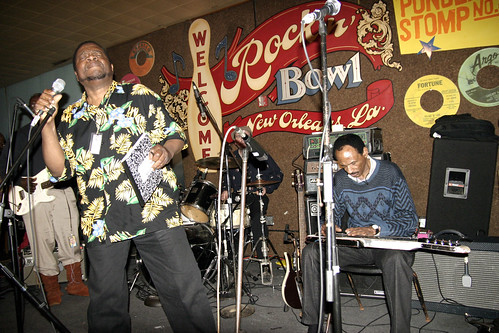
Bo Dud and Freddie Roulette

Bo Dud & Freddie Roulette by NoVARon
Bo Dud & Freddie Roulette, a photo by NoVARon on Flickr.
With all the attention on sacred steel players and their progeny like Robert Randolph, Freddie Roulette's contributions that date nearly fifty years old are sometimes overlooked for lap steel playing. Here he was at the Ponderosa Stomp backing Bo Dud(ley) who he played steel guitar on "Shotgun Rider."

Here is "Shotgun Rider"with some mind-blowing steel guitar.


Here is a track from a terrific album by Freddie with the late Willie Kent that came out a number of years ago. A follow-up album of more strong blues was recorded but the label never issued it.


Friday, May 16, 2008

Freddie Roulette is the forgotten blues steel guitar legend


Long before Chris Strachwitz issued his first collection of Sacred Steel recordings on Arhoolie, guitarist Freddie Roulette had recorded on lap steel on a variety of recordings including Earl Hooker’s classic Arhoolie album, Two Bugs and a Roach, Big Moose Walker’s great 45, Ramblin’ Woman b/w Puppy Howl Blues, and the Chicago Blues Stars. What stood out was the vocalized quality of his playing and how his playing evoked trains, howling dogs and other sounds in a fashion that the sacred steel players and few other guitarists do today (Derek Trucks being a notable one).

Roulette has lived in the San Francisco area over three and a half decades. Back in 1997, he had a terrific album on Hi Horse, Back in Chicago, where he was backed by the late Willie Kent and his excellent band. Now guitarist Henry Kaiser has produced a new release by Roulette, Man of Steel, on the German Tradition & Moderne label. Certainly it provides enough space for Roulette to display his considerable talents, but the presence of several other guitarists, some of whom also play slide provide for what may be overall a less satisfying recording. It opens with Roulette reviving the Johnny Taylor/Albert King classic Breaking Up Somebody’s Home, with some startling playing but a lesser vocal, followed by Washington Phillips’ Tattler on which David Lindley takes the vocal lead and adds slide. Once one gets past the limited vocal by Roulette on the simple lyrics of You Got To Funkifize, one hears nice playing from Roulette but there is perhaps too much from Kaiser for these ears. With Ken Emerson providing a foundation on his lap steel, Roulette imaginatively takes lead on a refreshing reworking of Lee Morgan’s Sidewinder, before either Kaiser or Phil Emerson takes a nice solo. Roulette’s vocal comes off better on Willie Nelson’s Nightlife with his lap steel embellishments behind his vocal being a nice touch. A Hawaiian instrumental How Do Ya Do? provides nice lap steel playing from Roulette and Ken Emerson, and is followed down by a slowed down, stop-time rendition of Arthur Crudup’s That’s Allright Mama, with a nice vocal by Ken Emerson and more nice mood-enhancing playing from Roulette. Surfin’ is a nice instrumental set to a reggae groove, followed by a decent vocal on In the Heat of the Night. It is a wide-ranging set with some typically fine work by Roulette covering a variety of musical styles with some fine ensemble playing. Still this does not quite place Roulette’s electrifying guitar to the fore as the Hi Horse disc did.