Showing posts with label downhome blues. Show all posts

Sunday, July 25, 2021

1994 Roots N'Blues Reissues - Columbia / Legacy

 Roots N'Blues Reissues - Columbia / Legacy

The latest batch of Columbia/Legacy's Roots N'Blues reissues maintain the level of the earlier issues. Double disc releases by Blind Willie McTell and Brownie McGhee are of particular interest.


The Blind Willie McTell set is entitled "The Definitive," which is not completely accurate as it omits such essential McTell recordings as Statesboro Blues, which was recorded for Victor. Still, the forty-one selections, some with Ruth Willis on vocals, and others with Curley Weaver or Buddy Moss on second guitar, are magnificent sides. There's the exuberant "Georgia Rag," a brisk reworking of a Blind Blake number, the jaunty "Stomp Down Rider" and "Broke Down Engine." Whether playing a bottleneck or not, McTell displays considerable fluidity on the 12-string guitar and sang convincingly with warmth and feeling. This has all of McTell's Columbia Vocalion, and Okeh recordings, and the booklet has an essay by David Evans that will be the standard source for information on McTell in the future. If not definitive, this is essential.


Two discs collect "The Complete Brownie McGhee." Despite his celebrity, in part a result of his long partnership with Sonny Terry, many blues fans are unaware of his commercial recordings for the African-American, then rhythm and blues market. This collection compiles 47 recordings originally waxed for Columbia's Okeh subsidiary, and while some have been reissued overseas, much of this has never been issued. The Kentucky-born McGhee had moved to the rich blues territory of North Carolina when he was discovered by talent scout, J.B. Long. Between August 1940 and October 1941, McGhee recorded the 47 sides (some alternate takes) included here. While distinct from Fuller, McGhee's recordings with Jordan Webb's harp, and either Bull City Red or Washboard Slim ón washboard carried some of the same flavor. Reworking "Digging My Potatoes" as "Picking My Tomatoes," doing "Step It Up and Go," memorializing Fuller in "Death of Blind Boy Fuller," or an early version of "Key to the Highway," these recordings are marked by McGhee's clean articulated vocals, fluid guitar playing and relaxed group swing. Highly recommended.


A single disc of Bukka White's complete Columbia, Okeh and Vocalion recordings is available on "The Complete Bukka White." One of the major Delta blues artists, White's hoarsely shouted vocals were backed by his percussive, barrelhouse bottleneck guitar. Also, White was a blues lyricist of considerable power whose songs often reflected his own experiences. A dozen of these 14 titles were recorded in 1940 after he was released from Parchman Farm, and the time he spent there is echoed in the intense imagery of "When Can I Change My Clothes" (referring to his prison uniform). The sessions also produced "Fixin' to Die Blues," with its morbid imagery, the barrelhouse dance number, Bukka's "Jitterbug Swing," and "Special Streamline," a half-spoken, half-sung train blues with a suggestive slide accompaniment. Prior to being imprisoned, Bukka recorded "Shake 'Em On Down," another classic that became a delta blues standard. These recordings were discussed at length by Sam Charters in his book "The Bluesmen" over 25 years ago, and they stand up as a cornerstone of a country blues collection. Incidentally, all of these titles were previously issued on Ip and cd, but this is newly mastered.


Tampa Red, "The Guitar Wizard," is a single disc with 17 early recordings by one of the most prolific and important early blues artists. One cannot exaggerate the importance or influence of Hudson 'Tampa Red' Whittaker. One would be hard-pressed to name any blues guitarist (particularly slide) who doesn't bear his imprint, nor has one of his songs in his repertoire. While most of his recording career was spent with Victor, this exemplary collection derives from recordings for Okeh and Vocalion. A number of them include Georgia Tom Dorsey on the piano including an accompaniment to "Papa Too Sweet," on a version of "It's Tight Light That." In addition, there are several fine blues presaging his later recordings and influence, including two versions of "Sugar Mama," and his reworking of Lucille Bogan's "Sweet Black Angel." The fact of Bogan's earlier recording is not mentioned in Mark Humphrey's otherwise informative annotation. The music is first-rate, with plenty of Tampa Red's clean, precise slide and bittersweet vocals. Highly recommended.


"Cajun Dance Party • Fais Do Do" is the second collection of vintage cajun music recordings Larry Cohn has compiled for this series. Covering the years 1929 to 1934, this collection is oriented to the recordings of cajun accordion pioneers such as Amédée Breaux, Amédée Ardoin, Dewey Segura and Joseph Falcon. It opens with Amédée Breaux's "Ma Blonde est Partié," the earliest recording of what would be known as "Jolie Blonde." This set is important for its inclusion of six recordings by the pioneer creole accordionist, Ardoin, who influenced both cajun and creole musicians. "Jolie Blonde" is not the only cajun classic whose first recording is collected here. While the musical form here is basically two steps and waltzes, the use of the diatonic accordion and cajun fiddle, along with the high lonesome, crying vocals have a bluesy tonality. While the lyrics may be incomprehensible to many, the soulfulness of this music, which is far removed from the more country-influenced cajun, or R&B flavored zydeco music of today, the music here is quite powerful, although some may find it difficult to listen to this complete in one sitting. But when the accordion gets rocking on a riff and the violin waxes over it, the music can be mesmerizing.


Part of the Contemporary Blues Masters series in Roots N'Blues, a new album, "Stompin' at the Penny," reissues a rare Canadian album of Lonnie Johnson with Jim McHarg's Metro Stompers. This album captures the legendary blues guitarist and vocalist at Toronto's Half Penny backed by a spirited "trad' band. There's a mix of songs associated with Johnson's fellow New Orleans' native, Louis Armstrong, "Dippermouth Blues" and "West End Blues," with Johnson taking a sprite solo on the latter. In fact, his electric guitar playing on this number, the relaxed R&B flavored "Bring It On Home Mama," or the rocking "Go Go Swing," illustrate the continuity between his innovative playing in the twenties and the modern electric guitar style most associated with B.B. King, who acknowledged Johnson as an influence. "Go Go Swing" is particularly fascinating as the Metro Stompers riff like a hot R&B band horn section. This is mostly instrumental and the vocals here show as often as not Johnson's predilection for ballads ("My Mother's Eyes"), a fact not often appreciated by Johnson's blues admirers. Still, this is a highly entertaining collection that is, in all honestly, of most interest to trad jazz enthusiasts but having enough of Johnson's playing to make it of wider interest.

I likely received review copies from Columbia Records. This review appeared in Jazz & Blues Report in 1994. I note that these should be available in some form, including from Amazon.

Friday, November 08, 2019

Alabama Mike Hip You To My Blues

Alabama Mike
Hip You To My Blues
Big Tone Records

It was a surprise to learn about a new release by Alabama Mike (real name Michael A. Benjamin) on Big Jon Atkinson's new label. Alabama Mike's earlier recordings, such as those with The Andy T Band in 1997's "Double Strike," often displayed a gospel-rooted vocal style in the manner of Little Johnnie Taylor. This new release finds him in a down-home blues vein with a dose of Lightnin' Hopkins flavor along with some tracks that evoke early 50s Chicago flavor. This recording reflects Alabama Mike's long-burning desire to "do a record in the classic style of early electric blues pioneers… ." The backing musicians on this set of retro blues include Kim Wilson on harmonica, Big Jon Atkinson guitar, Danny Michel on guitar, Troy Sandow on bass, Kedar Roy on bass, Joe Lempkowski on harmonica, June Core on drums, Malachi Johnson on drums, Robert Welsh on keyboards, on retro-sounding performances.

Alabama Mike certain invests his vocals with intensity and soul. The Lightnin' Hopkins influence can best be heard on the opening "Black Cadillac" (with Atkinson on guitar) as well as the revival of Hopkins' "Hello Central" with Danny Michel on guitar, Kim Wilson on harmonica and Marty Dodson on drums lending the performance a swamp blues flavor. Danny Michel also channels Hopkins guitar on the swamp blues "California Blues," with choice Joe Lempkowski harmonica accompaniment.

A reworking of John Lee 'Sonny Boy' Williamson's "Cut That Out" sounds as a down-home version of Junior Wells fifties recording. Kim Wilson is on harmonica, Atkinson on guitar and Dodson on drums. Welsh provides the greasy organ on "Diabetic Man" with Wilson on the harp. On "How You Want Your Rollin Done," Atkinson plays some excellent T-Bone Walker styled guitar. On Big Bill Broonzy's "I Feel So Good," Alabama Mike delivers a strong vocal in the manner of Muddy Waters with J.B. Hutto styled slide guitar in the backing. "Keep My Grave Clean" is an ingenious band reworking of what was Blind Lemon Jefferson's most famous recording, while the cover of J.B. Hutto's "Too Much Alcohol" sticks close to the arrangement of Hutto's Delmark recording.

A moody rendition of Willie Love's "V-8 Food" with Atkinson and Welsh closes a release of notable down-home blues performances. There are a couple of times the backing may be a tad skeletal, but Alabama Mike's singing and the idiomatic support result in a most entertaining blues album.

I purchased this. Here is Alabama Mike performing "Let Me Hip You To My Blues."


Sunday, December 02, 2012

Arthur Williams - Midnight Blue


Arthur Williams, a St. Louis resident today, has roots growing up under Sonny Boy Williamson down south and played with Frank Frost. In fact, Williams was the harmonica player on some of Frost’s recordings that Scotty Moore produced for Jewel in the sixties. On his album, Midnight Blue (Rooster Blues) he is joined by a terrific pianist, Bob Lohr, who also produced the album. Also on the session is bassist Charles “Nephew” Davis, guitarist Jesse Hoggard and the great Willie “Big Eyes” Smith on drums. 

Williams is heard performing some well known blues numbers (some retitled like Clarksdale Train, a retitled rendition of Elmore James’ Sunnyland Train). His energetic, raspy vocals are quite at home on Muddy Waters’ Trouble No More, Jimmy Reed’s Down in Virginia and Sonny Boy Williamson’s Don’t Start Me To Talking

The title track is a nice slow instrumental to showcase his direct appealing harp playing which is prominently featured throughout. The band plays a bit raw. If the music lacks subtlety, it makes up for it in spirit. The last number, ‘67 Cadillac is an interesting experiment as producer Lohr has sampled a bit of the late Doc Terry talking, and provided some programmed drums for an interesting experiment which can be skipped since it is the last track. A nicely put together collection of performances that certainly will get any blues party popping.

This review appeared originally in the the November 2001 DC Blues Calendar and the March/April Jazz & Blues Report (Issue 256). I have made minor stylistic changes. I believe I received a review copy from the record label. This may be hard to find but worth the effort.  Here is Arthur Williams and young bluesman, Marquise Knox.


Wednesday, July 11, 2012

I'm John Lee Hooker Brings Together Classic Vee-Jay Hooker Recordings

Shout Factory continues its reissues from the legendary Vee-Jay Records catalog and has made available some classic recordings on CD. This is a reissue of the original album and does not appear to be augmented by alternate takes or additional songs. They reproduce the original liner notes and have some contemporary commentary as well. Sound is very good.

I’m John Lee Hooker was a 1959 compilation of the first sides that the great John Lee had waxed for Vee-Jay. Included are solo re-workings of In the Mood, Boogie Chillum, Hobo Blues and Crawlin’ King Snake that are compelling in their own way as he stomps the rhythm and playing his signature hypnotic guitar. Other tracks such as Dimples, Maudie, I Love You Honey and Time Is Marching, have him backed by a supportive ensemble who do quite a credible job in following Hooker’s often unusual song structures. Eddie Taylor’s guitar work is especially noteworthy on these and Jimmy Reed plays the harp on Time is Marching.

This is a most welcome reissue and the band sides are pretty strong as are his recreations of his earlier recordings.

This review originally appeared in the March 2008 Jazz & Blues Report (Issue 303). I believe I received my review copy from the publication. Here is John Lee Hooker performing on BBC around the time of these recordings.


Sunday, February 26, 2012

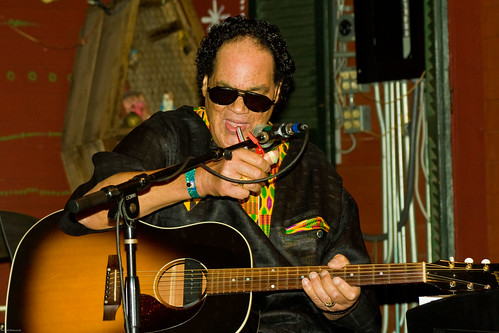
Louisiana Red at the 2008 Ponderosa Stomp

2008-0429_Ponderosa_Stomp-610 by NoVARon
2008-0429_Ponderosa_Stomp-610, a photo by NoVARon on Flickr.
We mourn the passing of Iverson Minter, better known as Louisiana Red on February 25. Louisiana Red had a recording career that stretched six decades, starting with recording for Chess Records in 1952 and including the wonderful Memphis Mojo for Ruf Records, which I reviewed this past October.

Red's music showed varied influences including Muddy Waters, Elmore James, John Lee Hooker and Lightnin' Hopkins. He was adept at the slide guitar styles of both Muddy Waters and James, and adapted some of their tunes for his own use, employing original, often chilling lyrics that arose from his own life and situations.

He recorded frequently and generally at a high level for a variety of labels. With his passing, another link to the blues vintage age of the fifties and sixties has passed, but even more important, an original musical voice has been stilled.

Friday, February 24, 2012

Heritage Blues Orchestra Is Still Rising

At the last Pocono Blues Festival, one of the acts was Bill Sims Jr. and his daughter Chaney doing a variety of material rooted in deep acoustic blues, spirituals and field hollers. Sims was a marvelous guitarist and vocalist and his daughter sang marvelously as well. It was to my delight that a new recording by a new group, Heritage Blues Orchestra, And Still I Rise (Raisin’ Music) featured them along with Junior Mack in a collection of blues, hollers and spirituals that bring a sophistication to them while preserving the rawness of the source material. This album by “H.B.O.” is produced by Larry Skoller, also includes the harmonica of Vincent Bucher (Matthew Skoller on one track), the drums and percussion of Kenny ‘Beedy Eyes’ Smith, and a horn section led by Bruno Wilhelm that provides fresh settings for some of these songs.

As Smith emphatically laying down the rhythm, Bucher wails on harmonica, and Mack and Sims lay down a delta-flavored guitar accompaniment, Mack delivers a strong vocal on Son House’s Clarksdale Moan, with horns added during the performance. Chaney takes a vocal on C-Line Woman with Mack and Sims providing a response as Kenny Smith provides the second-line rhythms and Clark Gayton provides a bass line on his sousaphone/tuba. I believe it is Mack that handles the vocal on Big Legged Woman, with the horn section adding musical coloring.

The horns are more prominent as is Bucher’s energetic harmonica on a hot shuffle rendition of Catfish Blues, with Bill Sims strongly delivering the lyrics with some interesting interplay between harmonica and the horns. The interplay between the vocals and horns marks Leadbelly’s Go Down Hannah, with a lovely vocal on this dirge by Chaney Sims. I believe it is Junior Mack that plays the driving slide guitar behind the three-part harmonies on the spiritual Get Right Church, as Smith emphatically lays down the groove.

The remainder of this release is equally stirring and moving. The playing by Sims, Mack, Bucher and Smith is terrific throughout. Smith’s ability to play in very contrasting and different rhythmic styles is noteworthy. The horns certainly are interesting, add rhythmic punch to these recordings even if not always seamlessly integrated into the performances. The horns stand out during In the Morning, and the closing Hard Times. The latter traditional blues is transformed into a three-movement performance, opening with a stirring vocal by Chaney that hints at Skip James, followed by a mournful horn interlude, and concluding with Junior Mack taking a vocal chorus to kick off a brief funky jam that fades out during Wilhelm’s fervent tenor sax solo.

The foundation of the Heritage Blues Orchestra are the voices of Junior Mack, Bill Sims, Jr., and Chaney Sims who bring such a range of moods and emotions in the marvelous vocals here. This trio could do a recording without instrumental accompaniment and be as compelling as they are here. And I Shall Rise is an compelling, contemporary exploration of African-American musical roots.

This is scheduled for release on February 28. I received a review copy from a publicist. And here is a promotional bit for this release.

Saturday, August 27, 2011

Alabama Slim's Down Home Blue & Lonesome Blues

Here is the latest installment in my series on small blues gems issued by the Music Maker Relief Foundation, Alabama Slim's "Blue & Lonesome" Slim was born Milton Frazier in Vance, Alabama in March, 1939. He grew up playing in juke joints before moving to New Orleans in 1965 and got jobs with a moving company and later making cooking oil before hooking up with his cousin Little Freddie King with whom he would jam ever so often. Drinking heavily for a period, he cleaned himself up in the 90's and resumed a close friendship with King. The pair have shared an album on Music Maker and Blue & Lonesome is a welcome solo disc by Slim who towers near 7 feet tall.


Slim is rooted in such artists as Lightnin' Hopkins, Muddy Waters, Jimmy Reed and especially John lee Hooker, which is made clear in his rendition of Fannie Mae that opens this up a duet with Freddie followed by a Hooker-styled rendition of Muddy Waters' Someday Baby, and then on the invigorating Old Folks Boogie, a take on Hooker's Boogie Chillum, and Junior Parker's Feeling Good. Ardie Dean adds some light percussion for this performance on which Slim's controlled performance adds to its appeal. "Weather Done Got Cloudy," is the first of several tracks featuring him with a Huntsville, Alabama band and is a nice brooding blues in a Hooker-ish vein which has lyrical allusions to "Checking on My Baby."


Ain't I Been to You is a one chord Hooker styled blues that would sound at home in the North Mississippi Hills with some biting guitar runs. Joined by Freddie, West Texas Blues, is a nice song showcasing Slim's restrained, pleading style. Two O'Clock in the Morning is a spare Texas styled blues based on Lowell Fulson's Three O'Clock in the Morning. There is a bit more modern flavor on Has Anybody Seen My Baby, which sounds like as Hooker interpreting a B.B. King blues, while "I Love My Guitar" is a Hooker-styled boogie as Slim tells his woman not to get hooked on him as he loves nothing but his guitar. The album closes with I'm Blue and Lonesome, a lazy Jimmy Reed blues interpreted in a manner that John Lee Hooker might have.


Alabama Slim has produced an entertaining collection of blues with strong evidence of the influence of John Lee Hooker. While one might not call this essential, it should appeal to fans of post-war, down-home, country blues. It certainly caught this reviewer's ear.


I received this from the Music Maker's Relief Foundation as a donor to that organization. Visit www.musicmaker.org for information on purchasing this and other recordings as well as contribute to help blues and other roots musicians.

Saturday, December 29, 2007

Some Outstanding Blues Reissues of 2007

In a second of three posts here are some reissues of first release of vintage blues and R&B that I believe merits your consideration. I have links to my reviews of the cds on this blog.
Andrew Brown - Big Brown Blues (Black Magic) Magic collection by singer who may superficially be described as in the style of Little Milton.
Johnnie Taylor - Live at the Summit Club (Stax). The Soul Philospher in a great live performance from time of Wattstax with a heavy blues emphasis on material.
Henry Townsend - The Real St. Louis Blues (Arcola) Distinctive acoustic blues by one who performed with Robert Johnson, Lonnie Johnson, Roosevelt Sykes, Walter Davis and others. His minor key piano blues are particularly moving. This label has some really important releases out and I do not believe they have been publicized but they certainly deserve. I became aware of this label last year so even though its a pre-2007 release I am including it.
Various - Bullet Records Blues (SPV Blue). Excellent collection of blues by the likes of Walter Davis and St. Louis Jimmy that was issued on Nashville label.
Various - Bullet Records Rhythm & Blues (SPV Blue). Another of Fred James' compilations of vintage Nashville labels with some great jump blues starting with Wyonnie Harris (with Sun Ra on piano). He has other notable reissues on SRV Blue of the Champion and other labels, but these two on Bullet are musically the finest.
Various - Crescent City Bounce (JSP) Wonderful European public domain 4 CD set of rare New Orleans recordings including great sides by Archibald, Smilin’ Joe, Roosevelt Sykes, Tommy Ridgely, Earl King and others.
Various - Down Home Blues Classics- (2CDS) California & West Coast 48-54 (Boulevard Vintage). Simply stunning downhome blues performances by the likes of KC Douglas, Sidney Maiden, Black Diamond, Little Son Willis, Haskell Sadler, Slim Green and others
Various - Down Home Blues Classics- (2CDS) Memphis & the South (Boulevard Vintage). Another compilation of terrific downhome blues with Willie Love, Willie Nix, Joe Hill Louis, Lightning Slim, Schoolboy Cleve, Big Joe Williams, John Lee, Luther Huff, Dr. Ross and more.
Various - MERCURY RECORDS- (2CDS) The New Orleans Sessions 1950 & 1953 (Bear Family). Expanded compilation that includes early recordings by Professor Longhair and others (including Lee Allen's first recordings as a sideman).

Monday, November 19, 2007

Robert Lighthouse's Blues For New Orleans

Robert Lighthouse is a Swedish native (real name Palinic) who settled in the Washington DC area about two decades ago and has established himself as an important part of the blues scene in the Mid-Atlantic. he has busked on the streets and played a variety of clubs. His regular weekday gig at the late club City Blues was a local institution. Today he plays a solo gig weekly at a club Chief Ike’s Mambo Room, and plays band gigs with his trio at various bars and clubs. Wayne Kahn, a champion of D.C.’s music scene recorded Robert and issued Lighthouse’s first album, Drive-Thru Love, which received considerable local and international acclaim. Now he has issued on his Right on Rhythm label, the follow-up album of location recordings, Deep Down in the Mud, which includes solo selections recorded at Chief Ike’s and band cuts recorded at D.C.'s Zoo Bar (The Oxford Tavern located across from the National Zoo). Robert has developed a distinctive style from a variety of influences including Muddy Waters, Dr. Ross and several others so that when he does Robert Johnson’s Last Fair Deal Gone Down and Preachin’ the Blues, his attack lacks the more percussive approach of Johnson and most imitators, and has a more flowing approach that is evocative of Furry Lewis. His original Stuck in the Mud and Dr. Ross’ Turkey Leg Woman are fine performances in a style suggestive of Dr. Ross, although his rendition of Cat’s Squirrel, Dr. Ross’ treatment of the Catfish Blues theme also shows a bit of Muddy Waters influence. The title track is not a blues, but a protest social commentary song about Katrina and the government’s inadequate response. The trio cuts include Lighthouse’s laconic rendition of Elmore James’ Red Hot Mama, totally reworking the melody, a nice cover of Magic Sam’s All Your Love, an understated treatment of Wolf’s Meet Me in the Bottom and an unusual piece of funk, a rendition of George Clinton’s Red Hot Mama. Lighthouse also has an attraction to Jimi Hendrix's music and included is a take on Spanish Castle Magic, but this somewhat lengthy rock performance I found somewhat less compelling than some of his prior Hendrix covers. Still, overall this album is an impressive follow-up release and illustrates why he maintains a loyal following in the DC area. This can be purchased at www.rightonrhythm.com or cdbaby.com

Monday, November 05, 2007

Sleepy John's Electric Chicago Blues


Sleepy John Estes was one of the great blues poets and vocalists whose prewar recordings were highly influential on the likes of John Lee ‘Sonny Boy’ Williamson and others. A creative lyricist who often spun songs from his own experiences, his crying vocals (and rudimentary guitar playing) backed by the vocalised harmonica of Hammie Nixon and the mandolin of Yank Rachell produced numerous classic songs that became part of the blues repertoire, such Diving Duck Blues, Drop Down Mama, and Everybody Oughta Make a Change. Rediscovered in the sixties, Estes had a revived career recording and performing world wide, producing several excellent albums for Delmark. Delmark’s reissue, On the Chicago Blues Scene, makes available for the first time on CD an album originally released as Electric Sleep, a play on the psychedelic recordings of Muddy and Howling Wolf, although this was simply presenting Estes in a Chicago blues setting with a backing band that included Sunnyland Slim on piano, Jimmy Dawkins on guitar, Carey Bell on harp, Odie Payne on drums and various bassist including Earl Hooker. Koester recalls seeing Estes participate in a jam in Europe with Hubert Sumlin, Rice ‘Sonny Boy Williamson’ Miller, Sunnyland Slim and others and able to sing with such modernists and a few years later cut an album in that vein and with the sympathetic backing by a band that does a fine job in backing Estes who could sometimes not be easy to follow. The vocals are marvelous as can be expected and its a joy to hear familiar Estes songs take on a fresh sound and here the music played with such joy and soulfulness. Recommended.