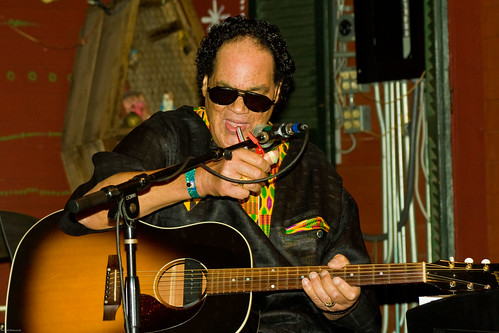
Notes Hot & Blue - This was a column of reviews I wrote for the DC Blues Society's original newsletter, the DC Blues Calendar. This is from April 1988 when it was a two-page flyer. The front-page noted the Blues Society was presenting a concert with Friz Hollway and John Dee Holeman. As noted from my review, Lonnie Brooks was appearing at the Bayou on April 4th.
Lonnie Brooks, in town at the Bayou on the 4th, has a new Alligator album, Live From Chicago- Bayou Lightning Strikes. Brooks has always had strong rock roots, first being part of the Louisiana swamp pop scene before moving to Chicago. This is a pretty tasty set of rocking blues and rhythm & blues which is sure to appeal to those who like blues laced with rock which strikes me as more bouncy than some other recent Alligator albums. As a label on the cover says, this is "Genuine Houserockin’ Music”.
The English Krazy Kat label has been issuing a variety of albums of blues, rhythm'n'blues, and gospel from the Gotham family of labels. A typical album is Big Band Blues (KK814) which includes several swinging selections by the great blues shouter Jimmy Rushing with a band including Bill Doggett and a variety of Basie alumni, a track by J.B. Sumners who sang with Tiny Grimes, three tracks by singer Tiny Tim (Timothy Flair, not the 60s" pop figure), and a jumping band led by trombonist Ernie Fields. Solid swinging and jazzy stuff.
A recent reissue, Alley Special (KK 820) represents Sometime of a coup. This album includes Muddy Waters’ first commercially issued recording, "Mean Red Spider" from 1946 appeared on the 20th Century label as by James ‘Sweet Lucy" Carter. Muddy sings strongly and is backed by an urban blues band which includes strong piano and alto sax but some awful Soprano sax. Other recordings on this include the fine Detroit bluesman, Baby Boy Warren, a previously unissued Eddie Burns track, a track by harmonica player Sonny Boy Johnson (influenced by the 1st Sonny Boy Williamson) and several tracks by Texas bluesman Wright Holmes.
More unissued Eddie Burns along with some excellent John Lee Hooker can be heard on Detroit Blues 1950-1951 (KK 816). The Hooker sides are Strong solo recordings including an early version of “House Rent Boogie". The Burns selections feature some tough harp and a rough down home blues band with John Lee Hooker's quitar evident on a couple tracks. Great Downhome blues.
I likely received a review copy of the Lonnie Brooks from Alligator Records. I likely purchased the three Krazy Kat releases (which were English). The Krazy Kat label no longer operates and I believe its releases are out-of-print although maybe available as CDs from Collectables.
These reviews originally appeared in the June 1978 Buffalo Jazz Report (Issue 52). I do not recall if I purchased these or received review copies.
There is a plethora of other new albums out. How can one miss with Little Walter, Blue and Lonesome (Le Roi du Blues 33.2007). This record contains unissued sides, alternate takes and sides only reissued overseas by the master of blues harmonica. Leonard Chess calls Walter, Little 'Motherfucker' Walter on the longer version of the title track than the released take. Sidemen include Muddy Waters, Jimmy Rogers, the Aces and Robert Lockwood and do I have to tell you the other titles. Great stuff, which might be the only Walter currently in print.
Clifton Chenier has not exactly been under recorded. His new Arhoolie album And His Red Hot Louisiana Band (1078) is typically fine even if it breaks no new ground. John Hart plays great tenor. Clifton wails on accordion and guitarist Paul Senegal gets more than usual solo space. This album is bluesier than Clifton's more recent recordings and especially nice is "Hungry Man Blues" with its Muddy Waters touches and the closing "Highway Blues". A typically solid album that may be overlooked if you are well-stocked with him, but if you don't have any of Clifton's Arhoolie albums, what are you waiting for.
Little Walter's recordings (including those that were on Blue and Lonesome) are available on a number of other reissues. This specific Clifton Chenier recording may be available used. There is plenty of Clifton Chenier on Arhoolie Records available from Smithsonian Folkways. You can visit folkways.si.edu and search for Clifton Chenier. Here Clifton performs "I'm a Hog For You."
Today's short playlist is devoted to several renditions of "Catfish Blues," a song first recorded by Robert Petway in 1941 although Jim Jackson's "Going To Kansas City (Part 3)" contains a couplet that would be the core of subsequent versions of the song including songs by Muddy Waters and Eddie Taylor. It was a theme that would also be covered by Jimi Hendrix and Government Mule. We start with Petway's classic recording.
Muddy Waters' song, "Rolling Stone" is derived from Petway's recording.
Another derivation of "Catfish Blues" is Eddie Taylor's "Stroll Out West." While he recorded it (I believe) Vee-Jay, here is an acoustic rendition for The album "I Feel So Bad."
K.C. Douglas was a Mississippi blues artist who moved to the San Francisco Bay area. Here is his rendition.
To close this playlist, we have an electric band version from Elmore James disciple, Johnny Littlejohn.
I can easily do a set with five more renditions, but that will wait for another day.
Douglas Records has made available on compact disc, “Mud In Your Ear”, 15 selections by the Muddy Waters Blues Band originally issued on two vinyl albums issued back over forty years ago on what was then Alan Douglas’ new label. Muddy Waters is on the session, but limited to backing guitar although taking a few recognizable slide solos. His band at that time included Luther ‘Snake Boy’ Johnson on vocals and guitar; George ‘Mojo’ Buford on harmonica and vocals; Otis Spann on piano; Sammy lawhorn on guitar; Lawrence ‘Sonny’ Wimberly on bass and Francis Clay on drums.
Johnson and Mojo, along with Spann, would have been featured on the Band’s opening selections before Muddy would be brought up. This recording allows Johnson and Buford to have more of the spotlight then they would live as well as allows us to hear this edition of Waters Band upfront. Johnson takes the bulk of the vocals including a nice rendition of Washboard Sam’s “Diggin’ My Potatoes,” and Muddy’s “Long Distance Call,” with his take on the “another mule kicking in my stall” climax. The title track, heard in a lengthy version and a brief reprise, is an rocking instrumental rendition of “Got My Mojo Working.” There are also solid renditions of “Coming Home Baby” and Jimmy Smith’s “Chicken Shack,” songs that were typical opening numbers.
Johnson’s “I’m So Glad” is a pretty strong original with Muddy adding some stinging slide. Also nice are his interpretations of a couple lesser known Waters numbers, the brooding “Remember Me,” and Waters’ “Evil,” where he sings that when you see him coming better run and hide. Spann is particularly superb on these and Buford adds some nice harp. Buford comes across well on the first-rate “I’m So Glad,” and “Watch Dog.” The latter number is a slow blues with a clever lyric about needing a watch dog to look after things when he goes away on business.
This was a tight band and these are solid performances. Johnson did record overseas after leaving Muddy Waters but died much too young while Buford made several albums until his passing a few years back. This is a good document of the Muddy Waters band of the time before Spann left, and while this is not an essential reissue, it is a welcome one.
This was a purchase. This review originally appeared in the September-October 2012 Jazz & Blues Report (Issue 344). Here is a performance from Luther ‘Snake Boy’ Johnson.
Muddy Waters (real name McKinley Morganfield) was one of the greatest of all the post-World War II blues artists associated with the city of Chicago. I was fortunate to see him perform several times in my life. Born in Mississippi, he moved to Chicago and electrified the deep Delta Blues. His music influenced countless other blues artists as well as rock artists. One of the most famous rock bands, as well as music magazines, took their name from one of his records, "Rolling Stone." Here is a small selection of his musical legacy with a focus on his pre-1950 recordings. One of his first recordings made for the Library of Congress was "Country Blues." Reflecting the influence of Son House and Robert Johnson, it is a brilliant country blues performance.
After he moved to Chicago, Muddy made some recordings for Columbia that went unissued for some time. His first issued recordings were not even under his own name including a cover of a Robert Lockwood, Jr. recording. Circumstances had Sunnyland Slim bring him to Leonard Chess at Aristocrat Records where he started his legendary recording career. one of the early recordings he made with Slim was "Gypsy Woman."
Next up is a song Muddy learned from Robert Lockwood, Jr. It is a cover of a recording Lockwood made for Bluebird, "Mean Red Spider." muddy first recorded this with James 'Sweet Lucy 'Carter under whose name it was released. Here is the recording Muddy made for Aristocrat.
Next up is a song that gave Peter Guralnick the title of one of his first books," I Feel Like Going Home."
The last selection of this brief playlist is "Burying Ground" with Big Crawford on bass. Big Crawford was the bassist on many of Muddy's early recordings
I will be presenting Muddy Waters in the weeks to come.
This installment of Take 5 looks at five songs by the popular Blues Hall of Famer, Junior Wells. Wells was a significant part of the post-World War II Chicago blues scene. He played with Muddy Waters, recorded with Muddy and Elmore James as sidemen. Other recordings had the likes of Earl Hooker playing guitar. Later his album "Hoodoo Man Blues," on Delmark, was one of the first album of a working Chicago blues band that was recorded as an album, not a collection of singles. For a number of years, he toured with Buddy Guy with a band that included A.C. Reed on saxophone and Phil Guy on second guitar. This was one of the best blues bands that ever was. Then after the partnership with Buddy ended, he led his own, very popular band throughout the world. Here are five choice recordings or performances by him.
We open with his original recording of "Hoodoo Man Blues," with Elmore James on guitar, Little Johnny Jones on piano, Louis Myers on guitar, Dave Myers on bass guitar and Fred Below on drums.
Next up is his original "Messin' With the Kid," which Muddy Waters would record an answer to.
The collaboration with Buddy Guy first included a session for the legendary "Chicago, The Blues Today" recordings, "Hoodoo Man Blues," and the Vanguard album "It's My Life Baby." Here is Junior with Buddy on guitar doing a Little Willie John song as "Country Girl."
A popular Junior Wells recording on Delmark, "Southside Blues Jam," tried to capture the feel of an informal jam at Pepper's Lounge. This was one of pianist Otis Spann's last recordings. Here is his reworking of "Stop Breaking Down" that goes back to Robert Johnson, but Junior likely got it from John Lee "Sonny Boy" Williamson's recording.
Junior also did a terrific job on Tracy Chapman's "Give Me One Reason." It is a song representing his later solo career of this brief retrospective of a Blues Hall of Famer.
Various Artists Ann Arbor Blues Festival 1969 Third Man Records
To celebrate the 50th Anniversary of the legendary Ann Arbor Blues Festival in 1969, Third Man Records has issued a both LP and CD releases. They collect 24 songs by such blues legends as Howlin' Wolf, Muddy Waters, B.B. King, James Cotton, Son House, Magic Sam, T-Bone Walker, Junior Wells, Big Mama Thornton, Clifton Chenier, Son House, Mississippi Fred McDowell, Lightnin' Hopkins, Pinetop Perkins, J. B. Hutto & His Hawks, Roosevelt Sykes, Luther Allison, Otis Rush, Big Joe Williams, Charlie Musselwhite and more. This release is the first-ever release of music recorded live at this landmark event, except the Magic Sam track that was issued on Delmark.
John Fishel recorded the Festival except for Son House's performance which Jeff Todd Titon did. In the accompanying book to the deluxe LP edition (I am not sure what is included with the CDs), it is stated "These recordings were stored in Jim Fishel's basement and have remained largely unheard for 50 years. In preparing this compilation, we treated the original tapes to an all-analog restoration process – including speed correction and equalization – prior to digitization. However, these are field recordings in the literal sense of the term: audience chatter is audible and there are some technical problems that proved difficult to fix. Every effort has been made to improve the sound without sacrificing the integrity of the performances." In other words, these may not be the highest fidelity, but as good as one is likely to be able to get. Listening through headphones may be the best way to enjoy this music.
The two Ann Arbor Blues Festivals (the second one held in 1970) were signature events. All the succeeding blues festivals pale in comparison to these line-ups full of artists who are in the Blues Hall of Fame in Memphis. There is a broad range of blues performances presented although there is a strong Chicago blues focus. The Chicago blues focus includes Howlin' Wolf, Muddy Waters, James Cotton, Magic Sam, Junior Wells, Pinetop Perkins, J. B. Hutto & His Hawks, Roosevelt Sykes, Luther Allison, Otis Rush, and Charlie Musselwhite. Freddie King is not included at the request of the estate. At the request of the family, the Otis Rush performance is from a preview of the 1970 Festival. There are down-home performances from Roosevelt Sykes, Lightnin' Hopkins, Son House, Arthur Crudup, Big Joe Williams, and Shirley Griffith. Sleepy John Estes and Yank Rachell performed, but the tape for it was lost. Clifton Chenier is accompanied solely by his accordion.
Despite any audio blemishes, the music here is often spectacular starting with Roosevelt Sykes opening with "Dirty Mother For You." He humorously wondered how he got by the censors when Decca issued the original 78. Sykes was in great form here. Arthur Crudup sounded fine singing "So Glad You're Mine," It was followed by the blistering slide guitar of J.B. Hutto on "Too Much Alcohol," and then Jimmy Dawkins' driving rendition "I Wonder Why." With Lefty Dizz on guitar, Junior Wells does a rousing "Help Me (A Tribute To Sonny Boy Williamson)." B.B. King (with Onzy Matthews on organ and Sonny Freeman on drums) is terrific on "I've Got A Mind To Give Up Living." B.B. King requested Mississippi Fred McDowell play "John Henry," resulting in a terrific performance in McDowell's rhythmically charged style.
Pinetop Perkins had recently joined Muddy Waters' band when he performed a rousing rendition of "Pinetop's Boogie Woogie." Members of Muddy's band backed him. Luther Allison may have been the most significant discovery of Ann Arbor, and his medley of "Everybody Must Suffer/Stone Crazy," is outstanding. I had a chance to see Luther at an Ann Arbor Blues Festival benefit concert a few months later, and it was a revelation. On "Tu m' as promis l'amour (You Promised Me Love)," Clifton Chenier shows he does not need backing musician in delivering a superb blues in French. Howlin' Wolf's rendition of "Hard Luck Blues," is an extended performance with Hubert Sumlin playing brilliant guitar. Wolf's band included Lucky Lopez on guitar, Bobby Fields on sax, and Calvin' Fuzz' Jones on bass. Otis Rush tears through "So Many Roads, So Many Trains," with Ernest Gatewood on bass and Sam Lay on drums. These performances are on Vol. 1, which is also split into two LPs.
Muddy Waters was impressive with "Long Distance Call" with its fattening frogs for snakes ending. This was a typical set opener for him at the time and opens Vol. 2 (also on 2 LPs). His band included Paul Oscher on harmonica, Pinetop Perkins on piano, Sammy Lawhown and Pee Wee Madison on guitars, Sonny Wimberly on bass and Willie' Big Eyes' Smith on drums. Charlie Musselwhite follows with a terrific instrumental, "Movin' and Groovin'," which also includes some spectacular lap steel guitar from Freddie Roulette, and piano from Skip Rose on piano. His band also included Louis Myers on guitar, Dave Myers on bass and Fred Below on drums. It is followed by Magic Sam's "I Feel So Good (I Wanna Boogie)." Shirley Griffith reworked the Billy Eckstine-Earl Hines classic "Jelly Jelly Blues" into a solo blues.
Mojo Elem may be best known as Luther Allison's bass player. Here he delivers a rollicking rendition of J.B. Lenoir's "Mojo Boogie," with Luther Allison playing some boogie chords while Elem sings in a high tenor. T-Bone Walker, with Luther Allison's band, follows with a terrific lengthy, "Call It Stormy Monday." Allison trades guitar licks with Walker plus sings a line or two as well. Walker also plays guitar on Big Mama Thornton's terrific "Ball and Chain." After Big Joe Williams' propulsive delta blues "Juanita," Sam Lay does a solid "Key To The Highway," with Luther Tucker on guitar and Jeff Carp on harmonica.
Lay's band also backs Lightnin' Hopkins who complains about folks at the Festival messing around with mojos before launching into a rollicking "Mojo Hand." While titled "Off the Wall," James Cotton's energizing instrumental is the same song he recorded as "The Creeper," It displays his fabulous harmonica and showmanship. Son House's "Death Letter" is the closing performance. I believe Freddie King may have closed the Festival, but one wonders how anyone (even King) could follow the baring of the soul in Son's riveting performance.
John Fishel recollects in the book, "Shortly after the Festival, I started college at the University of Miami. As luck would have it, James Cotton came to town a few months later for a performance, and I was assigned to interview him for the local underground newspaper. I asked him what he thought about what had happened in Ann Arbor: 'Oh man, I think that's the best festival I ever went to in my life! Everybody was just ready for it." After 50 years, I can still say that's the case for me. I hope you're ready for it too and that these performances prove as revelatory today, inspiring a new generation of blues listeners, musicians, scholars, and fans. That's the legacy of the 1969 Ann Arbor Blues Festival." That legacy is handsomely documented here.
I mentioned there is an accompanying book and the packaging includes many photos, an appreciation of the Festival and the story of the Festival, performer biographies with suggested further listening, and information on the artists and their accompanying musicians. One would be hard-pressed to think of a more significant historical blues release than this one. Get a copy for yourself and then get another as a gift for the blues lover in your holiday gift list.
I received a download to review from a publicist. This historic package is being released today, the 50th Anniversary of the Ann Arbor Blues Festival. For more information visit https://thirdmanstore.com/records. Here is a promo video for this package.
Muddy Waters Paris 1972 Pablo A part of Norman Granz’ Jazz at the Philharmonic Series of recordings (that includes albums by Ray Charles and Cannonball Adderley) this is a valuable new live recording of Muddy waters from a quarter-century past. He’s with his then working band of Pinetop Perkins/piano, Mojo Buford/harp, Calvin Jones/bass, Willie Smith/drums and Louis Myers on guitar, filling in for then ailing Sammy Lawhorn, and relegating himself to a mostly supporting role.
This is a “what you see is what you get” sort of recording. Muddy sounds in good form, singing robustly and plays a fair amount of slide guitar , Pinetop Perkins shows what a fine backing pianist he is, and even Mojo Buford, not my favorite of Waters’ harp players, acquits himself well on his steady, if unspectacular accompaniments. The material should be fairly familiar, with Clouds in My Heart, Hootchie Cootchie Man, Blow Wind Blow, Honey Bee, Walkin’ Blues and Got My Mojo Workin’.
Produced in cooperation with Waters’ estate, this is a lively, highly entertaining addition to Waters’ discography.
I likely received a review copy from Fantasy Records who owned the Pablo catalog. This review appeared originally in the July-August 1997 Jazz & Blues Report (Issue 223). Here is Muddy in 1976 performing "Rollin' and Tumblin'."
If one closes one eyes while listening to For Pops | A Tribute to Muddy Waters the new Severn Records release by Mud Morganfield & Kim Wilson, one might think one is listening to Muddy Waters himself. The idea for the album came from folks suggesting to Severn that after they released albums by Mud Morganfield and The Fabulous Thunderbirds, Severn had to get Mud and Kim together. So they were asked and agreed.
In putting an album together, they put together a band of Billy Flynn and Rusty Zinn on guitars, Barrelhouse Chuck on piano, Steve Gomes on bass and Robb Stupka on drums to support Mud’s vocals and Kim’s harmonica. Then it was decided to do an album of Muddy’s songs and selected a mix of both well known and lesser known songs associated with Muddy Waters. The recording was done live with everyone in the same room.
Included are 14 renditions of such Muddy Waters recordings as Gone To Main Street; Just To Be With You; Still a Fool; She's Got It; I Love the Life I Live, I Live The Life I Love; Blow Wind Blow; Nineteen Years Old; and Trouble No More. This is a marvelous backing band with Kim Wilson at the top of his game and Mud (Muddy’s oldest son) sounding so much like his father throughout these solid re-creations of the originals.
As noted, listening to this is almost like listening to a Muddy Waters recording, and folks have been copying Muddy’s music from over six decades from Junior Brooks and Louisiana Red to this present album. At the same time, no matter how enjoyable it is to listen to this album, it doesn’t replace the original recordings. No one has more right to perpetuate his father’s legacy than Mud Morganfield. As good as the recreations here are, this listener wishes interpretative liberties had been taken with Muddy Waters’ music.
I received my review copy from a publicist. Here is Mud Morganfield in performance.
This is my blues column from the March 1977 Buffalo Jazz Report which
had Benny Goodman on the cover. My column was relatively lengthy, and included a Blues On EP segment which I will post next week. There would be no column for February
issue as the Blizzard of 1977 that paralyzed the city around the time
the issue would have come out. I have noted the first 58 issues of Buffalo Jazz Report (now Jazz & Blues Report)
have been digitized and can be downloaded from the University of
Buffalo Library system. The website for these archived issues is: http://digital.lib.buffalo.edu/cdm/landingpage/collection/BuffJazz.
Note that Southern Record sales from which I obtained some releases no longer exists. The albums I reviewed (with the exception of the Gabriel Brown and the Albert King) are available as CDs (although they may be on different labels) with the exception of the Gabriel Brown. The Otis Rush Japanese live album is available on Delmark as So Many Roads. Lot of live blues in the Buffalo are in March. Muddy Waters will be joined by James Cotton and Johnny Winter at Shea's Buffalo on Saturday, March 12. Saturday, March 19 finds Bobby Bland and B.B. King at the Shea's Buffalo. Robert Jr. Lockwood, who was supposed to have been at UB Feb. 4 will be a featured act at the UB Folk Festival the weekend of April 15 and 16. Lockwood will most likely be playing Friday night April 15. More details next month. Gabriel Brown is a country blues artist, who, during the forties and early fifties, was based in New York. An English reissue of his music Gabriel Brown and his Guitar (Policy Wheel PW 4592) reveals him to be a talented performer. Brown's singing reminds me of Kokomo Arnold, a one-time Buffalo resident (60 years ago) whose music influenced many blues artists including Robert Johnson. Brown's guitar work is interesting and the selection of material is varied. Highlights include "I'm Gonna Take It Easy with slashing bottleneck guitar, Cold Love and the mildly pornographic "It's Getting Soft. While external packaging is somewhat skimpy, a booklet with all known biographical information and lyric transcriptions is included. There is some surface noise but these are on the originals and the sound is overall pretty clear. There are 18 selections including two 1930s recordings by one Poor Bill on which Gabriel may have played 2nd guitar. A very worthwhile reissue which, like the Otis Rush live album, Southern Record Sales can supply. Albert King's new Utopia album Albert Live (CYL2-2205) was recorded at Montreux. It is a double record with generous playing time (almost 90 minutes) as Albert tackles a wide variety of material from Watermelon Man to Stormy Monday, with the typical intensity and featuring his pinched note guitar playing. On one long number, Jam in A Flat he is joined by rocker Rory Gallagher (who is on other tracks). and bluesmen Louisiana Red and Lowell Fulson. The packaging is nice, though Robert Palmer's notes are media-hype.
Hard Again- Muddy Waters -(Blue Sky PZ 34449) is Muddy Waters first album since leaving Chess. Musically this is a pleasant set with support from Johnny Winter, James Cotton and Joe Willie 'Pinetop' Perkins. The presence of Winter and Cotton should help sell this though others could have replaced them without hurting the music. 'Pinetop' proves to be a worthy successor to the late Otis Spann and does play some brilliant blues piano. Tunes include reworkings of Muddy's Mannish Boy and I Can't Be Satisfied, Willie Dixon's I Wanna Be Loved and several new tunes that are in the same mould. Muddy seems to sing strongly but the recording mix I find grating. Johnny Winter should be thanked for helping Muddy get more recognition, and also some financial rewards, which is a nice way to show his appreciation for Muddy. Muddy has made many of the classic recordings in the Chicago band blues idiom and in comparison to them this album suffers. With such recent blues albums as those by Otis Rush and Son Seals out I can't give this anything but a qualified recommendation. Otis Rush's very first record, I Can't Quit You Baby was a top ten record on the r'n'b charts in the mid-fifties. Otis, despite being one of the finest and most individualistic performers in the post- B.B. King guitar dominated blues, has never been able to achieve, much less maintain, a position of popularity and recognition as one of the blues' premiere performers. As both a singer and guitarist Rush bows to no one and has been compared favorably to the legendary country bluesman Robert Johnson. Rush on record has been hard to find until recently. Last year Delmark released Cold Day in Hell a fine album that was Otis' first American recording issued in 7 years. Bullfrog Records has just issued Right Place, Wrong Time (301) which Otis recorded for Capitol Records in 1971, but which Capitol chose not to release. I refer you to the liner notes for speculation why this excellent set wasn't issued as this is probably the finest set of Otis Rush out and one if issued a few years back might have established Otis as a publicly recognized master of the blues. The album is tightly produced with horn arrangements recalling many of Albert King's fine Stax recordings of the time. Rush's guitar work also suggests King, though Otis is a more fluid guitarist and a stronger, more intense vocalist than King (which is high praise indeed.) The material on this set is varied and the recording mix provides for Otis' guitar work to be properly framed. Material includes rave-ups like Tore Up and Natural Ball, cooking instrumentals Easy Go and I Wonder Why and the slow blues on which Otis lets his soul out. The title track and Take a Look Behind are bound to become blues classics and are masterpieces of the modern blues idiom as Otis' anguished singing is couple with blistering guitar. This album is a must for blues enthusiasts. Also Trio Records of Japan has issued Blues Live (PA-3086) featuring Otis live in concert with just a rhythm section doing cooking renditions of I Can't Quit You Baby, All Your Love, and So Many Roads before an enthusiastic Japanese audience. This is available from Southern Record Sales, 42 North Lake Avenue, Pasadena, California 91101 though its price as an import may deter some buyers it is a most impressive workout. Delmark Records owns the American rights to this, though it may be some time before they issue it. They can supply the Bullfrog release which hopefully wiII be in local stores. Bullfrog Records is tied to Advent so stores carrying Advent should be able to get this. (If you write to Southern Record Sales, mention you read about them here). {{As noted this is available as So Many Roads}} on Delmark}}
Alligator is a small label that has excellent distribution locally and an impressive small catalog of modern blues. Son Seals' new set Midnight Son (AL 4708) is an excellent set of hard, intense blues sung with guts and played with Son's stinging Chicago guitar. Tight horn arrangements along with Son's cooking band has produced a varied set from the funky No, No Baby, the driving Don't Fool With My Baby to the slow Going Back Home, which should win Son new fans. This is even better than Son's first album, (Alligator AL 4703). Alligator also has excellent albums by Hound Dog Taylor, Big Walter Horton, Fenton Robinson and Koko Taylor out and they show concern for preparation and programming which sometimes small and major labels don't provide.
Otis Spann is among my favorites as a blues performer, not simply as a blues pianist. I had the pleasure of doing this review which appeared in the October 1997 (Issue 225) Jazz & Blues Report. I likely received the review copy from the record label or a publicist. It is most available used or as mp3 downloads.
Otis Spann’s star shined all too briefly in the blues world and the release of previously unissued recordings by one of the greatest of all blues pianists (with Muddy Waters and band), Live the Life (Testament/Hightone) is something for longtime blues enthusiasts to take notice of.
This collection of 16 mostly live performances includes five with Muddy Waters on acoustic guitar (and possibly Willie Dixon on bass) which offer a wonderful rendition of his Tribute to Martin Luther King as well as a stunning rendition of Big Maceo’s Worried Life Blues. These are followed by seven concert performances by Muddy Waters. After Spann opens up with Kansas City and a very impassioned vocal on Tin Pan Alley, he steps back to an accompanist role behind Waters’ four vocals, including a fine 5 Long Years, Willie Dixon’s Live the Life I Love, and Waters’ own Can’t Lose What You Never Had.
One would not characterize any of these twelve recordings as high fidelity, but all the vocals are quite audible, and Spann’s piano accompaniments and solos are quite prominent in the mix. These performances with the Waters band are particularly interesting in that Muddy’s vocals are not as mannered as some of his later vocals, and Spann’s playing is marvelous. In his brief liner notes, Dick Shurman notes one aspect of Spann’s brilliance may be an outgrowth of his low-key approach. In this day of over amplified in-your-face guitarists, the subtlety and pacing of Spann’s piano stands out even more so. Furthermore, his own smokey vocals are perhaps more ingratiating today when few can sing this material with Spann’s natural authority.
With the uneven quality of the sound, one cannot recommend this without reservations for the casual listener, although it is a very important addition to his discography.
Here is Spann performing with the Muddy Waters Band
Muddy Waters was a towering perfumer who I had the opportunity to see a number of times ranging from him opening for Moby Grape at Central Park (where one could not hear Otis Spann’s piano) to touring with the band that had Pinetop Perkins, Luther ‘Guitar Jr.’ Johnson, and Bob Margolin outside of Buffalo. Here are a couple of older reviews I have done of his recordings over the years. The first review appeared in the April 1994 Jazz & Blues Report (Issue 190) while the second one appeared in July/August 1997 (Issue 223) issue.
The Complete Plantation Recordings
If Muddy Waters had never made it to Chicago, and was simply some person who had only recorded for Alan Lomax and the Library of Congress, he would still be regarded as one of the great delta blues musicians. MCA/Chess’ The Complete Plantation Recordings makes available all the extant Library of Congress recordings, including 4 interview segments.
Whether magnificent solo blues like the two versions of Country Blues adapted from Walking Blues, I Be’s Troubled, the spiritual You Got to Take Sick and Die Some of These Days, Ramblin’ Kid Blues with the Son Sims Four or You’re Gonna Miss Me When I’m Gone, these performances are significant not simply as a harbinger of his Chess recordings, but as among the greatest country blues recordings.
The mastering of rough source material is as good as one can get, and while some may fine this noisy, it is unreservedly recommended.
Paris 1972
A part of Norman Granz’ Jazz at the Philharmonic Series of recordings (that includes albums by Ray Charles and Cannonball Adderley) Paris 1972 (Pablo) is a valuable new live recording of Muddy Waters from a quarter-century past. He’s with his then working band of Pinetop Perkins/piano, Mojo Buford/harp, Calvin Jones/bass, Willie Smith/drums and Louis Myers on guitar, filling in for then ailing Sammy Lawhorn, and relegating himself to a mostly supporting role.
This is a “what you see is what you get” sort of recording. Muddy sounds in good form, singing robustly and plays a fair amount of slide guitar , Pinetop Perkins shows what a fine backing pianist he is, and even Mojo Buford, not my favorite of Waters’ harp players, acquits himself well on his steady, if unspectacular accompaniments. The material should be fairly familiar, with Clouds in My Heart, Hootchie Cootchie Man, Blow Wind Blow, Honey Bee, Walkin’ Blues and Got My Mojo Workin’.
Produced in cooperation with the Waters’ estate, this is a lively, highly entertaining addition to Waters’ discography.
Now here is Muddy a few years later after Bob Margolin and Luther 'Guitar Jr. Johnson joined the band and the great Clark Terry sitting in.
An import reissue of the late George ‘Harmonica’ Smith’s first album, Blues With A Feeling - A Tribute To Little Walter (BGO) is welcome both for lovers of blues harmonica and the late blues giant. Smith was at the time in one of his stints with the Muddy Waters Band who back him as “The Chicago Blues Band” on a collection of performances that mostly derived from the recordings of the great little Walter Jacobs. The Muddy Waters Band of this time included Otis Spann on piano, Muddy Waters and Luther Johnson on guitar, Little Sonny Wimberly on bass and S.P. Leary on drums. On most of this recording they were also joined by Marshall Hooks, a guitarist who gigged with Smith and recorded with him on Smith’s singles for various Los Angeles based labels.
Of the original eleven selections, only West Helena Woman was not associated with Little Walter, who had died months prior to this recording. It had been a song Smith had recorded several times prior, but like the other performances here was a stunning sample of the classic Chicago blues sound. From the opening moments of Mellow Down Easy, this is classic Chicago blues as represented by the Waters Band. Spann is brilliant in support (listen to his accompaniment on Can’t Hold Out Much Longer while Smith sings and plays in a robust manner. His full-bodied tone on this perhaps is not as clean as Walter was on his best recordings, but had a sharpness to it. Another outstanding selection is the reworking of Last Night, which is a stunning slow blues performance that stands up well to Walter’s original.
Not included on the original vinyl album release (which I purchased when it was originally issued) is a terrific rendition of Goin’ Down Slow, with some stinging guitar fills and a brief break by Muddy Waters. Another bonus selection is Little Walter’s Just a Feelin’. The album closes with an excellent vocal by Lucille Spann, Love With a Feelin’. Smith sits out on this selection which like the music on the Smith recording has some of the feel of Otis Spann’s Bluesway album The Bottom of the Blues that the Muddy Waters Band played on and which Lucille sang on some selections.
The original Pete Welding album notes are included along with new notes by Tony Russell which includes an interview from Steve LaVere who produced the LP with Welding about how the session came about. Russell adds perspective on how this release was received at the time and Smith’s subsequent recording career. Sound is quite good and this reissue of some classic Chicago blues is overdue and quite welcome.
I purchased this CD. Here is a little video of George 'Harmonica' Smith performing.
Back in 2004 I did a review of Sony/Legacy reissues of Muddy Waters and Johnny Winter albums. The review originally appeared in the November/December 2004 Jazz & Blues Report (Issue 271). I have made minor stylistic edits. The review of the Muddy Waters reissues was posted on Friday, April 13.
Sony/Legacy also reissued Johnny Winter’s Columbia debut album – Johnny Winter. There is a nice choice of material including Mean Mistreater, Be Careful With a Fool, When You Got a Good Friend, I’ll Drown in My Tears, Dallas and Good Morning Little Schoolgirl. Winter sometimes was a bit too frantic to me, particularly in his vocals, and I must confess I find his vocals most appealing when he doesn’t try to belt them out but rather sings in a more relaxed manner. So his vocal on Be Careful With a Fool doesn’t appeal to these ears as much as does his fret work, but I know others differ from me on this point.
Dallas is a splendid acoustic slide performance in which Winter engrafts his lyric upon a slide accompaniment evoking Robert Johnson’s Terraplane Blues. Mean Mistreater goes back to Leroy Carr and the accompaniment here (based on a Muddy Waters recording) includes Willie Dixon’s bass and Walter Horton’s majestic harp, with Winter giving one of his best vocals on this date. I am not sure if it was included in the original release, but there is also a terrific rendition of Texas Johnny Brown’s Two Steps From the Blues, that was made famous by Bobby Bland and Winter does a more than credible rendition of the vocal with a full backing group with horns. There is also an alternate of Dallas.
Although I have not heard Winter’s most recent album, I really enjoyed listening to his last two Point Blank discs over a decade ago. This reissue of one of his earliest albums is most welcome, and, stands up today as when first recorded.
Following up the acclaimed and award-winning reissue, Muddy ‘Mississippi’ Waters Live, Sony/Legacy recently reissued the three studio albums Johnny Winter produced by the legendary Muddy Waters, Hard Again, I’m Ready and King Bee. Recorded after Muddy had ended his affiliation with Chess Records, there is no question that these recordings were among the most vital Waters recorded since the classic recordings from the late forties to mid-sixties with which his legend was established.
Hard Again was the earliest one and it opens with Muddy reprising his Mannish Boy with Johnny shouting in support with the band hammering out the beat and Muddy singing with a virility that a twenty-five year old wishes they possessed. The backing band here includes Winter, harpist James Cotton, Pinetop Perkins, Willie ‘Big Eyes’ Smith and Calvin Jones, who help Muddy reprise I Want to Be Loved. They take Brownie McGhee’s The Blues Had a Baby and recast it into a Muddy Waters song, and then take things Deep Down in Florida. The mix of old and new set the tone for the Waters Blue Sky releases.
I’m Ready was the second release and reunited Muddy with Big Walter Horton and Jimmy Rogers from his classic bands of the fifties. The rhythm section is perhaps a touch lighter here as Walter reprises the title track, (I’m Your) Hootchie Cootchie Man, Screamin’ and Cryin’ and Rock Me, along with Good Morning Little School Girl and 33, a slow blues that is a recasting of Eddie Boyd’s 24 Hours. Its also nice to hear Winter and Bob Margolin holding things together with their playing and Winter often adding his own inspired straight guitar as well as slide playing to compliment Muddy’s.
The final album, King Bee features more authoritative performances including Slim Harpo’s I’m a King Bee (with a strong Rock Me groove). (My Eyes) Keep Me in Trouble, Sad Sad Day, and Mean Old Frisco are classic recordings refreshed here along with Champagne and Reefers, which became a Waters staple in his later years.
Johnny Winter certainly must be thanked for showing that Muddy Waters remained among the true giants of American music and these recordings certainly kept him in the public eye.
This review originally appeared in the November-December 2004 Jazz & Blues Report (Issue 271) along with a review of a Johnny Winter reissue that will be posted here on Monday the 15th. Here is Muddy live with John lee Hooker as well as Johnny Winter.
Trombonist Chris Barber has been a mainstay of the British trad jazz scene for over five decades. With Lonnie Donegan he helped lunch the skittle music scene with ‘Rock Island Line,’ while his own band backed numerous legends including some from the world of blues and gospel. Not long ago he came across some old 1/4 inch magnetic tapes of some of the legendary blues artists he brought over to England in the 50 and 60s. The result are three volumes, Chris Barber Presents The Blues Legacy: Lost and Found Series (MVD Audio).
Volume 1 opens with Barber introducing Sister Rosetta Tharpe, the legendary gospel singer and guitarist. When she arrived in England with her arrangements from her days with Lucky Millender’s Big Band, Barber and his combo was flustered, but were able to back her on a variety of her classic sacred repertoire including Every Time I Feel the Spirit, Didn’t It Rain, Up Above My Head I Hear Music In The Air, and Old Time Religion, with the backing provided by barber and his band matching the exuberance of her performance if the overall sound of the performances occasionally sounds messy and chaotic. This Train, is performed solo with some fine guitar featured and her effectively dramatic vocal. Vocalist Ottilie Patterson joins her for one of two renditions of Old Time Religion, and When the Saints Go Marching In. The rest of this volume is devoted to performances by Sonny Terry and Brownie McGhee who mostly perform without a band and are in typical form for the two opening with Midnight Special, Climbin’ on Top of the Hill (a reworking of Sitting on Top of the World), the remarkable harmonica feature Fox Chase, How Long How Long Blues, another harp solo Callin’ Mama Blues, and Betty and Dupree. While the repertoire will be familiar, these concert performances are strong ones. Also included is an joyous duo version of When the Saints Go Marching In, followed by Little Light of Mine, on which Barber and band and accompaniment although playing somewhat more restrained here. Chris Barber and Band close with another gospel number with Ottilie Patterson taking the front stage.
Volume 2 opens with Chris Barber’s contemporary recollections of the 1958 recordings by Brownie McGhee & Sonny Terry that open this volume. There is a nice duo of Poor Man Blues, while Ottilie Patterson takes lead on the vocal backed by Barber and the duo on When Things Go Wrong, and How Long Blues. Barber provides another spoken introduction to the performances by Muddy Waters with Otis Spann presented here, which he noted was an amazing experience. Muddy and Spann were terrific and Barber’s band does a credible job in support although the drummer on several tracks is a bit stiff and tad heavy handed. Repertoire played included Hootchie Kootchie Man, Blow Wind Blow, Baby Please Don’t Go, Long Distance Call, I Can’t Be Satisfied,Blues Before Sunrise (an interesting to hear Muddy refer to this as originally made by a friend of his before he died), and Walking Through the Park. Muddy goes solo on ‘Rolling Stone,’ and revisits ‘Feel Like Going Home.’ Spann is exceptional while Barber and the band try to be unobtrusive in supporting Muddy, who certainly sounds fine here. Perhaps not indispensable, these tracks are a nice addition to Muddy’s discography in any event Next up are fine three tracks by Champion Jack Dupree including a nice Christmas blues, a humorous lament about his mother-in-law, and his own very distinctive rendition of Tampa Red’s When Things Go Wrong. The disc closes with a 1962 performance by the great Louis Jordan with whom Barber’s traditional jazz band provides nice support for a nice duet between the saxophonist-vocalist Jordan and Ottilie Patterson on T’aint Nobody’s Business. There is a nice mix of performers and some genuinely good performances on this volume.
Sonny Boy Williamson opens the final volume, Volume 3, with some performances from 1964. Barber mentions the great shows presented by Lippman and Rau which led to his performance that opens with United Blues/ Help Me as the band plays the melody before Williamson enters with his harp and launches into the song. Then Barber recalls some of the performances of him including some jazz songs like ‘C-Jam Blues,’ as well as staples of his repertoire as So Sad to Be Lonesome, his reworking of Robert Lockwood’s Take a Little Walk With Me, Bye Bye Bird, Your Funeral, My Trial, and Pontiac Blues. Like Brownie and Sonny, he closes his set with some gospel songs, Saints, and This Little Light of Mine, with Ottilie Patterson sharing the vocal.’ The music does get a bit chaotic but still remains fun with the joyful sound and Sonny Boy’s harp blends well with the trad jazz backing. Jimmy Witherspoon came over in 1964 and played at a festival Barber helped organize, and Spoon sounds terrific on his first trio of tunes, although the backing remains a bit rough on Times Getting Tougher Than Tough, and Roll ‘Em Pete. The backing behind Howlin’ Wolf with Hubert Sumlin seems a bit tighter as Wolf howls through Howlin’ For My Darling, Dust My Broom, and May I have a Talk With You. Sumlin sounds really good if a bit underamplified while Wolf’s vocals are ferocious, and the backing band almost sounds like a urban blues band as opposed to a Dixieland group. Jimmy Witherspoon has five more vocals to close this set, and the backing is a bit more together here as he reprised Everyday I Have the Blues, and When I’ve Been Drinkin’.
There are some very good performances on all three volumes although I give the nod to those on the latter two volumes. One would be hard-pressed to call any of these essential but fans of Muddy, Sonny Boy, Wolf and Spoon will especially find performances that may merit their consideration.
I recently received a double CD in commemoration of Chris Barber’s 80th Birthday which I hope to write-up shortly. I noticed that I had never posted this review of three blues-related CDs by this important English musician and music evangelist. This review originally appeared in the July 2008 Jazz & Blues Report (Issue 306). I likely received my review copy from a publicist.
We mourn the passing of Iverson Minter, better known as Louisiana Red on February 25. Louisiana Red had a recording career that stretched six decades, starting with recording for Chess Records in 1952 and including the wonderful Memphis Mojo for Ruf Records, which I reviewed this past October.
Red's music showed varied influences including Muddy Waters, Elmore James, John Lee Hooker and Lightnin' Hopkins. He was adept at the slide guitar styles of both Muddy Waters and James, and adapted some of their tunes for his own use, employing original, often chilling lyrics that arose from his own life and situations.
He recorded frequently and generally at a high level for a variety of labels. With his passing, another link to the blues vintage age of the fifties and sixties has passed, but even more important, an original musical voice has been stilled.
1999 brought a treat to Blues Lovers when Blind Pig issued previously unissued recordings by Muddy waters, The Lost Tapes. I wrote the following review in 1999 and it likely was published in the DC Blues Society newsletter. This recording is still in print.
Blind Pig Records has something of a coup with the release of a previously unissued live performance from one of the greatest blues performers of all time, Muddy Waters. The Lost Tapes presents Muddy from two 1971 West Coast shows with his band that included George ‘Harmonica‘ Smith, pianist Pinetop Perkins, guitarists Sammy Lawhorn and Pee Wee Madison, along with bassist Calvin Jones and drummer Willie Smith. The opportunity to hear Waters performing some of the staples of his repertoire with one of his best bands makes this a recording that should be of interest to blues lovers.
Songs heard here include, Honey Bee, Hootchie Cootchie Man, Walking Thru the Park, Trouble No More, Just to Be With You, She‘s 19 Years Old, Mannish Boy, Crawlin‘ Kingsnake, and Got My Mojo Working. While some of the songs may be overly familiar, the opportunity to hear Waters belt out the vocals in a robust fashion while showcasing his stinging slide on Honey Bee and Long Distance Call, makes it worth it.
This was a fine band although one wishes 19 Years Old was a brief shorter (although Lawhorn and Smith sound quite good on their solos). While probably not as strong as the Live Newport Jazz Festival album that appeared on Chess, The Lost Tapes, certainly is an important addition to the discography of one of the premier blues artists of all time. Incidentally, this is an enhanced cd, but the enhanced features only operate under the Windows operating system.
Here is a video of Muddy with George 'Harmonica' Smith doing Walking Thru the Park.
Occasionally one sees a write-up on music that strikes one as wrong-headed. In this case, the normally astute Tim Niland, on his blog Music and More, posted on the infamous Electric Mud recording, http://jazzandblues.blogspot.com/2011/10/muddy-waters-electric-mud-cadetchess.html, and found it a strong album of the Muddy Waters canon. Noting many of us found it abysmal Tim writes “But with fresh ears, it is easy to discover a lot of merit to this album. Muddy Waters plays a setlist of some his best known songs and one pop music cover, and he is singing as well as he ever had, albeit over the loudest group he had ever fronted. The power, braggadocio and sheer vitality of his voice and very presence lends credence to this project.” The problem is that the rejection by the blues enthusiasts of this album was not simply due to it being a ‘sellout,’ (and if it was, it was not Muddy we blamed), but because it was not a very good blues album.
Tim further writes, “Muddy Waters was no stranger to loud guitars and strong drumming, but the wild squalls of guitarist Pete Cosey (soon to become famous in Miles Davis’ electric bands) and the busy arrangements do take some of the subtlety out of the music.” However it this lack of subtlety and the bombast of the backing that eliminated the clarity, focus, and coherence inherent in Muddy’s best recordings. This is why Electric Mud fails as a Muddy Waters album and as a blues album.
Further, Tim’s assertion that “it was a successful experiment and showed that Waters’ music was adaptable to changing times and musical styles,” ignores the fact that this and the follow-up CD After the Rain (which was half psychedelicized funk in the vein of Electric Mud and half straight blues) were blips in Muddy’s career. Nothing Muddy ever did after these albums showed that they were anything more than Marshall Chess’ concept albums. I have no knowledge of Muddy ever recording or performing anything that reflected these commercially oriented experiments, suggesting he quickly put these recordings behind him.
I doubt Electric Mud had the impact on Muddy’s career that Tim suggests in his piece as well. Far more important was the collaboration with the rock star musical legends Mike Bloomfield and Paul Butterfield (and Buddy Miles) for Fathers & Sons, a recording that was more likely to reach the Fillmore and similar audiences because of presence of Bloomfield and Butterfield. Also, it was a very good Muddy Waters album.
This is not to say that with fresh ears, or a fresh perspective, one might appreciate Electric Mud, as an interesting musical experiment like the Chess Cadet recordings of The Rotary Connection and it may have merits on that basis. Just that with respect to the blues, particularly the blues of Muddy Waters, it was not a musically fruitful recording.
Blues singer-guitarist Bob Margolin has self-published an e-book, Steady Rollin’ (Vizz-Tone) compiled mostly from pieces he has contributed to Blues Revue. Margolin, is best known for his tenure playing guitar with Muddy Waters but as a performer in his own right has continued to perform in the basic style of the legendary Waters.
This e-book opens with a brief explanation of why and how he came to put this volume together. Included are reflections on turning 60, a short illustrated autobiography that traces his early days playing in a rock band: joining Luther Johnson, Jr.; and then joining Muddy Waters; his tenure with Muddy and his post Muddy Waters period which includes his recording career under his own name. There is a separate chapter where he focuses more on his time with Muddy and what he learned from playing with the blues giant.
Another chapter, entitled The Guitar Hero Conspiracy where he talks his view of music as a music collaboration, not a competition and provides stories he heard from blues legends and his own experiences while also acknowledging that others have a different view. He recalls the time he travelled with Muddy and Pinetop Perkins to be part of the final performances of “The Band” that was captured for the film, The Last Waltz. His recollections include some revelations of what went on backstage among some old hippies.
Bob considers the stays of the blues today and who is carrying on the traditional blues as well his experiences playing with the new breed of women blues artists. Touching is his farewell to Pinetop Perkins after Pinetop passed away. This comes from one who had four decades playing with the piano blues master. He also includes some short blues fiction that allows him to make points about the blues and the old school of the music. In one story, Bob to take his digs at today’s airlines as he tells the story of one Mississippi Slim who is not allowed to take his guitar on the plane and what then happens to Slim and his guitar.
Bob also included a number of photographs that he has taken over the years. I will not claim this is an essential book on the blues, but certainly I can’t see anyone who has enjoyed Bob Margolin perform, had a chance to meet him or just likes to read about the blues not enjoying this. I know I did. purchased Steady Rollin’ on Apple’s ibooks, but I believe it is also available from Amazon and Barnes and Noble for the Kindle and Nook respectively.

 Posts
Posts