Saturday, August 04, 2007

Happy Birthday Louis Armstrong

WKCR-FM, from Columbia University, is celebrating the music of Louis Armstrong until 6:00 AM on August 5. The link is http://www.columbia.edu/cu/wkcr/. You can access the internet broadcast on that page.

Without Louis Armstrong, the music of the the United States, even the whole world, would not be the same. Happy Birthday to the great Satchmo.Link

Friday, August 03, 2007

Essential Albert King


Albert King was one of the most important and influential blues artists from the sixties until his death, and had a number of great recordings including two highly influential albums. One was the Stax release,
Born Under a Bad Sign that Fantasy reissued in 2002. This record is still currently available. Here is a review that appeared in the October-November 2002 issue of Jazz & Blues Report.

Fantasy Records which acquired Stax Records sometime ago has reissued the classic Albert King album, Born Under a Bad Sign. This 1967 album was the first album by King for the Memphis label and matched King with a studio band centered around Booker T & the MGs. This was a highly influential recording which, along with Kings mid-seventies album I’ll Play the Blues For You, included a number of songs that became part of the core blues repertoire and shaped how so many artists played the music. Songs include the title track with its great line, “If it wasn’t for bad luck I would not have any luck at all,” the remake of the delta blues Crosscut Saw, with a hot rhythm section and blasting horns, the jaunty The Hunter, with stinging guitar and the bravado line about pretty women being King’s game, the classic blue ballad As the Years Go Passing By, and Personal Manager, where he tells his lady how he would love to manage her affairs. King delivers the vocals and plays some classic guitar mixing long sustained notes with short staccato runs. His sense of phrasing and use of silence is something setting him apart from his many imitators and those influenced by him. The liner notes focus a bit too much on King’s influence on Stevie Ray Vaughan, but the fact is that even as spectacular a guitarist as Otis Rush, who had already made some classic recordings a decade earlier, incorporated elements of King’s style into his own approach. This is an essential disc although much of it might have been previously issued on CD on Atlantic as King of Blues Guitar.

Thursday, August 02, 2007

Jimmy 'T-99' Nelson's Rockin' and Shoutin' the Blues


In light of Jimmy 'T-99' Nelson's passing, it is appropriate to remember him in this review from 1999 that appeared in the January-February issue of Jazz & Blues Report.

Big throated shouter Jimmy T-99 Nelson is among the last surviving of the blues shouters that were prevalent during the swing era and up through the emergence of rock and roll. Philadelphia born Nelson found his musical calling in 1941 when he was in San Francisco and saw Harlan Leonard’s Rockets (the liner notes misspell this as Rockers) with whom Big Joe Turner was singing. Turner became his idol and musical idol, and Nelson followed in Turner’s footsteps, performing with him and even writing some songs for him. He also recorded over the years for several labels, the most notable being Modern Records with who he recorded T-99, a reworking of the classic Honeydripper Blues backed by the Peter Rabbit Trio, who repeated the title in the background. It reached #6 in the R&B charts and the next year Nelson scored with a slow blues, Meet Me With Your Black Dress On , which is a totally different song from the Cheatham’s Meet Me With Your Black Drawers On.

Bullseye Blues and Jazz just released a terrific new album by Nelson, Rockin’ and Shoutin’ the Blues. The album brings together some originals along with fine renditions of blues covers. A top-flight band includes Matt McCabe on piano, Clarence Holliman on guitar and the horns of Doug James, Rich Lataille and Carl Querfurth from Roomful of Blues. It is a swinging band with some crisp horn charts. Nelson opens with a medium-tempoed rocker, letting everybody know they are in the House of the Blues. There is a standout rendition of Leroy Carr’s How Long, How Long Blues along with an affecting rendition of the ballad Don’t Let the Sun Catch You Crying. He rocks the house with his own New Shack Lover while able to croon affably on When You’re Smiling before closing the album with a rocking rendition of one of the numbers from Doc Pomus that Turner made famous, Boogie Woogie Country Girl, as well as a nice version of Sweet Mr. Cleanhead, a song associated with Eddie 'Cleanhead' Vinson. While I am surprised some of his own early Modern recordings were not redone, everything here is wonderfully sung and played. With far lesser talents being heralded as the latest thing, its good to have a release by this veteran who still shows how it is done right.

Sonny Rollins and John Coltrane & Carnegie Hall


Just a heads-up about the latest video podcast by Bret Primark that can be found at Sonny Rollins website, www.sonnyrollins.com. Like Sonny can be downloaded to play on your video ipod or similar device. Sonny talks about his relationship with John Coltrane along with observations from fellow saxophonists Paul Jeffrey and Percy Heath. Mixing audio clips, video clips and photographic images, their mutual admiration of each other is recounted and their times together remembered. Unfortunately the two only recorded one number, Tenor Madness, together.

Coltrane's Carnegie Hall Concert with Thelonious Monk was well-received. That concert also marked Sonny Rollins first appearance at that legendary venue which he will celebrate September 18 with drummer Roy Haynes and bassist Christian McBride playing the same songs Sonny performed back then in 1957. There will also be a set by his regular band and the material will be issued on CD along with Sonny's performance from 1957. Pretty neat way to celebrate the 50th anniversary of the great concert event.

Sonny's website has information on this show and how to order tickets, purchase merchandise as well as a link to the video podcast. Its well worth a visit.

Tuesday, July 31, 2007

RIP Oliver Morgan and Jimmy 'T-99' Nelson


I spent this past weekend at the Pocono Blues Festival and return home to learn via the net that two more performers of blues and rhythm music have passed.

Sad to hear that Jimmy 'T-99' Nelson died. The blues shouter had been a resident in Houston for half a century. He recorded some wonderful blues for Modern Records in the early fifties including "Meet Me With Your Black Dress on," and "T-99 Blues". The latter number was a reworking of "Honeydripper Blues", best known by Roosevelt Sykes. Nelson was inspired and influenced by Big Joe Turner and in recent years had produced some fine recordings for Bullseye Blues and other labels. I never had the pleasure to see him perform.

Oliver Morgan was known for the recording "Who Shot the La La". A New Orleans singer and entertainer, he was a fixture at JazzFest times and I did have a chance to see him at JazzFestPonderosa Stomp where he did his best known song. Allen Toussaint recorded an album by him that was issued on NYNO in the nineties. According to the New Orleans Times-Picayune obituary by Keith Spera, "In nightclubs and at the annual New Orleans Jazz and Heritage Festival, he performed with his trademark second-line umbrella. He was among the first to incorporate this jazz funeral accessory into a nightclub act, and never hesitated to lead a parade." He left New Orleans for Atlanta after Katrina destroyed his 9th ward home and had not performed since Katrina. He is pictured at the 2004 Ponderosa Stomp and the guitarist is Irving Bannister, the highly underrated Crescent City string bender

Wednesday, July 25, 2007

James "Wee Willie" Wayne

Many may be familiar with the song "Junco Partner". The song was written and originally by James Wayne although most are probably familiar from more modern recordings by Professor Longhair, James Booker and Dr. John (On his Gumbo album). He also has another recording Traveling Mood that Snooks Eaglin recorded for Imperial and Black Top (This link to Dan Phillips blog Home of the Groove has a nice label shot of the Imperial 45) and also nicely done by Dr. John on his live recording on Hyena, Right Place, Right Time.

On the post-war blues internet group at yahoo, this interesting link of Wayne's dealings with California judicial and mental health systems was provided and it is worthy of further publicizing. People v. James Douglas Wayne

Thanks to Terence McArdle for posting this link.

Tuesday, July 24, 2007

Montreal Jazz Festival - Marianne Trudel


I do not see as much live jazz as I wish i did. When I went to the Montreal Jazz Festival I did catch some blues, but discovered a variety of performers who were a total surprise and delight to me. The marvelous music of Marianne Trudel and her Quintet was captivating evoking me the terrific Keith Jarrett European Quartet and the early ECM recordings of the Jan Garbarek Quartet. She is a marvelous composer and her band played so wonderfully together. Her band this day was comprised of Chet Doxas - soprano sax, Jonathan Stewart - tenor sax, Morgan Moore - bass and Kelby MacNayr -drums. Their is slightly different personnel on her wonderful cd, Sands of Time, which has Rob Mosher on soprano sax and oboe and Robbie Kuster on drums. While I do not speak French, her music spoke to the heart and it sang so joyfully. Check out her website, www.mariannetrudel.com for more on her and information on how to purchase Sands of Time, which I heartily recommend.

Sunday, July 22, 2007

Baytop & Franklin's Duo Blues


My years with Rick Franklin go back to when we both were on the Board of Directors of the DC Blues Society in the late eighties and also I enjoyed when he performed with Neil Harpe and sometimes Rick Usilton, or by himself. I remember a Black History Program at Northern Virginia Community College where he shared the stage with Archie Edwards & John Jackson. Mike Baytop, head of the Archie Edwards Blues Heritage Foundation, and him have a new recording Searching For Frank, on Patuxent out of Rockville MD. The Frank on this CD is Frank Stokes and imagine an entire acoustic blues CD reviving tunes that deserved to be revived, not simply over familiar mediocre Robert Johnson covers. I have not heard the disc but they performed all the songs from it at a CD party at Paxtuxent's studios today and it was delightful to hear the two guitarists evoking the marvelous sound of Stokes who certainly should be something most of you should be familiar with. Not that was all there was. Baytop played mandolin on a nice Stop and Listen Blues, while harp and bones for other tracks, and on an encore of Jambalaya, Eleanor Ellis joined in on washboard. It was a wonderful evening and if the CD is half as good as the party I will be in for a treat.

While there I discovered Paxtuxent has two new CDs as well. Eleanor Ellis' Comin' a Time (again with no Robert Johnson covers, but plenty of Memphis Minnie and John Estes and others). Eleanor is as good as any acoustic blues woman out there and would be better known if she wasn't such an angel. She has recorded with the late Flora Molton and toured with her and Archie Edwards, putting their interests before her own. She produced the wonder movie Blues HouseParty which recently was issued on DVD. She was also one of the founders of the DC Blues Society and the Archie Edwards Foundation. I have been waiting for years for her to finally have an entire album by herself.

Finally there is a new Warner Williams and Jay Summerour disc, Down'N'Dirty by a most wonderful singer-guitarist, perhaps the word songster best describes Warner. Another DC treasure, but one who will not fly. Anyway, the website is www.pxrec.com and I would eventually expect to see some of this on cdbaby.com

Blues Boss Strong Boogie Woogie Disc


Here is a two year old review of a wonderful disc by a fine musician and gentleman, Kenny "Blues Boss" Wayne. This disc won the 2006 Juno Award, the Canadian equivalent of the Grammy Award

A few years ago I was sent a cd by a West Coast pianist, Kenny "Blues Boss" Wayne which was a superb disc of hot R&B and jump blues in the vein of such legends as Amos Milburn, Floyd Dixon and Little Willie Littlefield. Subsequently he has started to tour at top festivals and clubs and the Canadian Electro-Fi label has issued Let It Loose, his second disc for the label and I believe fourth overall. The cd opens with a hard rocking Blackberry Wine, yet another tune of many derived musically from Amos Milburn's Chicken Shack Boogie. Milburn is clearly the main influence on Wayne who plays strong jump boogie piano that would have served Milburn proud. Joogie to the Boogie is a nice easy rocking number with some strong tenor from Pat Carey. A trio of songs, Bewildered, Let Me Go Home Whiskey, Memphis Slim's Blue and Lonesome, are a mini-tribute to Milburn who was one of the top selling R&B acts between 1948 and 1953. A more modern tone and a funk groove mark the slow reflective Wishing Well, while the title track is a high-stepping number that should prove irresistible for the swing dancers with its quick but not frenzied tempo. A more contemporary feel also characterizes the closing, Blues Carry Me Home, which is perhaps not as striking as some of the other numbers. Russell Jackson on bass anchors a solid rhythm section that never rushes the tempo and Brandon Isaak plays solid idiomatic guitar to complement Wayne. Wayne also contributed most of the songs here, and his songwriting is like his piano and vocals, first-rate. With all the albums that are supposedly extending the blues, its nice to find a disc whose playing and vocals is rooted in some undeservedly forgotten giants of the music that makes for a generally terrific recording.

Friday, July 20, 2007

John Jackson's Last Performance

I was going through some of my old photos and I discovered I had cd-rom from John Jackson's last performance so I thought many who saw him and loved his music would appreciate seeing these.

John Jackson's Last Performance


A couple of real nice appreciations of John Jackson

Remembering John Jackson

Cascade Blues Obit

Carey Bell's Final Blues


Listening to and watching Carey Bell’s vigorous vocals and harp playing on a new CD/DVD he share with his son Lurrie, Gettin’ Up Live (Delmark), one will be astonished to learn that Carey had suffered a stroke, fell and broke a hip weeks before and yet still appeared at Rosa’s a few days after leaving the hospital. This new recording/ video captures the two at Rosa’s in July, 2006 and at Buddy Guy’s Legend’s in October 2006, along with some intimate performances at Lurrie’s home the day after the Rosa’s performance. With strong supporting musicians for the band sides and the empathy they demonstrate whenever they perform together, the Bells have produced both a strong CD and a delightful DVD. The CD has 4 performances from Rosa’s, Legends, and Lurrie’s home, while the DVD adds two performances from Rosa’s. The band selections are excellent with Roosevelt Purifoy certainly adding solid keyboards in support and the bass drum duos of Bob Stroger & Brian ‘BJ’ Jones or Joe Thomas & Kenny Smith keep things going. Scott Cable joins on guitar on Lurrie’s vocal at Rosa’s (a solid Baby Please Don’t Go) and the Legends’ performances. Carey is first heard on Junior Wells’ What My Mama Told Me, which is appropriate because Bell’s vocals evoke Wells. Gettin’ Up is one of those funky blues Carey was effective at, while at Legends he does a couple of Little Walter numbers along with his Low Down Dirty Shame. In addition to Bell’s vocals and really solid harp, Lurrie is marvelous with his mercurial guitar playing recalling some of Jimmy Dawkins’ equally fiery accompaniments on Carey’s first album over 35 years. Lurrie has really emerged as one of the finest blues guitarists, especially as an accompanist with suggestions of Dawkins and the equally individualistic Hubert Sumlin. Despite the flash and sizzle of his playing, he never overshadows his father’s performances, rather his embellishments and solos strengthen these marvelous performances. Carey handles three vocals at Lurrie’s home in the more intimate setting including John Estes’ Broke and Hungry, and J.T. Brown’s Short Dress Woman, before Lurrie closes things out with a heartfelt traditional gospel number, Stand By Me. The two songs on the DVD not on the CD are older Bell recordings although honestly are a tad bit weaker than those on the CD. The video on the DVD is simple and straightforward and all the more effective for its focus on Carey, Lurrie and their band. No claim that this is the best either has ever done, but this still is a first-rate disc of Chicago Blues that is highly recommended. Enjoy.
This was written prior to Carey's death, and having enjoyed him on disc as well as live over forrty years, I will miss him as will all blues lovers.

Thursday, July 19, 2007

A Celebration of Pinetop Perkins


Pianist Joe Willie ‘Pinetop’ Perkins keeps going, seemingly as musically vigorous in his nineties as much younger blues acts. Born in the Honey, The Pinetop Perkins Story is an hour-long bio-documentary produced by Peter Carlson who put together Don’t Start Me Talking: The Junior Wells Story. A narrative provides the details on Pinetop’s life including the circumstances of his youth and later emergence as a star on the blues circuit. Blended in are some stock still pictures of southern plantation, town and juke scenes, some acting to recreate Pinetop’s youth, along with interviews of Pinetop along with his admirers and some performance clips from a variety of shows including King Biscuit Festival, the Legendary Rhythm & Blues Cruise and some footage of him with The Nighthawks. Admirers include his colleagues with Muddy’s band such as Paul Oscher, who recalled when Pinetop replaced Otis Spann in Muddy’s band and, guitarist Bob Margolin and drummer Willie Smith. Others talking about Pinetop include Lonnie Brooks, Bobby Rush who tells a hilarious story about Pinetop who had some wisdom for men out on the town, Ike Turner recalling Pinetop’s influence and stature as a pianist, and Kim Wilson. Its an affectionate and loving performance that is as ingratiating as its subject. The DVD does not have any extras and does not seem divided into chapters, for those who that matters. It also comes with a CD of live performances, mostly Chicago performances with one studio track from a Bob Corritore that covers the same ground as his available recordings with versions of Chicken Shack, Mojo, How Long Blues, Ida B and the rollicking Down in Mississippi. Pinetop affably handles the material backed by Little Frank Krokowski on guitar, Bob Stroger on bass and Willie Smith on drums. The packaging erroneously credits Pinetop for Memphis Slim’s Grinder Man Blues, and Magic Sam for Rosco Gordon’s Just a Little Bit, titled here Little Bit of Your Love. Certainly a documentary that fans of the blues, especially Pinetop’s fans, will certainly enjoy.

Wednesday, July 18, 2007

Bennie Wallace's Coleman Hawkins tribute


Tenor saxophonist Bennie Wallace has a most intriguing career playing with blues and gospel artists as well as served as the musical director for several films including Blaze and Bull Durham. His own recordings have included sideman as diverse as Tommy Flanagan, Dr. John, Stevie Ray Vaughan, Dave Holland, Elvin Jones, Chick Corea, Oliver Lake and Ray Anderson. Viewed as among the most original saxophonists, he has had a deep reverence for classic saxophonists as Coleman Hawkins, Ben Webster, Lester Young and Don Byas. His latest Enja/JustinTime disc is a tribute to Coleman Hawkins, Disorder at the Border, that was recorded at a German concert in 2004, the year of the Hawkins Centenary. With a superb nine-piece big little band, they run through a program of songs associated with Hawkins in swinging arrangements that hint at Jazz at the Philharmonic and similar type gigs, but with wonderful arrangements by Anthony Wilson (except for Wallace on Honeysuckle Rose) that provide a bit of a more modern ambiance than the simple riffs of those swinging groups of years gone buy. Others present are Terell Stafford on trumpet, Ray Anderson on trombone, Jesse Davis and Brad Leali on alto saxophone, Adam Schroeder on baritone saxophone, Donald Vega on piano, Danton Boller on bass and Alvin Queen on drums. It opens with Hawkins’ title track, a blues-based number that Wallace gets right into. Stafford and Schroeder certainly get noticed with some hot playing on Bean & the Boys, the other Hawkins original. Wilson’s arrangement over Vega’s piano provides just the right setting for Wallace’s ballad playing which suggests a bit of Ben Webster with his heavy vibrato. Wallace’s arrangement of Honeysuckle Rose is inspired by Benny Carter's arrangement of the song with Vega’s thoughtful piano being to the fore before the horns dig in and the tempo kicks up a notch in a playful mode with Davis and Leali featured as they both take several choruses before they start trading off each other, before Schroeder takes the front stage and a gruff chorus by Anderson. On Body and Soul, the spare arrangement almost provides a feeling to the performance that Wallace is unaccompanied on his remarkable homage to Hawkins on what was perhaps his biggest hit. It is a entrancing performance. The rousing Joshua Fit The Battle Of Jericho, is the longest performance which takes this marvelous disc to a strong conclusion.

Monday, July 16, 2007

Chick Willis' Albert King Tribute


Chick Willis
Its been close to forty years since this writer acquired a 45 by one Chick Willis that included a solid rendition of Guitar Slim’s The Things I Used to Do. Shortly thereafter, Chick recorded another single that would generate his career defining song, Stoop Down Baby. Such a song can be a blessing and a curse because it does provide work but it is also an albatross that prevents folks from appreciating just how good and varied a blues performer he is as opposed to be limited to bawdy double entendre numbers. Jacques ‘Saxman’ Johnson and Dr. Bill Clark had Chick come in to the Washington, D.C. area for a gig at Blues Alley as well as a recording session. The result is the new Old School Productions CD, Cookin’ the Blues: A Tribute to Albert King featuring Chick Willis. As the album title suggests, Chick is heard on a number of songs associated with the late blues giant including Can’t You See What You Are Doing to Me, I’ll Play the Blues For You, Angel of Mercy, Laundromat Blues, and What the Blues is All About. Willis sings and plays his distinctive guitar in a straightforward fashion and Johnson leads a punchy and brassy horn section supporting Willis’ fine performances. Four of the ten tracks are instrumentals that give the Saxman a chance to stretch out including a rousing rendition of The Hucklebuck, with Bill Clark getting some space to show his Hammond B-3 skills and Johnson’s son, Jacques Jr. being featured quite admirably on guitar. In summary, Cookin’ the Blues is delightful with solid Willis interpretations of classic Albert King recordings with the Saxman’s tenor sax features for an added treat. For information on how to order contact Old School Records at Jacques Johnson’s website www.jacquessaxmanjohnson.com or email sax251@aol.com. A website that carries some of the Old School Records and hopefully will have this one is www.rightonrhythm.com. It is also available at cdbaby.com.

Thursday, May 24, 2007

2007 Ponderosa Stomp


2007 Ponderosa Stomp-272
Originally uploaded by NoVARon
Finally did an initial write-up of this year's Ponderosa Stomp (The Sixth One) held on May 2 at the House of Blues in New Orleans. It is subject to some editing.

The Ponderosa Stomp is a multi-genre evening of wild rock and roll put on by the non-profit, Mystic Knights of the Mau Mau, who mission is “rediscovering and celebrating America’s overlooked musical pioneers, and re-educating the community about their impact on music.” Returning to New Orleans after being relocating to Memphis in 2006 after Hurricane Katrina, the Stomp was held at New Orleans’ House of Blues, where music was presented with performances in the main room, The Parish and HOB’s outdoor patio.

The artists at this year’s Stomp included ex-Thirteen Floor Elevator, Roky Erickson and The Explosives, master arranger Wardell Quezergue and the New Orleans Rhythm & Blues Revue with Tony Owens, Robert Parker, Jean "Mr Big Stuff" Knight, and Dave Bartholomew; vocalist Little Jimmy Scott, Deke Dickerson and the Eccofonics, Dennis Coffey, soul songwriter supreme Dan Penn, Dale Hawkins, Texas Tornado co-founder Augie Meyers, Herbert Hardesty, Barbara Lynn, Lazy Lester, Lafayette Soul Show Houseband Little Buck and the Top Cats w/ Stanley "Buckwheat Zydeco" Dural on Hammond B-3, Willie Tee, Rockie Charles, Jay Chevalier, Roy Head, Joe Clay, Al "Carnival Time" Johnson, Blues Piano Master Henry Gray, Eddie "The Hawg" Kirkland, Duo of Guitarist Kenny Brown and Bobby Rush, Ralph "Soul" Jackson, "Guitar Lightning" Lee, drummer Matt "I'm Movin On" Lucas, Little Freddie King, Skip "Hoochie Coochie Man" Easterling, Ernie "DapWalk" Vincent, and David "Funky Soul" Batiste. There simply is too much music for anyone be able to catch every performer.

Arriving at the House of Blues at 5:30, I headed to the main stage where Lil Buck Sinegal and the Top Cats were holding forth with Lil Buck’s guitar, Stanley Dural’s B-3 and a tight three horn section. Emceeing this portion was Dallas dee-jay, soul-blues singer and songwriter, Bobby Patterson, who, after several numbers by the Top Cats, brought up Motown session guitarist and Funk Brother , Dennis Coffrey. Coffrey played several fine instrumentals including revisiting The Temptations’ “I Wish It Would Rain.” Lazy Lester followed with a set that included some of his Excello recordings including the instrumental that gave this event its name “Pondarosa Stomp,” (this is the spelling on the Excello single) and “Sugar Coated Love.” He also had a nice rendition of Merle Haggard’s “I’m a Stranger.” Lester was followed by David Batiste (of the legendary New Orleans funk band, The Gladiators, and father of drummer (David) Russell Batiste Jr.). While his set certainly had a funk core, he included some strong blues. Barbara Lynn was up next with a varied set that included her hit “"You'll Lose A Good Thing." (Herb Hardesty joined the horns for her set), and was followed by the energetic Texas rocker and blues shouter Roy Head who did his “Treat Her Right” and renditions of Bobby Bland numbers with a definite stage flair. I ventured to the Parish Stage during some of these performances and caught Eddie Kirkland (with a trio) and Henry Gray solo on the piano, giving solid, representative performances. After a short break, drummer and WWOZ announcer Bob French introduced Jimmy Scott, who was backed by piano and bass. This may have been the single finest performance of my New Orleans vacation. Scott’s was simply spellbinding, delivering a lyric in a manner suggestive of Billie Holiday in how he phrased the song. His performance was on the same time as Bobby Rush and Kenny Brown whom I heard were excellent.
After a break the main HOB stage was set up for the Wardell Querzergue New Orleans Rhythm & Blues Revue. The legendary producer and arranger, Querzergue, lost his vision several years ago and was this program was the first in several years to feature him and his arrangements. He opened with a bright, funky rendition of Smokey Johnson’s “It AIn’t My Fault.” Up next was soul-singer Tony Owens who reworked several of the recordings Querzergue had produced for Cotillion and other labels, including “Confessin’ a Feeling”, and he was followed by Robert Parker who did “Barefootin’” and a couple other songs, and Jean Knight, who sang a lively “Don’t Mess With My Toot Toot” and “Mr. Big Stuff.” During Knight's performances, Allen Toussaint played the B-3 for a couple songs. Conducting the band, Querzergue also could be seen greatly enjoying the performances. The longest stretch of this Revue featured Dave Bartholomew whose segment included a funky rendition of “The Monkey Speaks,” and some of the other classic songs he helped write and make musical history with. There was plenty of space for his trumpet to be featured along with guitarist Charles Moore and the members of the horn section including saxophonists Herb Hardesty and Amadeé Castanell.

After this revue closed I went back to the now packed Parish stage where Dale Hawkins (backed by Deke Dickerson and the Eccophonics) was winding down with “Suzy Q.” Downstairs on the mainstage I caught most of Dan Penn’s set, accompanied by his guitar and by Bobby Emmons on keyboards, which concluded with a fine “The Dark End of the Street.” It was after midnight and feeling the effects of traveling that day I left the Stomp had started at 5:30 and kept going for at least another two hours) although I saw Little Freddie King and a harmonica player on the Patio stage (King also had a set with his band), so I did not see Joe Clay, Rory Erickson, Augie Meyers, Willie Tee and Al ‘Carnival’ Johnson (who I also heard was outstanding). For those seeking an evening of straight, no chaser blues, frantic rockabilly, deep funk and southern soul with a dash of psychedelia and uptown R&B, one will find no more exhilarating concert than the Ponderosa Stomp.

For images from the Ponderosa Stomp, please visit: Ron's Ponderosa Stomp Pics

If the Ponderosa Stomp was not enough, Padnos and the Mystic Krewe helped produced a free “Legends of Swamp Pop” show the following evening outside the Cabildo on Jackson Square with Little Band of Gold (C.C. Adcock, Warren Storm, Steve Riley, David Egan and others) who brought on Tommy McClain, Rod Bernard and Lazy Lester (with Roy Head also singing a few numbers) for a marvelous evening featuring this important but usually overlooked Louisiana genre.

Tuesday, May 15, 2007

American Legacy Music Issue


The current issue of American Legacy: The Magazine of African-American Music History & Culture is a special Music Issue. Included in the issue is the cover story on Sammy Davis, and stories on Florence Mills, Deford Bailey, King Oliver, and an account of the true stories behind the ballads Stagolee and Frankie & Johnny. There are also short pieces on singer Sissieretta Jones (best known as Black Patti), and james Brown and excerpts from Richard Cook's recent book on Miles Davis. A fascinating collection of articles.

Here is the link for this issue
.

Saturday, May 12, 2007

King Oliver Lives


King Oliver's Creole Jazz Band stepped in a recording studio several times during 1923 and made some historical recordings. Louis Armstrong would leave his mentor a few months after the last of these recordings were made (for Paramount after recording for Gennett, Okeh and Columbia). These have been issued before (a wonderful lp on Herwin of the Gennetts and a complete cd reissue with some added Oliver tracks mastered by the late John R.T. Davies). However, the stakes have been raised and a new reissue on Off The Record (distributed by Archeophone (and available from amazon and the Louisiana Music Factory among others), King Oliver, Off The Record: The Complete 1923 Jazz Band Recordings, simply is the finest reissue of this music, bring a presence and clarity to the performances that even Mr. Davies marvelous work does not approach. Even with the limitations of the acoustic recording process, the music here sounds fresh and vibrant and really is essential to anyone interested in American vernacular music (particularly blues), not simply jazz.

Tuesday, May 01, 2007

Going to New Orleans for the Ponderosa Stomp


Well I will be away for a few days as I am going to New Orleans for the annual Jazz & Heritage Festival (the 38th I believe), but as far as an appertizer goes, one cannot do much better than the annual Ponderosa Stomp, which has joined WWOZ's Piano Night and the free performances at the Louisiana Music Factory as one of the must see events for those in New Orleans during the week between the Fairground weekends. This year's line-up includes Lazy Lester, Barbara Lynn, Jimmy Scott, Roy Head, Henry Gray, Little Freddie King, Lil Buck & the Top Cats, Dave Bartholomew, Wardell Querzerque, Dan Penn, Rory Erickson and more. After a one year hiatus in Memphis, the Stomp returns to post-Katrina New Orleans with a typically ambitious line-up of blues and roots acts.

By the way, the name Ponderosa Stomp comes from a Lazy Lester instrumental on Excello of the same name. Ponderosa refers to Angola Penitentiary. It was the name the inmates had for the prison, and some folk like the late James Booker refer to it in some of their recordings (I am thinking about Booker's rendition of "Junco Partner").

Here is a link to this year's Ponderosa Stomp.

I have posted some images from the 2004 Ponderosa Stomp.

Sunday, April 29, 2007

Little Milton - The Last Concert

I was at the North Atlantic Blues Festival on the dreary, rainy Saturday when Little Milton closed the day's performances with a solid performance opening with him taking the mike and belting out a few songs before picking up his guitar for the last two-thirds of the set. Milton was in wonderful form including My Dog and Me, Still Some Meat on These Bones, a marvelous medley of Anna Mae’s Cafe, Catch You on Your Way Down, and Walking the Backstreets Crying, and a rousing The Blues is All Right, that closes the performance. Fortunately, this performance was captured on a marvelous DVD, Little Milton - The Last Concert (Juke Joint Media). The video captures the performance in a simple straightforward fashion, focusing on Milton and his band with the cameras occasionally surveying the audience, but never straying from its focus on Little Milton. Looking at how vigorous Little Milton was that afternoon, you may understand my shock when I heard about his stroke-heart attack a few days later and his death less than a month after this wonderful performance. I was fortunate to be there but wish it had not been his Last Concert. This DVD (a CD is also available) is obtainable from amazon.com and from North Atlantic Blues Records. The CD is available from various sources including The Little Milton Store.

2021 note - I am not sure about the availability or if the links above still work. 

Bobby Rush, Chick Willis, and more coming to DC area May 26


PICT1496 Bobby & dancer
Originally uploaded by NoVARon.
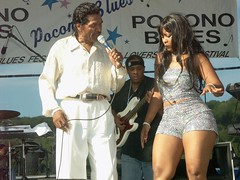
Big Pre-Memorial Weekend Blues Festival takes place at Lamont's at 440 Livinston Road, PoMonkey (or Indian Head in Charles County) Maryland, Saturday May 26. Music starts with Jim Bennett & Lady Mary followed by Big G coming all the way from Richmond. Then DC's legendary Bobby Parker is up with The Blues Night Band, followed by Chick Willis who will play with your poodle and also do "Stoop Down Baby, but insofar as he is playing with Jacques Johnson, one should expect some Albert King tributes and the saxman maybe will do his "Root Doctor." Finally Bobby Rush, appearing at Lamont's for the 1st time who certainly get the crowd really going. Hey the show is on the picnic grounds (unless weather forces it inside) and will end around sunset with an afterparty going on afterwards. So you can spend a day at one of the best lineups in this area and still go out and catch some more blues wherever you want to.
The phone number for Lamont's is (301) 283-0225

Arthur Williams' Tough Blues Harp

Here is a review from 1999 of a neglected but fine downhome harp blues gentleman which will have additional interest because of Boo Boo Davis' vocals who has become really well known with his Black & Tan releases.

Arthur Williams
Harpin’ On It
Fedora Records

Mississippi-born harmonica ace and blues vocalist Arthur Williams was associated with the late Frank Frost and played on Frost’s recordings for the Jewel label. After relocating in St. Louis in 1972, he became a part of that city’s under-recognized blues scene plying with the likes of Tommy Bankhead and Big Bad Smitty. Fedora has just issued his first album, Harpin on It, which provides some choice performances of what he calls “Mississippi Blues with Chicago Drive.” He is backed here by a small band that includes James ‘Boo Boo’ Davis on drums, pianist Bob Lohr , guitarist Jimmy Lee Kennert and bassist Charles ‘Nephew’ Davis. Williams shares the vocals with drummer “Boo Boo” Davis, with Williams covering Jimmy Reed’s Can’t Stand to See You Go, Mercy Dee Walton’s One Room Country Shack, and J.B. Lenoir’s Mama Talk to Your Daughter, while Davis handled originals like Ain’t Going Back to East St. Louis and Talkin’ Too Much. The title track is a Little Walter flavored instrumental which I believe was originally recorded as a harp duet with Frost for Jewel. While Williams sings quite well, when Davis handles the vocals, the music gets a bit more raucous. One can understand that people were talking about how they turned the tent stage at the recent Poconos Blues Festival into a juke joint. While the album never gets that rowdy, one can get a sense of just how these musicians can get a good time rocking and a rolling. Fans of downhome blues sounds will certainly find much to enjoy here.

Post review note - Arthur Williams has another Fedora release, Ain't Goin' Down and Midnight Blue, which is on Rooster Blues. He is part of the The Jelly Roll All-Stars who have an excellent Severn release, Must Be Jelly.

Thursday, April 26, 2007

Jimmy Burns Lively Live at B.L.U.E.S. CD-DVD


Here is a review I recently wrote for a couple of publications. I made a minor change in what may have been published elsewhere to clarify a point about two songs on the DVD not on the CD

Younger brother of the veteran bluesman Eddie Burns, the Mississippi-born bluesman has distinguished his modern Chicago blues with some tastefully integrated soul accents. His latest Delmark disc (and DVD) is Live at B.L.U.E.S., the celebrated Chicago club. With his solid band of second guitar, Tony Palmer; Greg McDaniel, bass; and James Carter, drums, Burns launches his live set with what is perhaps his signature song, Leaving Here Walking, with striking guitar and his vocal of leaving and going back to his woman back in Mississippi. Its a crisply delivered performance with a solid solo as well. Mixing in other Burns originals like Better Know What You’re Doing and Miss Annie Lou with fresh, interesting reworkings of Little Walter’s Can’t Hold Out Much Longer, and Elmore James’ Wild About You, Baby, Burns showcases his aching, soulful singing with fine playing. Perhaps a few songs go on a bit too long and some solos are more jams over a bass vamp, but this is a live performance after all and is representative of the solid performances by Burns that this writer has seen. A bonus is a guest appearance by Jesse Fortune who is terrific on Lowell Fulson’s Three O’Clock Blues which is mis-attributed to B.B. King. There is nearly 70 minutes on the CD and the DVD has an additional two songs for 80 minutes. I have never been the B.L.U.E.S. and wonder if the room is a narrow room with a somewhat small stage as many of the camera angles of the performers are directed upward at the faces or instruments of Burns and band members and not many at eye level and less crowd shots say than the wonderful videos of Mississippi Heat and Tail Dragger. Still the additional songs are not filler and could have been interchanged with some of the songs on the CD without changing the quality of the cd. Thanks Delmark for another solid CD/DVD release.

Thursday, April 19, 2007

Haywood 'Little Sonny' Warner 1930-2007


00740028
Originally uploaded by NoVARon.
I already have expressed my appreciation for the late Little Sonny Warner, but felt it useful to place a lengthier obituary for this wonderful singer and person.

Haywood, ‘Little Sonny’ Warner, one of the greatest blues artists to emerge from the Washington DC music scene passed away on April 12, 2007 from the effects of prostate cancer. Warner, born October 30, 1930, grew up in Falls Church, Virginia on Shreve Road, behind what was then Peacock Buick. As a teen he was part of a gospel group "The Four Sons" who sang at the Second Baptist Church in Falls Church. This was the beginning of his lengthy musical career. This group went up to New York and as the Rockets, backed legendary Atlantic Records session pianist Van Walls on Walls' single releases, "After Midnight" and "Open the Door."

Sonny became part of the DC music scene, singing at various area clubs while holding down a day job. In the mid 1950s he became valet for the legendary Lloyd Price in Prices’ touring band who had established the Washington DC based KRC label with Harold Logan and Bill Boskent. Being a valet also included some part-time vocal duties, Initially he shared duties with Price’s cousin, Larry Williams but Specialty Records' Art Rupe got Williams to sign with Specialty and start on his own career. Warner wasn’t unhappy, telling blues scholar Larry Benicewicz ““You see, Larry was also a hairdresser, which gave him an advantage, because Lloyd would always want to look good for his public. I could never compete with that.”

Benicewicz noted that Warner tired of Price’s grueling road itinerary and returned to the Washington area where still popular as a local entertainer he began hanging out at various clubs, including the legendary Maryland venue, where he would sit in with the locals. he recalled to Benicewicz, ““I met Jay McNeely at a place called Evan’s Grill in Forrestville, MD, and his singer wasn’t doin’ nothin. The crowd egged me to go on, so I got Jay to agree. I never saw that vocalist again.” Jay asked Sonny to go on the road with him and a few months later he Sonny left his day job and small local gigs behind to join McNeely in Seattle where Big Jay was based. He fronted McNeely’s Band, scoring with his Ray Charles influenced vocals. In Seattle, they were recorded at the Birdland club which McNeely later issued on his Swingin’ label (and this is available today on Collectables) which mixed a number of wild instrumentals showcasing McNeely’s honking tenor sax along with Warner’s soulful singing which included an early version of “There is Something on Your Mind.”

Big Jay’s recording of “There is Something on Your Mind” with Little Sonny’s vocal was the big moment in Sonny’s career, with the record going gold. The record, issued on the Swingin' label of Hunter Hancock, Roger Davenport and McNeely became a major R&B smash in 1959, even reaching #44 on the Pop Top 100. Sonny’s wonderful delivery of the lyrics and his ad-lib scatting towards the vocal’s end is still appealing almost five decades later. It was a classic recording of a terrific song and has been covered by numerous performers including Bobby Marchan, James Cotton, Kenny Neal, Professor Longhair and B.B. King. Over the next couple years, several more singles, some simply instrumentals, were waxed by McNeely and band but none reached the success of the song that took Big Jay, Little Sonny and band across the country playing some of the great venous and sharing the stage with other R&B giants.
Eventually, Sonny left McNeely and returned to the Washington DC area. He was able to hook up with Bill Boskent who Sonny would have gotten to know when he was with Lloyd Price because Boskent was Price’s road manager. Larry Benicewicz notes that Boskent recorded Sonny producing a pop flavored ballad “Wallflower” backed by the bouncy “That’s For Me” (both Boskent compositions) for the first Bee Bee (for Bill Boskent) release in 1961, and two more sides (duets with Marie Allen) in 1962. Benicewicz stated the recordings had an impact in the Mid-Atlantic region, but did not break out as had been hoped. Then Boskent recorded Warner for a band new Lloyd Price enterprise, Concertone records, but again the recording did not meet expectations. Later in 1966, Sonny recorded what was possibly his best know post-Big Jay recording, the single “Bell Bottom Blue Jeans” and Been So Long,” which was produced by Ted Bodner. The former tune remained a staple of his repertoire until the end.

Over the next few decades, Sonny continued to perform, being one of the most highly regarded artists in the region. He evoked Ray Charles as he sang blues and soul songs, and was always backed by a crack band. He continued to play the top venues in the region, and when Lamont's opened in 1990, was its opening act. He performed at The Taste of DC and twice was featured at the DC Blues Festival (1992 and 1998) where he captured his audience with his singing and his stage presence, being a whirling dervish on the stage. And as former DC Blues Society President Bob Gray would say, no one could sing “There is Something on Your Mind” like Sonny Warner could.

One highlight of recent years was being reunited with Big Jay McNeely at the August 1997, Hot August Blues event in Monkton, Maryland. It may have been the only time since he split from McNeely in the early sixties that the two shared the stage together. Brad Selko, who with his late wife Marcia, produced the event, mentioned that people still tell him that Sonny’s performance that day was among the most memorable shows they had ever seen. This writer also remembers Sonny as one of the acts at the 2000 Gator Blues Festival at Lamont’s where he left the stage to wade into the enthusiastic crowd.

Sonny continued performing, but slowed down his pace. He was discovered by Falls Church community activist David Eckert. Eckert, who had worked vigorously to recover the civil rights legacy of the Falls Church area, earlier helped the region appreciate the role of Piedmont Blues pioneer John Jackson. Eckert helped arrange performances for Sonny at the City’s First Friday celebration, the annual Tinner Hill Festival (a celebration of the first rural NAACP chapter in Virginia) and at the City of Falls Church’s"Concerts in the Park" series held Falls Church's Cherry Hill Park.

In more recent years Sonny endured some health ailments. He was diagnosed with prostate cancer and received treatment and slowed down his performances. Some of his last performances were as part of a revue, The DC Allstars that included Pookie Hudson & the Spaniels, The Jewels, The Velons, The Orioles, Skip Mahoney & the Casuals, and The Winstons. Still the health problems limited his ability to perform. When Big Jay called Sonny to join him in Italy to help Jay celebrate his 80th Birthday, Sonny was unable to join his fellow legend.

I happened upon Sonny and his wife Catherine on several occasions the past couple years, and it would always bring a smile just to chat with him. Even when last summer at a Safeway parking lot, when he told me his was undergoing chemo for the prostate cancer, he still had the infectious smile and optimism about the future. Sonny was as nice a person as he was one of the finest blues singers ever to come out of Washington. And he was so good that if there is ever a DC Blues Hall of Fame, he will be one of the charter members.

Sonny was survived by his wife, Catherine, seven children and two stepchildren; sister Jessie Mae Simmons and brother, Joseph Hunter; 13 grandchildren, 12 great-grandchildren, eight sisters-in-law, six brothers-in-law, numerous nieces and nephews, other relatives and many friends. To his family we extend our condolences.

Monday, April 16, 2007

Chicago's Blues Queen Goes Old School


Its been several years since Koko Taylor has had a new album. This is remedied by the new Alligator release, The Old School. As the title suggests, the recording is directed to hard-hitting, old-school Chicago blues and includes five interpretations (most definitely not copies) of older songs along with some originals that Chicago’s Blues Queen handles in her own hold-nothing back style. One track is by The Blues Machine, and the other eleven tracks have a studio band led by Criss Johnson and drummer Willie ‘The Touch’ Sutton and guest appearances from Bob Margolin, Billy Branch an Kaz Kazanoff. Most of the new tunes are from Koko and Gonna Buy Me a Mule is a striking song as she tells her man she’s gonna take the place of him and the jaunty warning You Better Watch Your Step, with Billy Branch (excellent throughout) playing some Jimmy Reed inspired harp. Bob Margolin adds slide guitar to Memphis Minnie’s Black Rat, and Lefty Dizz’s Bad Avenue. The arrangements of both tunes are a bit cluttered and the performances come off as too hectic. Criss Johnson who did the arrangements on this album, would have done well to have listened to Koko’s first Alligator album, I Got What It Takes, and have allowed more spaces in the backing, and not have come across overbearing like so much recent Chicago styled blues of the past few decades. I have no fault with Koko’s performances as she sings really well here sounding so at home with the material. Its also nicely programmed with very nice covers of a couple songs associated with Muddy Waters, Don’t Go No Further, and Young Fashioned Ways. Just wish the attempt at being ‘old school’ by the band had a bit more of a lighter, swinging groove than they play with here. If I was giving this stars, 4 1/2 to Koko and 3 for the backing, or overall 4 stars.

Saturday, April 14, 2007

Little Sonny Warner Remembered


Haywood 'Little Sonny' Warner passed on Thursday, April 12, 2007. The Falls Church native was one of the finest blues singers in the DC area. As part of a vocal group he first recorded for Atlantic as a teenager and then served as the valet for Lloyd Price for a period. One night at Evans Grille in Forestville MD, he jumped on stage when Big Jay McNeely was performing. McNeely asked Sonny to join him and a few months later he flew out to the West Coast to be part of McNeely's show, scoring with his Ray Charles influenced vocals. The big moment was Sonny's vocal on the classic There is Something on Your Mind. The record went gold. After a couple more years Sonny left Big jay and returned to the Washington DC area recording a handful of singles but one of the top acts on the local R&B circuit. His performances at the DC Blues Festival, Lamont's or the July 2003 Falls Church Parks show, from which these photos were taken, were always memorable. If there is ever a DC Blues Hall of Fame, he will be one of the charter members.

For more images from the July 2003 show check Sonny Warner-July 2003

For some images scanned from prints of the August 1997 show with Big Jay check Big Jay & Little Sonny

I thank Eric LeBlanc for forwarding the Washington Post's death notice which enabled me to correct the date from the 13th. Catherine, Sonny's widow, called me Saturday morning and that's where I found out about him passing.

Thursday, April 12, 2007

New Orleans 1960


In 1960, noted photographer William Claxton and German musicologist Joachim Berendt travelled the United States to document the American Art Form. The massive coffee table book JazzLife was published by Taschen and available in a regular edition which lists for $200 or a deluxe edition with prints and an audio CD for over $1000. It is a 700 page book and weighs over 17 pounds. Did I say coffee table book, the book itself might serve as a coffee table. Ok enough for the poor attempts at humor.

From JazzLife, Taschen has published the portion devoted to the New Orleans, New Orleans 1960, which is a more manageable 191 pages and has pertinent text portions to explain their trip across the United States and their experiences in the Crescent City and also Angola Penitentiary. It is dedicated to the many souls who lost their lives and the survivors who are rebuilding the city.

The selling point for this are the stunning photos of Claxton, who is probably best known for his iconic images of James Dean and Chet Baker. There are many striking images here, mostly of traditional jazz performers including the Eureka Brass Band, the Tuxedo Brass Band, the marvelous clarinet player George Lewis (and one of a marvelous one of Lewis' wife and Lewis 100 + year old mother), Nick LaRocca (who they recall was still claiming to have invented jazz), drummer Paul Barbarin, blues singer Lizzie Miles, trombonist Jim Robinson, Lewis Keppard and so many others. There are a couple images of a picnic in Slidell where Snooks Eaglin and band are seen playing on a truck bed, as well as a marvelous image of the Melvin Lastie Quintet (which included at the time drummer Charles ' Honeyboy' Otis), one of the few representations of modern jazz that they captured. A series of images here also follow a funeral to the cemetery and then back witnessing the second line exploding on the way back. The section on Angola includes marvelous images of Hoagman Maxey and Roosevelt Charles.

Text is presented in English, French and German and certainly helps the appreciation of the marvelous images. Certainly this will appeal to lovers of traditional jazz and the Cresent City.

Wednesday, April 11, 2007

Floored by the Thunderbolt of the Middle West

Brother Joe May
Thunderbolt Of The Middle West
Specialty

The first time I heard this Brother Joe May Specialty album, (reviewed in Jazz & Blues Report in the November 1993 issue) I was overwhelmed. Here was as powerful a singer as I had heard and if not religious, I could not help but be impressed by the fervor as well as his power in the performances. Concord has acquired Fantasy (and Specialty) and this CD is still in print and should be readily available.


Fantasy Records not only has a fine series of reissues from the Specialty rhythm and blues catalog, but also the equally invaluable Legends of Specialty Gospel series. Space limitations prevents as extensive coverage of all these releases that they deserve. One recent release in particular stands out with one of the most remarkable singers of any genre that America has ever heard. Thunderbolt of the Middle West spotlights Brother Joe May, with guest appearances by Sister Wyonna Carr, the Pilgrim Travelers, and, on the live recording of Old Ship of Zion that opens this collection, Charles Brown on organ and the Sallie Martin Singers. It isn't simply his range, it is, as the annotators state, his uncanny sense of dynamics and vocal projection that leave their mark on the listener. His vocals go from a gentle recitation to a soaring affirmation of his beliefs that make his renditions of Thomas Dorsey's How Much More of Life's Burden Can We Bear or I'm Gonna Live the Life I Sing About in My Song, so compelling. In addition to his powerful singing, there are also a dozen or so songs from the late gospel composer. Brother Joe May was firmly committed to gospel music, and resisted efforts to have him make secular recordings. If he had crossed over, he would have been one of the rhythm'n'blues artists recently honored with a stamp by the postal service.

Sunday, April 08, 2007

Snooks Eaglin Live


Has it been Ten Years since Black Top issued Snnoks Eaglin's Live in Japan. A poorly distributed studio album of Snooks had been issued after this, but its amazing that such a striking talent as Mr. Eaglin has not been in the studio in about a decade to present his highly idiosyncratic music.

Here is a review of this album that appeared in Jazz & Blues Report when it was issued.

A new Snooks Eaglin album is cause for celebration enough, but Eaglin’s new Black Top album also marks the return of the Black Top label that had been in hiatus since severing ties with its previous distributor. Live in Japan was recorded during Eaglin’s first Japanese tour, and he is backed by bassist George Porter’s trio (John Autin on keyboards and Jeffrey ‘Jellybean’ Alexander on drums). He gets to reprise songs he has recorded over the years with a few new surprises in terms of material. Eaglin is an exceptional guitarist, often referred to as the Professor Longhair of the guitar with a very individualistic, highly rhythmic instrumental chicken scratching attack, as well as being a fountainhead of material that lead some to call him a human jukebox. Whatever. The man is a dazzling and very effective guitarist. After opening with a Bill Doggett instrumental, Eaglin gets the second line groove going with I Went to the Mardi Gras, that he co-authored with Tommy Ridgely, followed by Earl King’s Soul Train, a superb soul dance number with a solo that is deceptively simple. Then there’s Don’t Take It So Hard, a swamp pop flavored blues ballad. Classic New Orleans is reprised in renditions of Fats Domino’s Josephine and Smiley Lewis’ Down Yonder (We Go Ballin’) and Lillie Mae. It’s interesting to hear Eaglin introduce Down Yonder, telling the Japanese audience he played on Smiley’s original recording. Eaglin is most effective as a singer on laments like Nine Pound Steel, while his guitar’s vocalizations during the solos serves to remind us of why the blues guitar is often referred to as the singer’s other voice. Covers of the Isley Brother’s It’s Your Thing, and Stevie Wonder’s (Boogie On) Reggae Woman get a nice funky groove going. A strong vocal is also given Jessie Mae Robinson’s Black Night.

This serves as a splendid sampler of Eaglin’s music, illustrating his depth as a performer and guitarist, although his skills as a bop guitarist is only hinted at. Snooks Eaglin is an American original, but one probably has a better chance of seeing Snooks in Japan than in the US outside of New Orleans. Well, at least you don’t have to go to Japan to get this album.

Cleanhead's Blues


Among its recent releases, Delmark has just re-reissued Kidney Stew is Fine by Eddie 'Cleanhead Vinson. Originally issued on the French Black and Blue label, the disc has the shouter-alto saxophonist with an all star band that included Jay McShann on piano, T-Bone Walker on guitar and tenor saxophonist Hal ‘Cornbread’ Singer. Its a good mix of classic songs that Cleanhead made famous like the title track, Somebody’s Sure Got to Go, Juice Head Baby, Big Bill’s Just a Dream and Old Maid Boogie, along with Joe Turner’s Wee Wee Baby, Percy Mayfield’s Please Send Me Someone to Love, and Duke Ellington’s Thing's Ain't What They Used To Be. Vinson is in terrific form both vocally and instrumentally and the band swings wonderfully for a most enjoyable session that is welcome to be readily available.

As a postnote to this review, I note that when I first came across the various Black and Blue releases on vinyl in the 70s and early 80s I generally found the jazz releases (and this was one that was originally more oriented towards jazz audiences) was generally more satsisfying than the blues releases. In part it may have been because the bands were tighter and could handle the material, even if not fresh, with an authority that many of the label's blues releases could not quite achieve without sounding generic.

Incidentally, amazon still (3/23/08) shows the 1994 Delmark CD cover of this release on its website. I corrected this posting on 3/23/08

Monday, March 26, 2007

Interesting take on recent Jazz Reissues

Tim Niland on his blog, Jazz & Blues Music Reviews has a very interest take on The Keepnews Collection of Jazz Reissues that Concord Music has started issuing. These are reissues of discs that Orrin Keepnews had produced and many include alternate takes and new liner notes. Keepnews himself includes some commentary that Tim does characterize as "a little self-reverential." He does raise the issue of the producer (or engineer as in the case of the many recent Rudy van Gelder reissues) receiving co-billing with the performers. "But do they deserve co-billing with the musicians on these CDs? They did not in most cases compose songs or perform on instruments, but as a result of their longevity they are honored as if they were performers." More provokingly he comments, "Keepnews and Van Gelder certainly deserve their place in jazz history, but giving them equal billing with the musicians on classic albums seems a little bit much." This is concise and thought-provoking.
Here is a link to this specific blog entry, Revisionist History

Photographic Blog on Jazz 101 on Sale

A really wonderful and thought provoking writer on photgraphy (and a terrific photographer himself) Mike Johnston recently had a nice entry of the itunes Jazz 101 on Sale on his blog, theonlinephotographer. It includes some interesting discussion as well. Mike's blog entry - Riches in Store. Given that these are priced below what itunes usually charges, there are some gems you cannot go wrong with.

One interesting quote: "A Love Supreme is many peoples' first Coltrane record, which is unfortunate because it then becomes their last. Not that it's not a great record, but it should be peoples' eighth or tenth Coltrane CD, and their 200th jazz recording rather than their second*.)"

Wednesday, March 14, 2007

Sonny Rollins in London

A recent visit to the website of Sonny Rollins revealed that he has available for download four selections from a 1965 performance at London's Ronnie Scott club.

An email I received from Bret Primack, who is webmaster for sonnyrollins.com, noted:

"When Sonny appeared at Ronnie Scott's for one month in January of 1965, he was secretly recorded by someone in the audience.

"Those tapes have been shared by collectors globally, but last year they were released, without Sonny's permission, by a London based record label. All efforts to contact the label have proven fruitless, so instead, Sonny decided to release the music himself.

"Although these tracks are not digitally recorded, they do offer documentation of truly remarkable music. Some of the performances run half an hour and capture Sonny live in a way he's rarely heard on recordings."

In upcoming months additional tracks will be made available for download.

Monday, March 12, 2007

Dying Crapshooter's Blues

THE DYING CRAPSHOOTER’S BLUES
By David Fulmer
HARCOURT 2007
Atlanta based writer David Fulmer authored three acclaimed historical mysteries involving the Creole of Color detective Valentin St. Cyr set in New Orleans at the beginning of the 20th Century, and among the characters were such legendary jazz pioneers as Buddy Bolden and Jelly Roll Morton. Fulmer’s writing was atmospheric as well as thrilling as he skillfully weaved together the actual mystery against a background of Storyville and its musicians, madams, streetwalkers and associated characters.

Fulmer’s latest novel, The Dying Crapshooter’s Blues takes us to Atlanta of the mid-twenties and is inspired by the Blind Willie McTell song that the book takes its title from. McTell told Edward Rhodes, who recorded him in 1956, that the song was based on the shooting of Jesse Williams, a gambler that was shot on Courtland Street; and after McTell took him home, sick from the shot, he requested that McTell play the song over his grave.

From this simple premise, Fulmer weaves together the killing of Little Jesse Williams and a heist of a cache of jewels from a mansion of one of Atlanta’s leading citizens into a compelling story anchored around the efforts of Joe Rose, a rambler, gambler and thief, to find out why Little Jesse was shot and who stole the cache of jewels and how can they get returned. The dying Little Jesse and Blind Willie, who composes the song (as the story unfolds) both press Rose, a former policeman and Pinkerton, to help find out why Little Jesse was shot, even though the gambler does not help by not talking about what happened.

A black-hearted, power-hungry police officer, “The Captain,” who did not receive his expected promotion with the election of a new Mayor, presses Rose on solving the jewel heist with threats to him and the beauty Pearl Spencer if he isn’t successful. With more bodies turning up, Fulmer also weaves in Columbia Records coming to Atlanta and a fictional recreation of Blind Willie McTell’s first recording session. This book has the same virtues of the Valentin St. Cyr novels and I found this easy reading which did get compelling. I had to finish this before I went to sleep.

Even more so than the St. Cyr books, Fulmer weaves the musical threads as an indispensable element of the narrative as a whole, and if Blind Willie McTell is a secondarycharacter here (to Joe Rose), Fulmer presents us with a fictional McTell that comes across as a real person as opposed to say the highly mythologized romanticism of say Robert Johnson that has appeared in some blues fiction in which Johnson is a character.

If you want a good mystery, read and love jazz and blues, you won’t go wrong with David Fulmer, especially this excellent novel.

Ron Weinstock

This review originally appeared in Jazz & Blues Report, Issue 291.
www.jazz-blues.com

Thursday, March 08, 2007

Farewell Paul deLay


Word has been filtering to the blues community that the multi-talented Paul deLay passed away from Leukemia. deLay had performed last weekend, and went into a Portland Hospital on Sunday when what was thought to be acute bronchitis turned out to be acute, end term Leukemia. On Tuesday he fell into a coma and died Wednesday, March 7.

deLay was a innovative blues harmonica player who incorporated jazz influences into his style. While a virtuouso, hi playing demonstrated a subtlety in his solos that eschewed simple crowd pleasing gimmicks. He also was a strong songwriter and vocalist with a soulful sound. He was also backed by a terrific band.

In the earlier part of his career, substance abuse hampered his career. After serving time for drug trafficking, he cleaned up and his career was rejuvenated producing several excellent albums including Ocean of Tears and Heavy Rotation for Evidence. I had the pleasure to hear him perform and meet him and he was a fabulous artist as well as a wonderful person. He will be missed.

Saturday, March 03, 2007

Farewell Crown Prince Waterford

Word arrived over a month later that Rev. Solomon Charles "Crown Prince" Waterford passed away at the age of 90 on February 1. The Oklahoma City native began a recording career (I believe with Jay McShann) and recorded for Capital, Mercury and King Records and composed over thirty blues compositions. A terrific shouter in the vein of Walter Brown and Jimmy Witherspoon his earliest recordings have been compiled on the Classics label, In more recent years he moved to the Jacksonville Florida area where he served a a minister. In 2002 he had his first recordings in decades, All Over But the Shoutin' for Cypress Records.

This info taken from his myspace page, link.

In a description of the CD by Geechie Smith & Crown Prince Waterford - Swingin KC Combos on Blue Moon on www.bluebeatmusic.com has some stuff inconsistent with the above, sayig he was born Charles, born in Jonesboro, Arkanasas and sang in bands that included Andy Kirk and the Clouds of Joy (with Charlie Christian and Abe Bolar) before beginning his career as the Crown Prince of the Blues in Chicgao during the 1940s and started recording for hy-Tone and Aladdin in addition to Capitol. Here is the pertinent link.