Showing posts with label Electro-Fi Records. Show all posts

Thursday, February 06, 2020

Mark Hummel Way Back Machine

Mark Hummel
Way Back Machine
Electro-Fi Records

This is the latest recording in Mark Hummel's quite distinguished 35-odd year career with over 33 recordings, including several documenting his Blues Harmonica Blowouts. A substantial portion of this new release documents his relationship with The Deep Basement Shakers, who specialize in primal, joint-rockin', barrelhouse blues n' boogie. This East Bay Duo is Aaron Hammerman on piano and guitar and Dave Eagle on percussion, washboard/spoons/train whistles/animal calls/etc. Other playing on this include Kid Andersen on bass, Billy Flynn and Rusty Zinn on guitar, and Alex Pettersen on drums. Joe Beard adds guitar and vocals to three selections.

This recording focuses on the blues that pre-dated the electrified Chicago blues of the post-World War II era, along with a few choice originals. On this recording, Hummel sings with his usual authority, although his harmonica playing on this album is more in the vein of John Lee 'Sonny Boy I' Williamson than Little Walter. The band captures an easy rocking swing while guitarist Flynn (heard on most of this) is typically excellent as he channels Willie Lacey and Big Bill Broonzy.

Standout tracks include the topical original from RW Grigsby "Flim Flam," about the scammers in the world; Baby Boy Warren's "Hello Stranger"; Tampa Red's "So Much Trouble"; "Play With Your Poodle"; and Sonny Boy Williamson 1's "Cut That Out," which some may know from Junior Wells' recording. "Road Dog", with just the Barrelhouse Shakers is an imaginative skiffle style blues et to the medley of "Sloppy Drunk." Percussionist Eagle I found goes a bit over the top here and a couple of places elsewhere (including a rendition of Blind Boy Fuller's "Rag Mama Rag" and the instrumental "Breathtaking Blues," which is rooted in "Saint James Infirmary"). Hammerman, however, is a reliable, straight-forward pianist. Still, with solid blues performances like Robert Nighthawk's "Pepper Mama," and Jazz Gillum's "Gillum's Windy Blues," there is much to delight listeners. The latter number displays Hummel's ability to capture the reedy harmonica style of Gillum, with Flynn's sparkling guitar, a feature of an overall skiffle blues styled performance.

The three selections with Joe Beard's delta-rooted vocals are highlights here. With Kid Anderson on bass and Alex Pettersen on drums, Beard turns a sterling cover of Eddie Boyd's "Five Long Years," with a simple groove and terrific harmonica. Hummel contributed an original, "Say You Will," that Beard turns into a droning blues in the manner of early John Lee Hooker. A lively rendition of "Mean Old Frisco," provides a close to this album of first-rate performances of older blues gems mixed with a few choice originals.

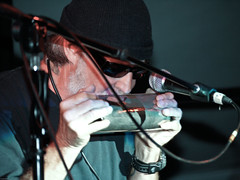
I received my review copy from a publicist. Here is Mark performing as part of a Little Walter tribute band at last year's Calgary Blues Festival.

Sunday, December 01, 2019

Mark Hummel Ain’t Easy No More

Mark Hummel
Ain’t Easy No More
Electro-Fi Records

West Coast harmonica wizard Mark Hummel has been increasing his visibility with his annual blues harmonica packages, which have brought together a number of harmonica legends and led to several outstanding CDs documenting the tours. The shows are anchored around Hummel and his fine band of guitarist Charlie Wheal, bassist Steve Wolf and drummer Marty Dodson. Electro-Fi has just issued Hummel’s third album for the label, which will certainly delight his fans and blues harp fans as well.

With a mixture of Hummel’s originals and some choice rearrangements of previously recorded blues, Hummel impresses most as a harp player and his band (augmented by horns on several tracks) is terrific supporting him. Hummel also writes some strong originals, including the topical "Big Easy (Ain’t Easy No More)," based on his reaction to the aftermath of Hurricane Katrina. Hummel is a pleasant vocalist but his delivery does not match the outrage of the lyrics here nor does he have the forcefulness to be completely convincing on Muddy Waters’ "i."

But on other tracks, his delivery works better and there is really little to fault whether listening to his reworking of a Ray Charles jump blues "Get on the Right Track," or a couple of fine Eddie Boyd songs, "You Got to Reap" and "Blues is Here to Stay." Harp features include his originals "Harpoventilating," and "Bird Brain," and Little Sonny’s "The Creeper Returns," all of which showcase his driving, full-bodied playing.

Overall quite a fine album and my quibbles about his vocals on a couple tracks should not be taken too far as his vocals are easy to take. Recommended highly.

I likely received my review copy from a publicist. This review originally appeared in the October 2006 Jazz & Blues Report (Issue 287). Here is a video of Mark Hummel and the Blues Survivors.


Tuesday, August 20, 2019

Fruteland Jackson Good As Your Last Dollar

Fruteland Jackson
Good As Your Last Dollar
Electro-Fi

Blues advocate, educator and acoustic blues artist Fruteland Jackson returns with this new album. He is heard singing as well playing acoustic guitar, National Resonator guitar, and mandolin. Fruteland is supported by Harrison Kennedy, who supplies backing vocals on three selections; guitarist Jack de Keyzer; pianist Julian Fauth; bassist Alex Fraser and drummer Bucky Berger. These four also provide backing vocals where heard.

There are some interpretations of classic blues as well as original, sometimes topical songs. Discussing the title track, Fruteland says "I learned during the Great Recession, that no matter how long you've had a relationship with a utility or cable company, if you are late or unable to pay, you become only as "Good As Your Last Dollar." Nothing more, nothing less. Living through the Great Recession was a time of Economic and Psychological depression. For some an unscripted test of survival." The songs and the performances resonate with Fruteland having lived much of the music.

It has been several years since Fruteland's last recording. It has been worth the wait as he sings with authority, while forcefully playing resonator slide guitar on "Two Steps To Hell." It is a blues about the hard times while also being two steps to hell and one step from his baby's door. The delta blues approach of that number contrasts to the small group backing (Fauth's piano is impressive too to the gospel performance of "Death Creep." Here there is a blend of fingerstyle guitar and slide guitar, and an uncredited harmonica player (Harrison Kennedy?). The title track is a haunting performance as he remembers when one's word was bond, but now cash in hand beats a payment plan. Fruteland's interpretation of "Careless Love" uses a fresh arrangement for a heartfelt vocal. Harrison Kennedy adds vocal asides on a standout performance.

Fruteland observes that "It's odd isn't it that so many Blues songs are written about a spouse or lover breaking one's heart, while so few Blues songs are written about our parents." "All the Daddy I Had," set against a Muddy Waters styled backing is a song about a father breaking his heart. It is a moving performance with Fruteland wondering if Daddy loved Fruteland recalling that his daddy never said a kind word to Fruteland. "All Pain No Gain." is another engaging performance as he sings of trying to survive during a bad economy. "Damaged Goods" is a relaxed shuffle about having his heart and self broken by an ex, but noting that we are all damaged goods. Also of note is Fruteland's performance of "Love in Vain," where he pays tribute to Robert Johnson and playing original instrumental touches as well as a terrific vocal. Again there is some fine harmonica heard here.

"Good As Your Last Dollar" is a gem of acoustic blues with compelling performances of intriguing original blues songs and fresh, choice interpretations of classic blues songs. It has been way too long since Fruteland Jackson's last album, and this is a more than welcome addition to his body of recordings.

I received a digital download from Fruteland Jackson. Here is Fruteland performing "Midnight Special."


Friday, April 22, 2016

Golden State Lone Star Blues Revue

The eponymously titled Electro-Fi album by the Golden State Lone Star Blues Revue brings together singer and harmonica player Mark Hummel with guitarists Little Charlie Baty and Anson Funderburgh, R.W. Grisby on bass and Wes Starr on drums. They are friends although only some have played together prior to this revue. They are joined by Jim Pugh on keyboards, along with saxophonists Eric Spaulding and Jack Sanford for this recording that Chris "Kid" Andersen recorded at his Greaseland Studios.

Its a terrific set of all blues with any lumpy or rocky filler that contains a mix of interpretations of  lesser known blues gems along with originals penned by Hummel. Hummel has been and remains a real good vocalist and here this starts with the opening rendition of Gatemouth Brown's "Midnight Hour." In addition to Hummerl's vocal there is  plenty of slashing guitar by Baty and Funderburgh, both of whom delight with their contrasting styles. Hummel plays harp on Billy Boy Arnold's "Here's My Picture," followed by Hummel's original shuffle "Prove It To Me" with some greasy fafisa sounding organ and terrific guitar (I suspect from Charlie Baty). Hummel's moody "Cool to Be Your Fool," with backing from just piano and rhythm, borrows the "Sittin' on Top of the World" melody.

Lowell Fulson's "Check Yourself" takes listeners  into a jump blues vein with Hummel taking a harp solo followed by some blistering playing (likely from Funderburgh). Baty trades fours with Hummel's harp in the relaxed rendition of Mose Allison's "Stop This World," with Pugh terrific again. An older Jimmy McCracklin tune "Take a Chance," takes us uptown on a rocking number that sounds like it would have if Junior Parker had done it. "Walking With Mr. Lee" is a terrific feature for Hummel's harp, while the Grisby penned "Detroit Blues," is a nice lazy Jimmy Reed-style shuffle. Among the other selections is a solid cover of J.B. Hutto's "Dim Lights" if Hummel can't match the fervor of Hutto, it still has terrific slide guitar.

This is a terrific revue and reports of their shows seems consistent with the music here. The performances are marvelously performed and backed by an excellent rhythm section. Fans of real deal blues are in for a treat with this gem.

I received my copy from a publicist. Here is a recent performance by them.

Wednesday, April 23, 2014

Rip Lee Pryor - Nobody But Me

There is nothing fancy about the new CD by Rip Lee Pryor, Nobody But Me (Electro-Fi). Pryor is the son of the late blues legend and blues harmonica pioneer, Snooky Pryor, but started learning to play harmonica when his father had dropped out of music. He played with his dad for a time, but in recent years had walked away from music, and recently resumed after bouts with gambling problems and cancer (now in remission). On this Rip Lee plays harmonica (using a rack) and guitar with Alex Fraser or Bucky Berger adding drums on several selections.

His father and John Lee Williamson (the first Sonny Boy Williamson) are obvious influences on his playing especially on the opening Shake Your Boogie that both Sonny Boy I and Snooky recorded. His guitar playing is pretty bare, just laying down a bare bass riff on most selections over which he sings and plays his crying harmonica. He is a very expressive singer (like his take on Elmore James’ You Gotta Move, but also handles the humor of Rice Miller’s rendition of an old English folk song, the delightful Wake Up Baby, with Fraser’s bass and circus drum adding support.

The title track is an original with Rip Lee laying down some boogie guitar to get a rocking groove which underlies his driving harp solo. Another original Lonesome, is a moody slow blues with some strong harp to accent his pleading vocal. Heard The News, credited to Snooky, is an easy boogie shuffle that incorporates Good Rocking Tonight, I Feel So Good as well as Snooky’s own Boogie Twist. Stuck on Stupid is a Rip Lee original with a Jimmy Reed boogie groove. His father’s Pitch a Boogie Woogie has Berger’s drums which helps propel the easy rocking boogie performance here with some real fine harmonica here.

The music here is pretty straight-forward and as Scott Bock observes in his liner notes, Rip Lee has a pretty stripped down sound. Nothing fancy perhaps, but Rip Lee Pryor proves he doesn’t need Nobody But Me for a straight dose of classic Chicago blues that is increasingly rare.

I purchased this.  Here is a video of Rip Lee Pryor in performance and he will be at the Pennsylvania Blues Festival this July and the link is to my Festival preview.


Monday, April 30, 2012

Billy Boy Arnold's Heartfelt Big Bill Broonzy Tribute

The last year and a half saw two books about the great Chicago-based blues artist big Bill Broonzy. Bob Riesman’s I Feel So Good, emerged as the major chronicle of Broonzy’s life, correctly information about his date and place of birth and his development of his musical career. While he made use of archival interviews and other materials, one of his sources was bluesman Billy Boy Arnold was captivated by Broonzy as well as Broonzy’s friend, John Lee ‘Sonny Boy’ Williamson and while Billy Boy wanted to record with Broonzy, Broonzy directed him to musicians more in keeping with the contemporary blues scene.

Now over fifty years after Broonzy’s passing, Billy Boy has recorded a tribute album, Sings Big Bill Broonzy on Electro-Fi. It is produced by Eric Noden who plays acoustic guitar and others supporting Billy Boy are Billy Flynn on electric guitar and mandolin, Beau Sample on acoustic bass and Rick Sherry on washboard, percussion and clarinet. The 15 songs, all written by Broonzy, selected were recorded between the late 1930s and the early 1950s.

Bob Riesman in his liner notes that they attempt to play in the spirit of Broonzy’s work, rather than recreate the recordings. The lack of piano as well as Billy Boy’s harmonica helps to insure that. Arnold’s vocals also do not possess the ebullient quality that Broonzy brought to his recordings (the late John Cephas was one of the few singers of the past few years who had a comparable vocal style), but then again Muddy Waters’ vocals also lacked Broonzy’s good-natured exuberant quality when he recorded his Broonzy tribute shortly after Broonzy’s passing.

There is the lament of Sweet Honey Bee followed by the lively, relaxed swing of Going Back To Arkansas where Sherry contributes washboard and clarinet to help contribute a flavor of some of the Broonzy-Washboard Sam collaborations. Arnold added additional lyrics to the nice slow blues, Girl In The Valley a.k.a. Water Coast Blues, with Sherry again adding washboard while Flynn contributes mandolin in support. Key to the Highway is among the best known songs heard here and done quite strongly with some nice guitar in the backing.

These performances do also highlight Broonzy’s gift at crafting sophisticated songs with irony and wit in his expression of the blues, analogizing to a rooster in Looking Down At Me, or take the voice of a prisoner in Cell No. 13 Blues. The rendition of the former song is done in the fashion that Sonny Boy Williamson might have performed the song with a nice harmonica break. There is the mix of the contemporary and traditional in I Want You By My Side, that adapts the melody of Careless Love, and has a crisp Billy Flynn guitar solo.

The easy swing is also present when Billy Boy sings about Living On Easy Street, where he tells women if you want money get your man on the WPA but if you want good loving you got to do what I say. When I Get To Thinkin’, is nicely reworked and a bit more laid back than the Muddy Waters more emphatic 1960 recording that is a bit more threatening towards his lover. Arnold also provides his own spin to Broonzy’s fanciful It Was Just a Dream with its surrealistic imagery has been revived and reworked by a number of bluesman, most notably the late Louisiana Red, as he sings about waking up in the White House and the President shaking Bill’s hand.

This recording was heralded in Bob Riesman’s Broonzy biography, and its release has met the expectations for it. Today, one might find it hard to appreciate how significant Big Bill was in the history of the blues. Along with Riesman’s book, this tribute recording addresses that in a fine and spirited manner.

I was provided my review copy from the label.  Here is a video clip of the legendary Big Bill Broonzy.


Here is Billy Boy Arnold doing a Sonny boy Williamson number.


Sunday, April 29, 2012

Mark Hummel Finds It Ain't Easy No More

West Coast harmonica wizard Mark Hummel has been increasing his visibility with his annual blues harmonica packages which have brought together a number of harmonica legends and led to several outstanding CDs documenting the tours. The shows are anchored around Hummel and his fine band of guitarist Charlie Wheal, bassist Steve Wolf and drummer Marty Dodson.

Electro-Fi has just issued Hummel’s Third album for the label, Ain’t Easy No More, that will certainly delight his fans and blues harp fans. A mixture of Hummel’s originals and some choice rearrangements of previously recorded blues, Hummel impresses most as a harp player and his band (augmented by horns on several tracks) is terrific supporting him. Hummel also writes some strong originals, including the topical Big Easy (Ain’t Easy No More), based on his reaction to the aftermath of Hurricane Katrina.

Hummel is a pleasant vocalist but his delivery does not match the outrage of the lyrics here nor does he have the forcefulness to be completely convincing on Muddy Waters’ She’s Got It. But on other tracks his delivery works better and there is really little to fault whether listening to his reworking of a Ray Charles jump blues Get on the Right Track, or a couple of fine Eddie Boyd songs, You Got to Reap and Blues is Here to Stay. Harp features include his originals Harpoventilating, and Bird Brain, and Little Sonny’s The Creeper Returns, all of which showcase his driving, full-bodied playing.

Overall a strong album and my quibbles about his vocals on a couple tracks should not be taken too far as his vocals are easy to take. Recommended highly.

This review originally appeared in the October 2006 DC Blues Calendar and the October 2006 Jazz & Blues Report (Issue 287). I am not sure whether I received this directly from the company or a publicist for the label. Here is some Mark Hummel for your viewing pleasure. I reviewed last month Mark Hummel's recent Little Walter tribute.


Sunday, February 12, 2012

Curley Bridges Has The Keys To The Blues

Another review from 1999 that I likely wrote for the Dc Blues Calendar, at the time the DC Blues Society’s newsletter which I edited. I do not remember whether I received a review copy from Electro-Fi or purchased this CD. He has at least one more release on the label.

North Carolina born pianist Curley Bridges was a part of D.C‘s music scene in the fifties and sixties when he was member of Frank Motley & the Motley Crew. Among his claim to fame as arranging the Motley Crew‘s version of Hound Dog. He moved to Toronto in 1966 with Motley, and then set up his own band later. Since 1981 he lived in Barrie, Ontario, mostly playing solo gigs. The Canadian Electro-Fi label released his first cd, Keys to the Blues, a mix of blues, boogie and jump tunes performed in a no-nonsense style.

A strong singer, he gets plenty of space to showcase his two-handed piano style on material that will b somewhat familiar but given distinctive readings. The opening You Talk Too Much may be better known as Honey Hush that Albert Collins recorded, while he also sings Joe Turner‘s different number, Honey Hush, that he originally recorded with the Motley Crew. Rock Me Baby is given a funk rhythm, while the Brook Benton ballad Thank You Baby, has a tasty sax solo from John Deeham. Other songs are from Ivory Joe Hunter, Memphis Slim, Lowell Fulson and Dave Bartholomew.

While nothing spectacularly original is heard, Bridges‘ delivery of Every Day I Have the Blues and Good Rocking Tonight are fresh and vital. Chris Whiteley adds trumpet (nice muted work on Since I Met You Baby)or harp to several tracks. Overall, this album has many very enjoyable performances and Curley Bridges would certainly be worth bringing back to the States to perform.

The sentiments in that last sentence ring true today. He also has other releases on Electro-Fi including Live At The Silver Dollar, which I have purchased and have enjoyed for a couple of years. I presume these should be readily available. Electro-Fi’s web address is www.electrofi.com. Here is a video of Curley Bridges performing.

Tuesday, May 31, 2011

Kenny "Blues Boss" Wayne Lets It Loose

A few years ago I was sent a CD by West Coast pianist Kenny ‘Blues Boss’ Wayne, that was a superb disc of hot R&B and jump blues in the vein of such legends as Amos Milburn, Floyd Dixon and Little Willie Littlefield. Subsequently he has started to play top festivals and clubs, and the Canadian Electro-Fi label since issued Let It Loose, Waynes second disc for that label.


Let it Loose opens with a hard rocking Blackberry Wine, a tune musically derived from Milburn’s Chicken Shack Boogie. Milburn is clearly a major influence on Wayne, who plays strong jump boogie piano that would have served Milburn well in his heyday. Joogie to the Boogie is an easy rocking number with strong tenor sax from Pat Carey. A trio of songs, Bewildered; Let Me Go Home Whiskey; and Memphis Slim’s Blue and Lonesome, provide a mini-tribute to MIlburn, one of the top-selling R&B acts between 1948 and 1953.


A more modern and a funk groove mark the slow, reflective Wishing Well, while the title track is a high-stepping tune that should prove irresistible to swing dancers with its quick, but not frenzied, tempo. A more contemporary feel also characterizes the closing Carry Me Home, which is perhaps not as striking as some of the other songs here.


Russell Jackson on bass anchors a solid rhythm section that never rushes the tempo and Brandon Issak plays solid idiomatic guitar to complement Wayne. Wayne also contributed most of the songs here and his songwriting is first-rate. With all the albums that are supposedly extending the blues, its nice to find a terrific recording that is rooted in some undeservedly forgotten giants of the blues.


The above review appeared in the June 2005 DC Blues Calendar, the newsletter of the DC Blues Society that I edited from 1988 to 2007. I have made a few minor stylistic changes from the original review, but the tenor remains the same. I have resurrected the review in light of the upcoming new Stony Plain release by him, An Old Rock On a Roll that I will be posting a review of in a few days.

Saturday, March 26, 2011

Andrew Jones Gets Real

Its been a few years since Andrew ‘Jr. Boy’ Jones has had a new release out. The Canadian Electro-Fi label has just released the Texas guitar slinger’s latest disc, Gettin’ Real, with some muscular guitar and husky vocals from the one-time Freddie King band member. His first release was for JSP and led to a solid subsequent release for Bullseye Blues. Having this new release from him is certainly welcome.

Jones makes no attempt to break new ground by recycling blues-rock as rock here. Instead what we have on this collection is some straight-ahead Texas blues along with two jazz-inflected soul-funk instrumentals. The opening
Struggle, sets the table here with an insistent vocal of a lyric about losing his job and things being unsettled on the home front accompanied by some searing guitar. John Street’s keyboards add to the feel of the People Say I’m Crazy, as Jr. Boy sings about how this woman breaks his heart so many times yet still crazy to love his woman. He tells his lady his tired of her Negative Talkin’, as Cheryl Arena adds some down home harmonica with Street rollicking on piano. The rest of the rhythm, bassist, Tommy Tucker and drummer, Jamie Byrom keep things in the pocket.

The old Wilson Picket groover
Don’t Let the Green Grass Fool You, is given a driving instrumental treatment as Jr. Boy opens with some tasty mix of jazzy chording and single note runs which would be interesting if he also employed this approach backing some of his vocals here. Don’t Get It Twisted, has a slow funky groove with a melody suggestive of Mustang Sally, as Andrew wonders who is driving his new car and wearing his new suit. A nice change of pace is afforded by the soulful ballad Good Lovin’. This varied and entertaining disc closes with some more jazz-inflected playing on an instrumental rendition of What’s Going On.

Given what passes for blues today, it is refreshing to listen to such a strong, straight-forward blues recording that doesn’t claim to break new ground. All it does is deliver straight blues to the listener.


I likely received my review copy from Electro-Fi. This review was written in late 2009. This should be readily available.

Saturday, February 06, 2010

Harrison Kennedy Shows He Is Also Chairman of Acoustic Blues

One of the pleasures I had at the Pocono Blues Festival this past summer was to hear Harrison Kennedy. Kennedy, one of the group, The Chairmen of the Board which had several hit recordings, has turned to acoustic blues in the past few years and his most recent disc “One Dog Barkin’,” (Electro-Fi), should hopefully spread the news about his musical alchemy. Kennedy plays a variety of instruments including guitar, harmonica, banjo, mandolin and percussion assisted by keyboards and bass that help provide the foundation for this recording, without detracting from the focus of his playing and vocals. He is an adept instrumentalist and an outstanding vocalist who often is riveting.

The originals on “One Dog Barkin’,” range from the title track, a strong downhome performance a topical lyric about the environmental crisis (a theme touched in other songs like “The 90s Blues,” or the soul-tinged “Leading Lady,” with his banjo embellished by the dreamy keyboard backing, as he sings about his lady being a shining star in his universe. “Cruise Control,” singing about the long drive to New Brunswick and with cruise control can travel those country roads as his banjo accompaniment accompanies a field holler-like vocal. “Could Be You, Could Be Me,” is a blues about being homeless with hard rock for a pillow, and nice sky only blanket while sleeping on a cardboard bed as he encourages sighting to help the homeless with effective guitar and harmonica backing. With some rollicking piano in the background, Harrison sings in “Hair of the Dog,” about losing his woman and best friend too and going downtown to drink away these blues which is followed by some nice slide playing and harmonica on “Ode to Huddie,” a moving song about Leadbelly intermixing biographical facts with song titles and lyrical fragments by the legendary songster. “Hogtown Blues” is a delta-styled blues as his phone rings and his baby has called saying she is in Hogtown and found a new ride with Kennedy singing and moaning his vocal with hints of “Rollin’ & Tumblin,’” in the backing. It is tracks like this that should how rooted in tradition and yet contemporary Kennedy gets. Sounding like some delta bluesman of the 30s and 40s he convinces us elsewhere of “The Healing Power of the Blues,” recounting some of his travels as he helps souls needing healing from the hurt within, while his accompaniment on “Cry For Mother Africa,” suggests some of the groits from Africa that have recorded in recent years, with Kennedy’s insistent, repetitive accompaniment matching his ethereal falsetto.

The vigor of the performances on this album match the freshness in which Kennedy uses traditional blues materials to craft these impressive, contemporary acoustic blues performances, making for a superb album that is highly recommended.

This review originally appeared in substantially the same form in Jazz & Blues Report issue 322 (December 2009-january 15 2010) which can be downloaded at www.jazz-blues.com. For FTC regulation purposes, I received review copy of this CD from Electro-Fi records.

Saturday, August 15, 2009

Paul Oscher's Strong Blues Roots

Paul Oscher (seen at this past 2009 Pocono Blues Festival) returned to the Pocono Blues Festival as part of the Friday Night Festival opener. The following is a review of his Electro-Fi CD,Alone With the Blues, that appeared in the July-August 2004 Jazz & Blues Report (www.jazz-blues.com). The review (written a couple years of his Pocono Blues Fest appearance) captures a bit of the avriety that Oscher brings to a live performance as he recalls some stories from his time in Muddy's Band as well as recollections of some folks he admires. His story about playing 3 card Monty with Junior Wells is priceless. He is someone that you really should endeavor to try to catch live. And his CDs are outstanding. This CD should still be readily available.

This writer remembers catching Paul Oscher’s impressive performance at the Pocono Blues Festival in 2002. Oscher, was the harmonica player in the Muddy Waters Band between 1967 and 1971 and the first white to be a regular member of the blues legends band. He lived in Muddy’s house and shared the basement with the great Otis Spann, from whom he learned blues piano just like Muddy was his model for his slide guitar playing. Not nearly as known as other Muddy Waters’ alumni, it is a reflection of the fact that fame is often elusive. With the release of his new Electro-Fi album, Alone With the Blues, one can hope that Oscher’s time has finally arrived. This is a varied album with a number of solo performances mixed in with some small group sides. The mood ranges from his chromatic explorations on Richard Carpenter’s Walkin’ (yes the tune known from Miles Davis’ recording), a telling reworking of Jimmy Rogers’ That’s Alright, the zydeco groove of My Sweet Suzanne with his chromatic harp replacing the accordion, his recasting of the Standing at the Crossroads theme into how John Lee Hooker might have reworked the song back in 1950, Blues and Trouble, a slow Muddy Waters-styled blues with some strong slide playing, Chuck Willis’ You’re Still My Baby (on which he plays guitar and rather full-bodied rack harp), and the title track, an instrumental tour de force based on the instrumental After Hours, on which Oscher plays assorted harmonicas and the melodica. David Maxwell and ex-Muddy sidemen, Calvin Jones and Willie Smith, back his rendition of Robert Nighthawk’s Anna Lee, while he plays the accordion on Mississippi John Hurt’s Louis Collins. The versatility does not obscure the fact that Paul Oscher’s playing is of the highest level and his vocals ring true on this superb disc that is obviously highly recommended.