

 A fine set for harmonica blues fans, George ‘Wild Child’ Butler’s These Mean Old Blues (Bullseye Blues, are his first recordings since Funky Butt Lover in 1976 (now available on Rooster Blues). This London session captures some of the flavor of a Willie Dixon session. Some of these songs, The Devil Made Me Do It, and No One Woman’s Man, sound like songs Dixon wrote for Howlin’ Wolf. Butler is a capable, harmonica player who best suggests Sonny Boy Williamson, and he is a solid, ebullient, vocalist. He is particularly effective in a solo, country-blues mode (where he recalls the second Sonny Boy) such as on Walkin’ the Little Girl Home, where the mix of harp and narrative is very effective. Wild Child’s It’s a Pity is a nice Dixon-like topical minor-key blues. Wild Child Butler may not be among the first-rank of post-war blues singers or harp-players, but he puts on a good show, and makes a good record. Overall, this is a tasty blues morsel. Here is a video of the Wild Child performing. |
Subscribe To

 Posts
All Comments
Posts
All Comments
Wednesday, June 20, 2012
Wild Child Butler Knew These Mean Old Blues


Tuesday, June 19, 2012
WIlliam Clarke Live In Germany
 The late William Clarke had established himself as among the premiere harmonica players and performers in blues when he passed in 1996. His widow, Jeanette Clarke Lodovici, has previously issued some unreleased studio recordings for Clarke’s many fans and has just produced a new CD, Live in Germany, (Watch Dog) that should be welcome by Clarke fans and those who love great blues harp. From the opening notes of Blown’ Like Hell, a torrid instrumental showcasing his strong driving play and full tone, to the closing moments of Lollipop Mama, Clarke was in top form. He was backed by a terrific band that included on guitar (and vocal on Charles Brown’s I Cried Last Night), Willie Brittle on bass and Eddie Clark on drums. Most of the performances are interpretations of some terrific, but not over-recorded numbers from Muddy Waters, Walter Horton and Mercy Dee Walton. Clarke’s strength as a singer is such that he can make a classic like One Room Country Shack, his own. New releases of Clarke are very welcome, but it’s a bonus that the music is as good as it is here. |
Monday, June 18, 2012
Otis Spann Lived The Bluesman's Life
 Otis Spann’s star shined all too briefly in the blues world and the release of previously unissued recordings by one of the greatest of all blues pianists (with Muddy Waters and band), Live the Life (Testament/Hightone) is something for longtime blues enthusiasts to take notice of. This collection of 16 mostly live performances includes five with Muddy Waters on acoustic guitar (and possibly Willie Dixon on bass) which offer a wonderful rendition of his Tribute to Martin Luther King as well as a stunning rendition of Big Maceo’s Worried Life Blues. These are followed by seven concert performances by Muddy Waters. After Spann opens up with Kansas City and a very impassioned vocal on Tin Pan Alley, he steps back to an accompanist role behind Waters’ four vocals, including a fine 5 Long Years, Willie Dixon’s Live the Life I Love, and Waters’ own Can’t Lose What You Never Had. One would not characterize any of these twelve recordings as high fidelity, but all the vocals are quite audible, and Spann’s piano accompaniments and solos are quite prominent in the mix. These performances with the Waters band are particularly interesting in that Muddy’s vocals are not as mannered as some of his later vocals, and Spann’s playing is marvelous. In his brief liner notes, Dick Shurman notes one aspect of Spann’s brilliance may be an outgrowth of his low-key approach. In this day of over amplified in-your-face guitarists, the subtlety and pacing of Spann’s piano stands out even more so. Furthermore, his own smokey vocals are perhaps more ingratiating today when few can sing this material with Spann’s natural authority. With the uneven quality of the sound, one cannot recommend this without reservations for the casual listener, although it is a very important addition to his discography. Here is Spann performing with the Muddy Waters Band |
Sunday, June 17, 2012
Liza Minelli's Classic Winter Garden Performances

Minnelli, like her mother Judy Garland, is one of the great singers of theater and stage and on this recording she is supported by a superb orchestra with terrific arrangements that certainly made for a smashing show on Broadway from which these performances represented a slice of her month long stay at the Broadway theatre.
Clive Barnes contemporaneous New York Times remarked about Minnelli having a “voice that can purr, whisper, snarl and soar.” Listening to this recording, one finds Barnes description quite apt. There are some terrific renditions of standards like Shine On Harvest Moon, and More Than You Know, along with interpretations of Gordon Lightfoot’s If You Could Read My Mind, Bobby Hebb’s Natural Man, Johnny Nash’s I Can See Clearly Now, and Stevie Wonder’s You and I, selections from Edith Piaf and Charles Aznavour, and songs from John Kander and Fred Ebb including new ones in addition to selections from Cabaret.
There is a brilliance and so much personality invested in the music by Minnelli. This is not simply a lovely, sweet rendition of classic songs, but interpretations Minnelli not simply places her own interpretative stamp, but provides us with a recording that is timeless like other great interpreters of song like Tony Bennett, Frank Sinatra and Barbara Streisand. Liza Minnelli’s Live at the Winter Garden is a classic American recording that is lovingly restored and available again.
I received my review copy from a publicist.
Saturday, June 16, 2012
Muddy Waters in Mississippi and Paris
Muddy Waters was a towering perfumer who I had the opportunity to see a number of times ranging from him opening for Moby Grape at Central Park (where one could not hear Otis Spann’s piano) to touring with the band that had Pinetop Perkins, Luther ‘Guitar Jr.’ Johnson, and Bob Margolin outside of Buffalo. Here are a couple of older reviews I have done of his recordings over the years. The first review appeared in the April 1994 Jazz & Blues Report (Issue 190) while the second one appeared in July/August 1997 (Issue 223) issue.
The Complete Plantation Recordings
 If Muddy Waters had never made it to Chicago, and was simply some person who had only recorded for Alan Lomax and the Library of Congress, he would still be regarded as one of the great delta blues musicians. MCA/Chess’ The Complete Plantation Recordings makes available all the extant Library of Congress recordings, including 4 interview segments.
Whether magnificent solo blues like the two versions of Country Blues adapted from Walking Blues, I Be’s Troubled, the spiritual You Got to Take Sick and Die Some of These Days, Ramblin’ Kid Blues with the Son Sims Four or You’re Gonna Miss Me When I’m Gone, these performances are significant not simply as a harbinger of his Chess recordings, but as among the greatest country blues recordings.
The mastering of rough source material is as good as one can get, and while some may fine this noisy, it is unreservedly recommended.
Paris 1972
The Complete Plantation Recordings
Whether magnificent solo blues like the two versions of Country Blues adapted from Walking Blues, I Be’s Troubled, the spiritual You Got to Take Sick and Die Some of These Days, Ramblin’ Kid Blues with the Son Sims Four or You’re Gonna Miss Me When I’m Gone, these performances are significant not simply as a harbinger of his Chess recordings, but as among the greatest country blues recordings.
The mastering of rough source material is as good as one can get, and while some may fine this noisy, it is unreservedly recommended.
Paris 1972
 This is a “what you see is what you get” sort of recording. Muddy sounds in good form, singing robustly and plays a fair amount of slide guitar , Pinetop Perkins shows what a fine backing pianist he is, and even Mojo Buford, not my favorite of Waters’ harp players, acquits himself well on his steady, if unspectacular accompaniments. The material should be fairly familiar, with Clouds in My Heart, Hootchie Cootchie Man, Blow Wind Blow, Honey Bee, Walkin’ Blues and Got My Mojo Workin’. Produced in cooperation with the Waters’ estate, this is a lively, highly entertaining addition to Waters’ discography. Now here is Muddy a few years later after Bob Margolin and Luther 'Guitar Jr. Johnson joined the band and the great Clark Terry sitting in. |
Friday, June 15, 2012
Don't Mess With Mister Turrentine

Turrentine had come a long way from the days of touring with Lowell Fulson (Ray Charles on piano), but his music never lost its blues roots and its present in his playing on the title track, a soulful Marvin Gaye composition followed by Turrentine’s mid-tempo groover, Two For T. that has the feel of an organ combo with Gale chording while Mabern takes a nice electric piano solo with carter and Muhammed (with a short break) laying down the steady groove. Turrentine’s Too Blue is another medium tempo blues groover with Richard Tee’s organ and backing horns to support Mr. T’s blues playing and Gale’s jazzy single note solo also benefits from spare use of horn riffs. Turrentine’s warm ballad playing and Gale’s bluesy fretwork and Tee’s churchy organ are heard on Bruce Hawes’ I Could Never Repay Your Love. James arrangement merits mention as the employment of horns and strings complement Turrentine on this and do not get syrupy.
Pieces of Dreams is the first of the bonus selections and the strings are a bit too prominent although Turrentine and rhythm section sounds fine when the strings lay out. The alternate take of the Marvin Gaye title track has Billy Cobham on drums and Johnny Hammond on organ and has more of blowing feel as the horn section and strings lay out. Hammond and Gale really tear into their solos while Turrentine exhibits considerable passion. Hammond, Gale and Turrentine exhibit more fire in Cobham’s Mississippi City Strut, and while James’ Harlem Dawn is not a striking a composition perhaps, it is a nice moody performance with more robust tenor saxophone.
Certainly there is nothing wrong with the first four tracks that constituted the original album. The addition of the bonus tracks (especially the last three) makes the CTI Masterworks reissue of Don’t Mess With Mister T., an even stronger showcase for Stanley Turrentine’s tender yet muscular, bluesy and soulful tenor saxophone.
A publicist sent me the review copy. And here is Mr. Turrentine playing the title track
Thursday, June 14, 2012
Not the Last Time To See Microwave Dave

The music here is simple hard-driving blues and rock’n’roll, delivered simply and directly. His gritty, gravelly singing may evoke Omar Dykes but does not distract from his oft witty lyrics. Drinkin’ Wine Since Nine is a simple bluesy rocker as he sings about feeling fine drinking wine with some simple, insistent guitar and driving drums. Jesus Was Smart, has Dave describes some of the complaints about himself (horny and hairy) as he notes Jesus was smart not to marry, with a nicely done rocking guitar solo. The hard rock flavor of I’ve Got a Bet With Myself (recalling the 70’s Rolling Stones) contrasts with the wistful The Worst Thing, about someone who is the worst thing to happen to the blues. His precise guitar playing and low-key vocal enhances the mood of this performance.
Tire Man is a very amusing, mid-tempo number played with restrain with some amusing metaphors about the rubber and the road. Here, Dave sings about being like his daddy, being a tire man and “that must be why I am tired of you,” while Dave gets revved up when his woman spins her pretty wheel but then she makes him shimmy when he puts on the brakes and squeals. Billy C. Farlow’s Alabama Saturday Night is a Bo Diddley rooted celebration of Alabama Women and dancing with some raw harp from Godfrey. More Bo Diddley flavor can be heard in the guitar on the title track with him singing lyrics about leaving his woman as Irvin’s slightly behind the beat drumming pushes the groove. All Nite Boogie is rollicking and relentless as he sings about having the all night boogie with no place to stay.
Goin’ Downtown is a one-chord rocker about going downtown to strut one’s stuff played with an forceful beat that suggests Hill Country Blues while “Cadillac Ride” with him playing a resophonic guitar (and a real nice solo) has Irvin using brushes, as the melody conjures up the country trucker’s song Six Days on the Road. Dick Dale meets Tex-Mex on the spirited Vagabundos as Dave sings in Spanish against the driving playing. The closing Rafferty is an instrumental that makes use of tone and dynamics to set a mood and evokes to an extent the Allman Brothers.
This is a fun recording. One would be hard-pressed to call the music on Last Time I Saw You profound. It is however full of wit and employs a wide musical pallet for some very appealing performances that bridge the blues and rock realms quite nicely. It is a recording I will be returning to listen to. It is available from cdbaby.com.
A publicist provided me with the review copy. Here he is in performance.
Wednesday, June 13, 2012
Long Tall Dexter's Night Ballad Mastery

Gordon was a commanding presence as well as one of the greatest of the post-war musicians to come up during the bebop era. It wasn't simply his playing, but his suave and sophisticated manner when speaking with folks or the audience. Around this time, he was be signed to Columbia Records and made a number of memorable recordings for them, continuing to perform and make music until his passing as well as be acclaimed for his acting in the movie "Round Midnight."
Dr. Robert E. Sunnenblick has produced for his Uptown label a new Dexter Gordon live recording, Night Ballads Montreal 1977. This was recorded at Rising Sun during an engagement in November of 1977 (the music on this recorded between November 9 and November 12). It had Dexter with his working band of George Cables on piano, Rufus Reid on bass and Eddie Gladden on drums who wouldn't record their first studio album until half a year later.
As suggested from the title, the focus on this set is on ballads which include Lover Man, You've Changed, Old Folks and Polka Dots and Moonbeams, along with a brief rendition of LTD, his theme song to close the release. These are, with the exception of the closing theme, lengthy ballad performances. Gordon of course is in the spotlight with his lengthy improvisations that caress the songs with warmth, wit and soul as he would explore the themes, incorporate musical quotes and let the magic develop.
Gordon, like Lester Young, believed in the importance of the lyrics andhe introduces the songs with his recitation of the lyrics in his deep, sonorous voice. In his playing, there is a hint of his idol, Ben Webster, in some of his playing here mixed in with his more lengthy bop inflected choruses. Pianist Cables also gets a fair share of solo space that allowed him to explore the melody in his distinctive style, with his playing on Old Folks being especially memorable.
The CD comes with a booklet with extensive annotation from Gordon's widow, Maxine alone with pianist Cables who provides astute and detailed comments on each of the performances. As wonderful as the music on Night Ballads is, over 70 minutes of ballads may be a bit much for some folks in one sitting, but that quibble doesn't change the view that the terrific music makes it a highly recommended addition to the body of Long Tall Dexter's recordings.
This was a purchase.
Tuesday, June 12, 2012
Rick Germanson Quartet Live at Smalls

On this date, backed by an excellent rhythm section, and benefiting from Henderson’s bright playing (in a Freddie Hubbard vein), he leads off with a driving interpretation of Bobby Timmons’ So Tired. Henderson employs a mute for a fresh and imaginative take on Surrey With A Fringe On Top, lending more of a Miles Davis’ tone here although the performances allude to the melody and chord structure of Surrey with little direct rephrasing or embellishment of the familiar melody.
Shorter’s Waltz is a Germanson original evocative of some of Shorter’s compositions with some strong work by Gill and Nash providing the base supporting more fine playing Henderson and Germanson. Playing solo, Germanson provides a lovely impressionistic rendering of Duke Ellington’s The Single Petal of a Rose, which is followed by another appealing ballad, Say It (Over & Over Gain), with Gill and Nash adding light, understated support.
A Germanson original, Edge brings Henderson back who plays in a fiery mode on this hard bop cooker. It closes another strong live recording of straight ahead hard bop from the Greenwich Village jazz club.
I purchased this. Here is Rick performing Bebop.
Monday, June 11, 2012
An Engaging Evening With Paul Jones and Dave Kelly

Songs range from adaptations of classic country blues like Charlie Patton’s Moon Going Down, to originals like Without You, which Paul Jones notes had an unusual musical structure but more importantly was a B side of a Manfred Mann single. Not all the performances are in a strict blues song form such as Velocity and Love, a spirited performance, but Kelly’s Mr. Estes Said is a strong original blues that incorporates some classic lines in this moving tribute to the late blues poet. Paul Jones does a moving interpretation of Blind Willie Johnson’s Nobody’s Fault But Mine, with his harp prominent and Kelly adding some spare guitar. There is nice use of split screen on this. A washboard player backs Kelly on a driving interpretation of Mississippi Fred McDowell’s Few Short Lines.
Paul Jones’ contributes his moving tribute to Sonny Boy Williamson, that was composed after Williamson’s passing. It segues into a lively Dust My Blues, modeled after one of Elmore James’ recordings. You’re Wrong, was a recent composition of Jones performed solo. It is followed by Kelly nicely handling Robert Johnson’s When You Got a Good Friend. Erskine Hawkins’ swing classic Tuxedo Junction, serves as a showcase for Jones’ skilled harmonica playing and exhibits the influence of Sonny Boy Williamson on his approach.
The two trade verses on a powerful rendition of Muddy Waters’ I Can’t Be Satisfied, and then this DVD closes with a relaxed pace with Kelly taking the lead vocal on Jimmy Reed’s Baby What You Want Me To Do. It is an amiable close to a very enjoyable concert DVD. This was recorded in 2004 and there is a second volume available, which on the basis of watching and listening to this, is worth checking out as well.
I was provided a review copy by a publicist. To whet your appetite, here are the two in recent performance.
Lenny Robinson and Mad Curious
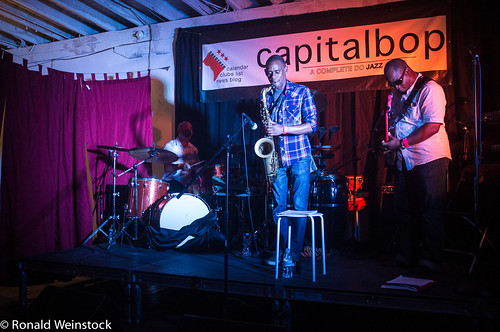
DC drummer Lenny Robinson led his band, Mad Curious as part of @capitalbop's DC Jazz Loft Series MegaFest, Saturday. With tenor saxophonist Brian Settles and Tarus Mateen on electric bass, the band performed a terrific original blues by Robinson and a couple of jazz standard's including a rollicking rendition of Thelonious Monk's "Green Chimney," that Robinson licked off on drums followed by Mateen's funky bass before Settles joined for a spirited treatment of this latter Monk composition. It was the second time this week that I heard a rendition of this composition (the other was by Jonathan Batiste at The Hamilton last Monday night. Anyway Robinson's trio was superb.
Sunday, June 10, 2012
Rockin' Johnny Has A Date With The Grim Reaper

Comprised of several originals and interpretations of generally blues that have not been overly covered, Rockin’ Johnny has put together a solid album of Chicago blues. One can hear a variety of influences in his approach. On guitar, the West Side styling of Magic Sam and Eddie C. Campbell can be heard while Billy Boy Arnold’s low-power singing (to use Johnny’s characterization) is a strong influence on his vocals.
The title track is an original, co-authored with Ken Kemawshima, is a solid West Side Chicago styled blues with plenty of nice guitar and his earnest singing. It also displays his approach which is to not overplay and let the silences speak as much as what he plays. The band provides the appropriate support without laying down things too heavy. Johnny’s Window To Your Soul channels a bit of Magic Sam with a more low-key vocal and impressive, imaginative fretwork. On I Was Fooled, he channels Billy Boy Arnold vocally on a Jody Williams number that Arnold recorded for Vee-Jay. A swamp blues feel marks Lousy Dimes as he worries about his money problems and on which Big D takes a strong solo with Johnny adding chords and jazzy fills.
The venerable Rollin’ and Tumblin’ is given an understated treatment in a performance that owes as much to Sleepy John Estes (singing about of the river was whiskey and I was a diving duck) as Muddy Waters. Its Expensive To Be Broke is a laid back urban blues with the horn section, while the cover of Otis Rush’s My Baby Is a Good ‘Un, is taken a very leisurely tempo. He takes out the slide for some broom dusting on My Sweet Baby, where DiMuzzio adds his baritone sax behind Rockin’ Johnny’s vocal and guitar and then channels Fenton Robinson in a nice rendition of Robinson’s Somebody Loan Me a Dime with some nice guitar and a heartfelt vocal. Shoe Leather and Tire Rubber is about wearing out shoes and tires looking for some blues gigs as Big D contributes another solid harmonica solo.
Rockin’ Johnny is an engaging, low-key singer as well as a consistently imaginative and tasty guitarist backed by a sympathetic band. With a nice varied collection of songs he has produced a very appealing album.
Delmark provided me with a review copy. He he performs Fenton Robinson's I Hear Some Blues Upstairs.
Saturday, June 09, 2012
DC Jazz Festival Picks for June 10
This is the last post I am making to highlight some of the shows associated with this year’s DC Jazz Festival. I am posting this a day ahead of the date of performances, and being a bit less verbose. For more information visit http://www.dcjazzfest.org/content.cfm/schedule_and_major_events.
Saxophonist Brad Collins Trio at Georgia Brown’s at 10 AM
Tiacoh Sadia Afro-Jazz (4:00 PM) at the African Heritage Center (1320 Good Hope Road Southeast, Washington, DC) part of the East River Jazz Festival series.
DC Choro at 7:00PM at Grill From Ipanema (1858 Columbia Road NW, Wash. DC.) Choro is a Brazilian musical style that bears similarities to classic ragtime.
Guitarist Pino Daniele is at the Howard Theatre.
Freedom Children Celebration with Reginald Cyntje (seen above) at Twins Lounge
The Hamilton features The John Scofeld Trio, featuring the well-known guitarist.
Saxophonist Brad Collins Trio at Georgia Brown’s at 10 AM
Tiacoh Sadia Afro-Jazz (4:00 PM) at the African Heritage Center (1320 Good Hope Road Southeast, Washington, DC) part of the East River Jazz Festival series.
DC Choro at 7:00PM at Grill From Ipanema (1858 Columbia Road NW, Wash. DC.) Choro is a Brazilian musical style that bears similarities to classic ragtime.
Guitarist Pino Daniele is at the Howard Theatre.
Freedom Children Celebration with Reginald Cyntje (seen above) at Twins Lounge
Friday, June 08, 2012
Doris Day Is Always With a Smile and a Song

At the same time as her notable film career, Doris Day also enjoyed a recording career surveyed on this generally backed by lush orchestral accompaniments with occasional vocal choirs. So on this sampling of mostly sentimental ballads and love songs we hear the Paul Weston Orchestra, Percy Faith, Frank Duvol, the Norman Luboff Choir, and Mort Garson with a couple sessions have more intimate backing by the Andre Previn.
Some of the songs include On Moonlight Bay, It Had To Be You, I’ll See You In My Dreams, By the Light of the Silvery Moon, Whatever Will Be, Will Be (Que Sera, Sera), Pillow Talk, Little Boy Blue, But Beautiful, Our Love Is Here to Stay, Fools Rush In (Where Angels Fear To Tread, and the title track. These certainly are attractive, often dreamy and romantic performances, and wonderfully restored here.
As a matter of personal taste, the performances (including the arrangements) are a bit too sweet for my taste to listen to in more than a few selections at a time. My tastes go perhaps to jazzier and more interpretative vocal stylings like Billie Holiday, Sarah Vaughan, Dinah Washington and the like. This is not to dismiss superb performances here like Secret Love, or some lightweight material (Pillow Talk) that is the musical equivalent of cotton candy. And the selections with Andre Previn (“including Fools Rush In) provide a more intimate setting for her. It is certainly valuable to have this available and if this style of music appeals to you, then I have little doubt that you will warmly enjoy this compilation of Doris Day’s recordings.
I received a review copy from a publicist. Here is Doris Day singing Que Sera, Sera.
DC Jazz Festival Picks for June 9
This is the ninth post I am making to highlight some of the shows associated with this year’s DC Jazz Festival. I am specifically not highlighting the DC JazzLoft Fest (the Loft Mega-Fest is today) since I have posted on this already. I will may also pick a few other shows around the DC Virginia area that should not be overlooked. I am posting this a day ahead of the date of performances, and being a bit less verbose. For more information visit http://www.dcjazzfest.org/content.cfm/schedule_and_major_events.
The terrific vibraphonist Warren Wolf leads his Quartet at Faith Presbyterian Church (5PM show) as part of the East River Jazz Festival.
Gallery O on H Street (1354 H Street, NE Washington) has a day and evening of music starting with a student ensemble at 5:30. Saxophonist and composer Brad Linde Quintet is on at 6:40PM; Lennard Jack & Fusion are on at 7:50PM and the Afro-Bop Alliance is on at 9:15PM.
The Hamilton has trumpeter Etienne Charles & Kaiso and pianist Monty Alexander & The Harlem-Kingston Express.
Bohemian Gardens hosts saxophonist Marcus Strickland once more.
Vocalist Dee Stone is at the Black Fox Lounge.
For blues fans, The Tinner Hill Blues Festival takes place in Falls Church.
Here is a video of Brad Linde Ensemble with guest Lee Konitz (who is not scheduled to appear at the DC Jazz Festival).
 |
| Warre Wolf at 2012 Mid-Atlantic Jazz Festival |
Gallery O on H Street (1354 H Street, NE Washington) has a day and evening of music starting with a student ensemble at 5:30. Saxophonist and composer Brad Linde Quintet is on at 6:40PM; Lennard Jack & Fusion are on at 7:50PM and the Afro-Bop Alliance is on at 9:15PM.
The Hamilton has trumpeter Etienne Charles & Kaiso and pianist Monty Alexander & The Harlem-Kingston Express.
Bohemian Gardens hosts saxophonist Marcus Strickland once more.
Vocalist Dee Stone is at the Black Fox Lounge.
For blues fans, The Tinner Hill Blues Festival takes place in Falls Church.
Here is a video of Brad Linde Ensemble with guest Lee Konitz (who is not scheduled to appear at the DC Jazz Festival).
Thursday, June 07, 2012
Ralph Lalama's Hard Bop Bopjuice

An obvious point of comparison to this might be Sonny Rollins classic Live at the Village Vanguard recordings on Blue Note. From the opening take on Wayne Shorter’s Lester Left Town, through the closing moments of Wonderful, Wonderful, one is impressed by Lalama’s robust tone, as well as his lengthy thematic and melodic improvisations and the support he receives from Forbes and Barbaro, both who get their own spotlight. On the lively original Da-Lamma’s Da-Lemma, Lalama and Barbaro engage in a spirited musical dialogue. A ballad like Thad Jones Mean What You Say, displays a different side of his playing and sound.
Victor Young’s classic ballad, Love Letters, is taken at a brisker tempo and the tone and thematic develop might be the strongest here, but the level of Bopjuice’s music and this entire recording is first-rate. This is another excellent addition to the SmallsLive catalog.
I purchased this. Here is a sample of Ralph Lalama's tenor sax.
DC Jazz Festival Picks for June 8
This is the eighth post I am making to highlight some of the shows associated with this year’s DC Jazz Festival. I am specifically not highlighting the DC JazzLoft Fest since I have posted on this already. I will may also pick a few other shows around the DC Virginia area that should not be overlooked. I am posting this a day ahead of the date of performances, and being a bit less verbose. For more information visit http://www.dcjazzfest.org/content.cfm/schedule_and_major_events.
Drummer Mark Prince’s Aqua Leo is at the National Gallery of Art Sculpture Garden at 5:00PM. Prince is an accomplished drummer who is able to transverse hip hop and rhythm & blues to contemporary and straight-ahead jazz.
At the Hamilton, The Brass-a-Holics will be performing a tribute to the late Chuck Brown with a mix of go go and New Orleans Brass Band.
Acclaimed Saxophonist Marcus Strickland will be the Bohemian Caverns. Here he is in performance.
Donvonte McCoy, who Capital Bop calls perhaps the DC area’s leading trumpeter, is at the 18th Street Lounge.
For a non Jazz Festival show, Diunna Greenleaf and Blue Mercy along with Memphis Gold will be at the State Theatre for the opening event of the Tinner Hill Blues Festival. This evening I will be passing on the several excellent jazz programs to see this performance.
 |
| Mark Prince at 2012 Mid-Atlantic Jazz Festival |
At the Hamilton, The Brass-a-Holics will be performing a tribute to the late Chuck Brown with a mix of go go and New Orleans Brass Band.
Vocalist Lena Seikaly will be performing at the Mandarin Oriental
Acclaimed Saxophonist Marcus Strickland will be the Bohemian Caverns. Here he is in performance.
Donvonte McCoy, who Capital Bop calls perhaps the DC area’s leading trumpeter, is at the 18th Street Lounge.
For a non Jazz Festival show, Diunna Greenleaf and Blue Mercy along with Memphis Gold will be at the State Theatre for the opening event of the Tinner Hill Blues Festival. This evening I will be passing on the several excellent jazz programs to see this performance.
 |
| Diunna Greenleaf and Jonn Del Toro Richarson at 2010 DC Blues Festival at the Carter Barron |
Wednesday, June 06, 2012
DC Jazz Festival Picks for June 7
 |
| Michael Thomas |
At 1:00 PM, as part of the East River Jazz Festival, Todd Marcus Ensemble will be at the East River Washington Senior Wellness Center. Todd Marcus, one of the few who specialize in the bass clarinet, leads a little big band which displays his compositions and ability to make use of a variety of musical colors. Capital Bop notes that he leads a nine piece ensemble. “Thankfully, both Marcus’s oddball instrumentalism and his offbeat ensemble are astonishingly strong, modern and infectious. Few people improvise with more fervor or write music better than he does.”
At 5:00PM, trumpeter Michael Thomas will be featured at the Phillips Collection with their hard bop and blues inspired by such legendary figures as Lee Morgan, Freddie Hubbard and Art Blakey. This is hard swinging music at its finest.
 |
| Roberta Gambarini |
The 6th and I Historic Synagogue will host the Anat Cohen Quartet. Proficient on saxophone as well as clarinet, Anat Cohen is a repeat poll winner on the clarinet and brings a contemporary approach to traditional jazz and Brazilian music as well as displays her mastery of the modern jazz canon.
 |
| Anat Cohen with guitarist Howard Alden |
Tuesday, June 05, 2012
Leroy Jones' Fond Memories of the Fairview & Hurricane Band

Back in 2005 Jones issued on his own label New Orleans Brass Band Music: Memories of the Fairview & Hurricane Band. In his notes he mentions his fond memories of the Fairview and Hurricane Brass bands. The former was under the leadership of Reverend Andrew Darby, pastor of the Fairview Baptist Church as well as church member and New Orleans legend, Danny Barker. Later the Hurricane Band came into existence and some of its members would form the Dirty Dozen Brass Band. Anyway, Jones put together this recording to evoke the older bands with a fresh twist and flavor. He did the arrangements on familiar numbers and assembled a band that included Calvin Klein on trombone, Alonzo Bowens on tenor saxophone and clarinet; Ron Espino on sousaphone; Kerry ‘Fat Man’ Hunter on snare drum and Cayetano “Tanio’ Hingle on bass drum. On one selection, Jones wife, Katja Toivola handles the trombone solo.
This is a delightful recording which exhibits the same swinging grooves and clean, but spirited ensembles and solos that were exhibited at the festival. Most of the performances will be familiar from the opening Lily of the Valley, the slow drag tempo used for Just a Little Walk With You, the peppy Lord, Lord, Lord, Muskrat Ramble, and South Rampart Street Parade. They standard out with the relaxation in the performances and the lack of frenzy. Dixieland favorites like When the Saints Go Marching In and Back Home In Indiana, also share these virtues as the two drummers set forth the rhythm and then the band kicks in. Furthermore, all three horns are excellent soloists. I was most familiar with Jones playing on a variety of sources but Bowens saxophone also constantly impressed while Espino also proves his capabilities on the cumbersome sousaphone on Indiana.
This is available from the Louisiana Music factory, www.louisianamusicfactory.com. Leroy Jones own website is http://www.satchmo.com/leroyjones/main.html.
I purchased this CD. Here is part of their French Quarter Festival performance.
DC Jazz Festival Picks for June 6
This is the sixth post I am making to highlight some of the shows associated with this year’s DC Jazz Festival. I am specifically not highlighting the DC JazzLoft Fest since I have posted on this already. I will may also pick a few other shows around the DC Virginia area that should not be overlooked. I am posting this a day ahead of the date of performances. For more information visit http://www.dcjazzfest.org/content.cfm/schedule_and_major_events.
The Hamilton features trumpeter Roy Hargrove this evening. Hargrove is among the leading trumpeters and composers to emerge in the past several decades and a DC Jazz Festival favorite.
Bistrot Lepic Wine bar in Georgetown will feature Véronneau. Véronneau is an acoustic, song-based group playing Latin Jazz, Gypsy Swing and much more featuring the marvelous vocals of Lynn Véronneau along with Ken Avis on guitar, vocals and percussion, David Rosenblatt on guitar and percussion and Pete Walby on drums. Their first recording is the wonderul Joy of Living (Véronneau Music) that showcases Ms. Véronneau’s marvelous singing of which I have written, :She simply has a way of touching the listener's heart … .” They have just issued the Jazz Samba Project which celebrates the classic Stan Getz and Charlie Byrd record Jazz Samba that was recorded in Washington 50 years ago.
The Atlas Performing Arts Center hosts both a Master Class and a performance by guitarist Rodney Richardson and vocalist Lena Seikaly. Richardson is among the foremost jazz guitarists (as well as educators) in the area whilst vocalist Seikaly has emerged as among the many fine jazz singers in the region. Of her most recent CD, Lovely Changes, the website CapitalBop.com said, “In just a few years, Seikaly has established herself as a major jazz vocalist and educator in the D.C. area, performing with the cream of the local crop. …The arrangements and musicianship on the album are crafted to serve the songs, leaving space for the vocal to shine front-and-center. That voice, the endlessly inventive arrangements, and the sensitive ensemble musicianship serve to make Lovely Changes a complete delight.”
 |
| Roy Hargrov |
 |
| Lena Seikaly |
Monday, June 04, 2012
DC Jazz Festival Picks for June 5
This is the fifth post I am making to highlight some of the shows associated with this year’s DC Jazz Festival. I am specifically not highlighting the DC JazzLoft Fest since I have posted on this already. I will may also pick a few other shows around the DC Virginia area that should not be overlooked. I am posting this a day ahead of the date of performances. For more information visit http://www.dcjazzfest.org/content.cfm/schedule_and_major_events.
 |
| Jimmy Heath |
The Hamilton hosts a show with the Antonio Hart Organ Trio and NEA Jazz Master, Jimmy Heath. Hart is a Baltimore Native who has become amongst the most acclaimed alto saxophonists today. In addition to his own seven albums, he has worked with the David Holland Big Band, Roy Hargrove, Frank Wess, Gary Bartz and others. Jimmy Heath is a little giant of the tenor saxophonist, acclaimed as a composer, as well as a musician and part of the legendary Heath brothers. One probably cannot name a major jazz figure with whom he wasn’t friends or worked with ranging from John Coltrane, james Moody to Miles Davis (who recorded Heath’s Gingerbread Boy among other tunes.
Sunday, June 03, 2012
George Lewis at Congo Square in 1951 and 1952

Lewis’ Band on both occasions included Percy Humphrey on trumpet, Jim Robinson on trombone, Alton Purnell on piano, Alcide ‘Slow Drag’ Pavageau on bass and Lawrence Marrero on banjo. In 1951, Louis Barbarin subbed for Lewis’ regular drummer, Joe Watkins, while in 1952, Albert Walters joined Humphrey on trumpet. Included are five performances from 1951 and six from 1952, although “Bugle Boy Boy March” from 1951 has limited fidelity because of its source material.
The 1951 selections open with a terrific Panama Rag with Lewis clarinet snaking around Humphrey’s lead and Robinson’s potent tailgate style. Just a Little While To Stay Here is a spirited treatment of the hymn where Lewis takes off on his solo with Purnell’s honky tonk piano pushing him along before his own break accented by Lewis with Marrero’s banjo adding to the percussiveness of the playing here. Louis Armstrong’s influence is evident from Humphrey’s sizzling trumpet and Purnell’s vocal on Heebee Jeebies.
The 1952 concert opens with The Star Spangled Banner, played fairly straightly before they launch into a dynamic rendition of the staples of Lewis’ repertoire, Climax Rag, with the two trumpets adding perhaps more sizzle than usual and Lewis taking a highly energetic solo. The is a little raggedness between the two trumpets for the head of the exciting Bugle Call Rag. Perhaps the highpoint is Lewis’ rendition of his classic, Burgundy Blues, with just rhythm backing (Marrero’s chords being effective) Lewis on this superb piece of instrumental blues that was a signature number for him. After his pensive playing, the group ends its performance with a spirited Down in Honky Tonk Town.
A decade later, when Preservation Hall opened, the Lewis Band was the model for the type of music presented, and these musicians were the foundation for the Hall’s own bands as it became the institution it is today. George Lewis at Municipal Auditorium, Congo Square 1951 and 1952 is another excellent release of Lewis’ music that George Buck has issued on American Music and other labels. With so many excellent Lewis recordings available, the music on this one still stands out as among the better ones. This is available directly from www.jazzology.com as well as finer retailers like the Louisiana Music Factory (www.louisianamusicfactory.com).
This was a purchase and here is the George Lewis Band in performance with Kid Howard on trumpet I believe.
DC Jazz Festival Picks for June 4
 |
| Kris Funn |
At 6:00 PM, the Kennedy Center Millennium Stage will feature bassist Kris Funn. This Baltimore, Maryland native is currently a member of trumpeter Christian Scott’s Band. He currently leads Kris Funn & Corner Store. which also features drummer Quincy Phillips of the Roy Hargrove Quintet. The band features Funn’s blues-battered bass lines, rocking originals, and dramatically danceable revisions of John Coltrane and Sam Cooke tunes.
The Kennedy Center at 7:30 hosts Jazz Meets The Classics with the Classical Jazz Quartet featuring Kenny Barron, Stefon Harris, Ron Carter, Lewis Nash; Paquito D’Rivera Sextet; Pepe Rivero; Michael Phillip Mossman and Pernell Saturnino. This is the signature concert featuring a number of NEA Jazz Masters.
 |
| Jonathan Batiste |
The Bohemian Caverns Jazz Orchestra has its weekly performance at the Bohemian Gardens. For information of them visit http://www.bohemiancavernsjazzorchestra.com/live/.
For more information visit http://www.dcjazzfest.org/content.cfm/schedule_and_major_events.
For more information visit http://www.dcjazzfest.org/content.cfm/schedule_and_major_events.
Saturday, June 02, 2012
Rob Garcia's The Drop and the Ocean

The performances themselves display some rather inspired interplay among Garcia’s quartet. On the opening Will, Preminger asserts himself with his dry tone and a solo using staccato before Garcia takes a solo accented by Tepfer’s piano. Boundaries opens with Garcia setting the rhythm before Preminger and Tepfer engage in a brief dialogue before Garcia interjects leading to Tepfer’s atemporal playing against Garcia’s percussive counterpoint as Preminger restates the theme and takes a heated solo followed by Hebert’s solo. Lost By Mourning provides a contrasting mood with its pensive tone with some lovely tenor sax over understated accompaniment. The River suggests the classic Miles Davis’ recording, Nefertiti, with Preminger and Tepfer outstanding in their solos. Interspersed among the lengthier ensemble performances are three short, focused drum solo interludes entitled Flash.
Garcia’s compositions here transverse a wide range of styles ranging from ballads to free-bop and the excellent performances on The Drop and the Ocean exhibit marvelous ensemble playing and imaginative, focused soloing.
My review copy was provided by a publicist. Here is Rob Garcia 4 in performance.
DC Jazz Festival Picks for June 3
This is the third post I am making to highlight some of the shows associated with this year’s DC Jazz Festival. I am specifically not highlighting the DC JazzLoft Fest since I have posted on this already. I will may also pick a few other shows around the DC Virginia area that should not be overlooked. I am posting this a day ahead of the date of performances.
For more information visit http://www.dcjazzfest.org/content.cfm/schedule_and_major_events.
The Phillips Collection, the prestigious modern art museum near Dupont Circle hosts the first of two Jazz 'n Families Fun Days. Performances to note today include Elijah Jamal Balbed Quartet at 2:00PM featuring one of the DC area’s acclaimed young saxophonists. Michael Bowie and Sine Qua Non appears at 3:30PM. The bassist leads a five-piece ensemble that applies specific lessons from Spanish classical guitar music to an unorthodox jazz combo setting, without a guitarist. Legendary pianist Kenny Barron appears at 4:00PM.
At 6:00PM, the Kennedy Center’s Millennium Stage will host a performance by the Erena Terakubo Quartet leading an ensemble from Berklee College of Music. The Sapporo, Japan native plays alto saxophone. Saxophonist David Sanchez is at the Hamilton this evening. David Sanchez was mentored by Dizzy Gillepsie, toured with Kenny Barron, Roy Haynes and legendary drummer Elvin Jones, while recording with Barron and Haynes respectively. He incorporates and re-contextualizes the rhythms and folk melodies of his native Puerto Rico in his music that has achieved international acclaim including winning a Latin Grammy® Award. Here is David Sanchez performing.
 |
| Elijah Jamal Balbed |
The Phillips Collection, the prestigious modern art museum near Dupont Circle hosts the first of two Jazz 'n Families Fun Days. Performances to note today include Elijah Jamal Balbed Quartet at 2:00PM featuring one of the DC area’s acclaimed young saxophonists. Michael Bowie and Sine Qua Non appears at 3:30PM. The bassist leads a five-piece ensemble that applies specific lessons from Spanish classical guitar music to an unorthodox jazz combo setting, without a guitarist. Legendary pianist Kenny Barron appears at 4:00PM.
At 6:00PM, the Kennedy Center’s Millennium Stage will host a performance by the Erena Terakubo Quartet leading an ensemble from Berklee College of Music. The Sapporo, Japan native plays alto saxophone. Saxophonist David Sanchez is at the Hamilton this evening. David Sanchez was mentored by Dizzy Gillepsie, toured with Kenny Barron, Roy Haynes and legendary drummer Elvin Jones, while recording with Barron and Haynes respectively. He incorporates and re-contextualizes the rhythms and folk melodies of his native Puerto Rico in his music that has achieved international acclaim including winning a Latin Grammy® Award. Here is David Sanchez performing.
Friday, June 01, 2012
George 'Harmonica' Smith's Tribute To Little Walter Is Blues With a Feeling

Of the original eleven selections, only West Helena Woman was not associated with Little Walter, who had died months prior to this recording. It had been a song Smith had recorded several times prior, but like the other performances here was a stunning sample of the classic Chicago blues sound. From the opening moments of Mellow Down Easy, this is classic Chicago blues as represented by the Waters Band. Spann is brilliant in support (listen to his accompaniment on Can’t Hold Out Much Longer while Smith sings and plays in a robust manner. His full-bodied tone on this perhaps is not as clean as Walter was on his best recordings, but had a sharpness to it. Another outstanding selection is the reworking of Last Night, which is a stunning slow blues performance that stands up well to Walter’s original.
Not included on the original vinyl album release (which I purchased when it was originally issued) is a terrific rendition of Goin’ Down Slow, with some stinging guitar fills and a brief break by Muddy Waters. Another bonus selection is Little Walter’s Just a Feelin’. The album closes with an excellent vocal by Lucille Spann, Love With a Feelin’. Smith sits out on this selection which like the music on the Smith recording has some of the feel of Otis Spann’s Bluesway album The Bottom of the Blues that the Muddy Waters Band played on and which Lucille sang on some selections.
The original Pete Welding album notes are included along with new notes by Tony Russell which includes an interview from Steve LaVere who produced the LP with Welding about how the session came about. Russell adds perspective on how this release was received at the time and Smith’s subsequent recording career. Sound is quite good and this reissue of some classic Chicago blues is overdue and quite welcome.
I purchased this CD. Here is a little video of George 'Harmonica' Smith performing.
DC Jazz Festival Picks for June 2
 |
| Herman Burney |
 |
| Michael Bowie |
Michael Bowie and Sine Qua Non appears at the Anacostia Art Gallery & Boutique at 8:00PM. Bowie is another of the DC area’s most accomplished bass players. Capital Bop conducted an interview with Bowie where he talks at length about this group.“The five-piece applies specific lessons from Spanish classical guitar music to an unorthodox jazz combo setting — notably, one without a guitarist.” For the full interview go to Capital Bop’s website.
The legendary bassist Ron Carter at the Bohemian Gardens for the second of two nights at this legendary DC club. Ron Carter may have recorded more than any bass player in history (he is on over 2000 albums) who first came to notice as part of the last great Miles Davis Quintet, and recorded with Eric Dolphy, Esther Phillips, Freddie Hubbard, Gil Evans and countless others.
For more information visit http://www.dcjazzfest.org/content.cfm/schedule_and_major_events.
Subscribe to:
Posts (Atom)